
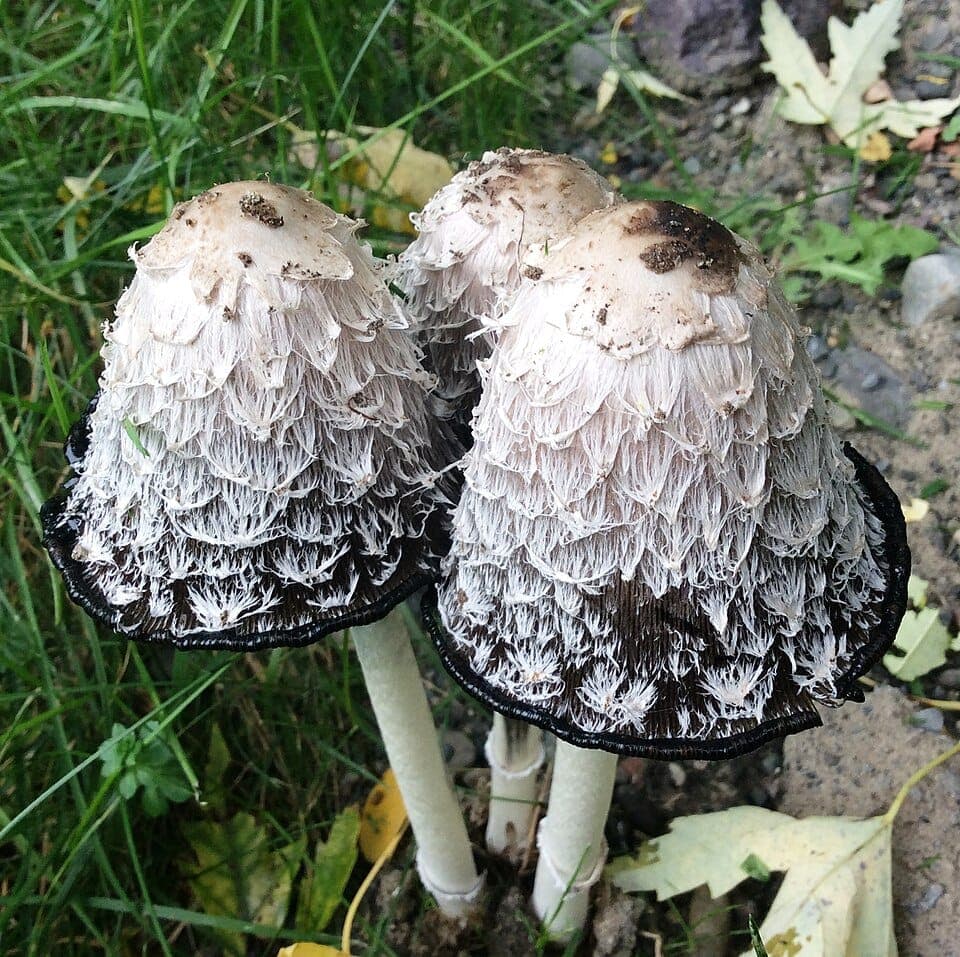
It is one of the easiest fall mushrooms to recognize and one of the strangest to watch. After a cool, wet stretch in autumn, tall white columns push up overnight through lawns, roadside gravel, wood chips, and disturbed soil — cylindrical caps a few inches high, covered in shaggy, upturned scales that look like ragged feathers or a peeling powdered wig. Then, within a day, they betray themselves: the bottom edge of each cap darkens to pink and then jet black and begins to dissolve, drooping into a spreading puddle of inky black liquid until the whole mushroom has essentially melted away. That self-destructing shaggy column is the shaggy mane (Coprinus comatus), also called "lawyer’s wig" or "shaggy ink cap," and it is one of the most distinctive fungi you will find in fall. Here is how to identify it and understand its remarkable disappearing act.
How to Identify a Shaggy Mane
Shaggy manes are unusual enough that a few features identify them with confidence:
- The shape: tall and cylindrical, like an egg stretched upward or a slim bullet, standing up to four to six inches high — much taller than wide, quite unlike the typical umbrella-shaped mushroom.
- The shaggy surface: the white cap is covered in coarse, upturned, brownish-tipped scales that give it a ragged, feathery, or wig-like texture — the "shaggy" in shaggy mane.
- The color change and dissolving: young caps are clean white; as they mature the lower edge turns pink, then black, and liquefies into an inky black fluid from the bottom up. A mushroom actively dripping black ink is unmistakable.
- A tall white stem with a ring: the stem is white, smooth, and hollow, with a thin ring that often slips loose and slides down as the mushroom grows.
- The habitat and timing: it grows in grassy lawns, roadsides, gravel, packed soil, and disturbed ground — often in scattered groups, lines, or arcs — appearing in spring and especially fall after rain.
- The short life: individual mushrooms last only a day or so before dissolving, so a patch looks completely different from one morning to the next.
The combination is hard to mistake: a tall, shaggy, white cylinder in the grass that turns black and melts into ink within a day is a shaggy mane.
Try Spotter Free on iOS & Android
Plants, animals, fungi, and rocks — all from a photo. 5 free identifications every day, no credit card required.
Why It Turns Itself Into Ink
That dramatic melting is not decay — it is the mushroom’s method of spreading its spores, a process called deliquescence. Instead of quietly dropping spores from dry gills the way most mushrooms do, the shaggy mane digests its own gills from the bottom edge upward, dissolving them into a black, spore-laden liquid. As the cap liquefies it pulls back and drips, freeing spores at the receding margin and letting them fall clear of the crowded gills below, while the ink itself can be carried off on the feet of insects. The mushroom races through this in a matter of hours, which is why it is so short-lived and why the same spot can look like a field of white columns one morning and a scatter of black smears the next. People once actually collected this inky fluid, mixed it with other ingredients, and used it as a writing ink — hence the name "ink cap."
A Safety-First Word on Any Wild Mushroom
The shaggy mane is one of the more famous and recognizable wild mushrooms, but recognizable is not the same as safe to eat, and this is exactly where beginners get into trouble. Small brown lawn mushrooms growing nearby can include seriously toxic species, and several deadly mushrooms — including the pure-white destroying angel, an Amanita — can look superficially pale and innocent to an untrained eye; the destroying angel, unlike a shaggy mane, has smooth white gills that do not dissolve and a cup-like sac around the base of its stem. There is also a close relative, the "tippler’s bane" ink cap, that can cause a serious reaction when combined with alcohol. Spotter is built to help you identify what you are looking at, not to tell you whether it is safe to consume — so treat every wild mushroom as something to observe and photograph, never to eat based on an app, a website, or a single field mark. If you ever want to eat wild fungi, that decision belongs with an experienced local expert who has examined the actual specimen in person, and never with anyone who is not completely certain.
Quick field call: a tall, white, cylindrical mushroom covered in shaggy upturned scales, growing in lawns or gravel and dissolving from the bottom into black inky liquid within a day, is a shaggy mane. Identify and enjoy it where it stands — never eat any wild mushroom based on a photo or an app.
Found a strange shaggy mushroom melting into black goo on the lawn, or any fungus you cannot place? Snap a photo and let Spotter help you identify it — and get to know one of fall’s most bizarre and beautiful mushrooms.
Try Spotter Free on iOS & Android
Plants, animals, fungi, and rocks — all from a photo. 5 free identifications every day, no credit card required.