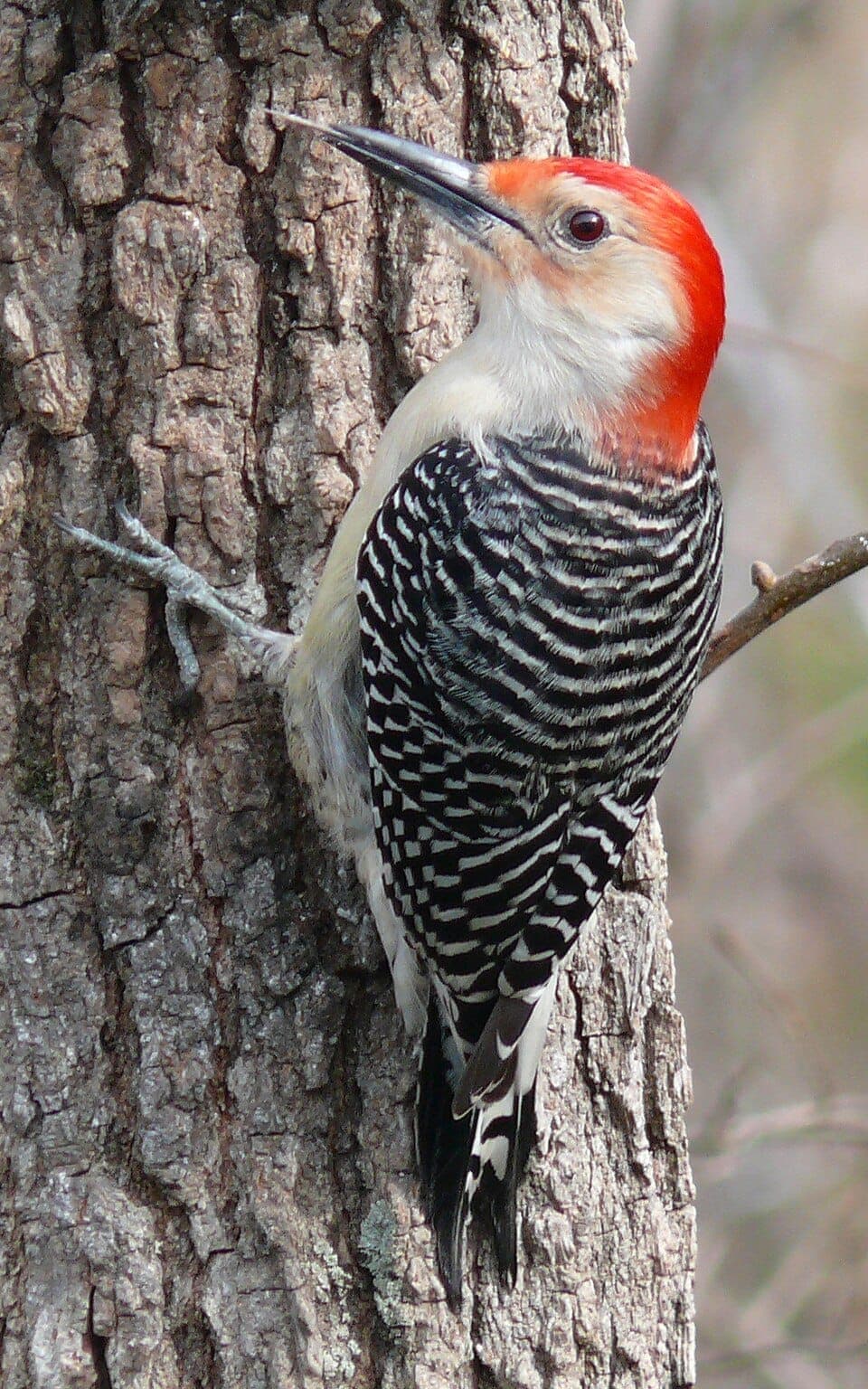
It is one of the most common woodpeckers at feeders across the eastern half of the country, and it is misidentified constantly. A sturdy, robin-sized bird flies in with an undulating swoop, grabs the suet or a sunflower seed, and shows you a pale grayish face and belly, a back cross-barred in tidy black-and-white "zebra" stripes, and a striking band of red over the crown. Nearly everyone who sees it calls it a "red-headed woodpecker" — a reasonable guess that happens to be the wrong bird. This is the red-bellied woodpecker (Melanerpes carolinus), whose real red-headed cousin is a different, far less common species entirely, and whose own name points to a patch of color you will almost never see. You notice them more as the weather cools and they start visiting feeders in earnest, so fall is prime time to finally sort out what this bird actually is. Here is how.
How to Identify a Red-Bellied Woodpecker
The red-bellied is a medium woodpecker — clearly bigger than the little downy at your feeder, roughly the size of a robin — with a handful of features that pin it down quickly:
- The zebra back: the single best mark. The entire back and wings are covered in crisp, evenly spaced black-and-white horizontal bars, giving a ladder-like or zebra-striped look no other common backyard woodpecker shares.
- The red cap and nape: a bright red stripe runs over the top of the head. On a male it stretches all the way from the bill across the crown to the back of the neck; on a female the crown is plain gray and only the nape (the back of the neck) is red.
- A pale face and underparts: the face, throat, and chest are clean grayish-tan, which makes the red on the head stand out sharply and the bird look pale-bodied overall.
- The "red belly" you rarely see: there is a faint reddish or pinkish wash low on the belly, but it is usually hidden against the branch — a genuinely bad name for a genuinely common bird.
- Size and shape: about nine inches long, chunkier and longer-billed than a downy or hairy woodpecker, with the classic straight-backed, propped-tail woodpecker posture.
- The voice: a rolling, throaty "churrr" or "quirrr," plus a laughing "cha-cha-cha," often heard before the bird is seen.
Put it together — a pale-faced, robin-sized woodpecker with a barred zebra back and a swipe of red over the head — and you have a red-bellied woodpecker, whether or not you can find the red belly it was unfortunately named for.
Try Spotter Free on iOS & Android
Plants, animals, fungi, and rocks — all from a photo. 5 free identifications every day, no credit card required.
Red-Bellied vs. Red-Headed: Why the Name Confuses Everyone
The endless mix-up is between the red-bellied woodpecker and the red-headed woodpecker (Melanerpes erythrocephalus) — two real, separate species. The difference is clear once you have seen both:
- The head: a red-headed woodpecker has an entirely, solidly crimson head — face, chin, throat, and all — like it has been dipped in red paint. A red-bellied has red only over the top and back of the head, with a pale gray face and throat.
- The back and wings: a red-headed woodpecker is boldly patterned in solid blocks — a black back with large, clean white wing patches that flash in flight. A red-bellied is finely barred zebra-stripes all over, with no big white patches.
- How often you see it: the red-bellied is a common, regular feeder visitor across the East and Midwest; the true red-headed is much scarcer and more localized, a genuine treat to find. So the everyday "red-headed" woodpecker at your feeder is almost always the red-bellied.
It is also worth separating the red-bellied from the smaller downy and hairy woodpeckers, which are black-and-white but lack the zebra-barred back and have only a small red spot on the back of the head (males only), and from the much larger, crow-sized pileated with its flaming triangular crest. If the bird is robin-sized with a fully barred back and red over the crown, it is a red-bellied.
Why You See Them More in Fall and Winter
Red-bellied woodpeckers do not migrate — they are year-round residents wherever they occur — but they become far more noticeable in your yard as fall arrives. In the warmer months they spend much of their time high in the leafy canopy hunting insects, but as insects grow scarce and leaves come down, they shift toward the nuts, seeds, fruit, and suet that feeders provide, and the bare trees make them much easier to see. They are also busy caching food this time of year, wedging acorns, seeds, and other morsels into bark crevices to retrieve later, so you may watch one make repeated trips to hammer a seed into the same spot on a tree. Their range has been steadily expanding northward over recent decades, so in many northern areas a bird that would have been a surprise a generation ago is now a feeder regular. Offer suet, sunflower seeds, or peanuts and you will likely keep one around all winter.
Quick field call: robin-sized woodpecker + finely barred black-and-white "zebra" back + pale gray face and belly + red over the crown (full crown on males, nape only on females) = red-bellied woodpecker. A solid, all-crimson head with big white wing patches = the much rarer red-headed woodpecker instead.
Not sure whether the woodpecker on your suet is a red-bellied, a red-headed, or one of the smaller black-and-white feeder woodpeckers? Snap a photo and let Spotter help you identify it — and get to know one of the boldest, most entertaining birds visiting your yard this fall.
Try Spotter Free on iOS & Android
Plants, animals, fungi, and rocks — all from a photo. 5 free identifications every day, no credit card required.