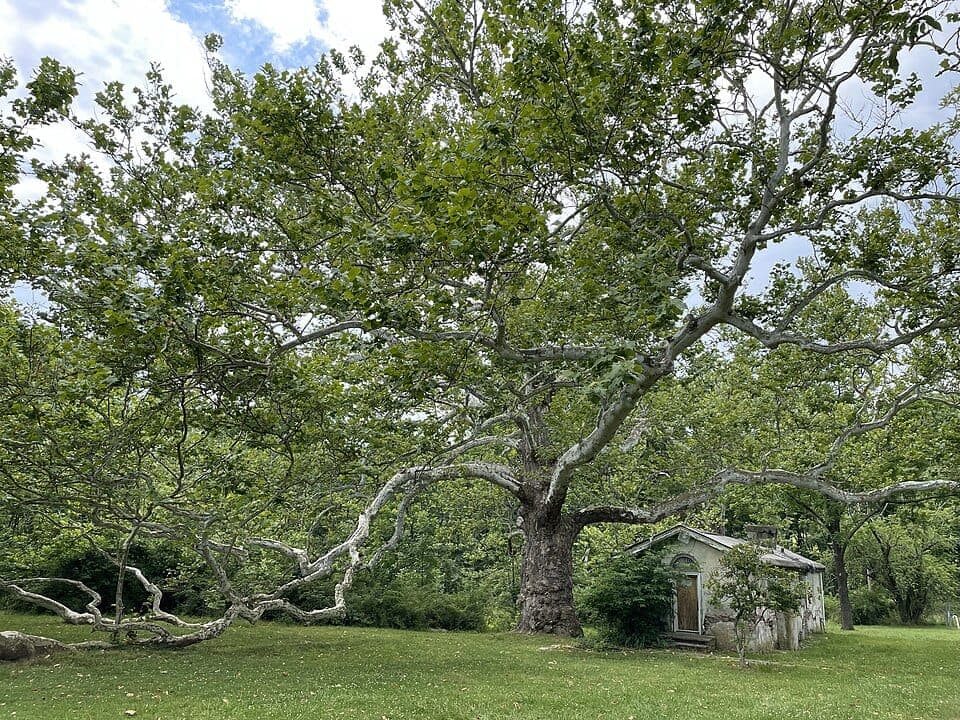
Some trees you identify by their leaves; the American sycamore you identify from across a valley by its bark. It is one of the biggest trees in eastern North America — a broad, massive-trunked giant of riverbanks and bottomlands — and its most unforgettable feature is the way its bark flakes off in irregular, puzzle-piece plates, shedding the brown outer layer to reveal smooth patches of cream, tan, olive-green, and chalky white beneath. The effect is a mottled, military-camouflage pattern, and toward the top of the tree the bark goes almost pure white, so the upper trunk and big crooked limbs seem to glow against a gray autumn sky. That is the American sycamore (Platanus occidentalis), and as the leaves drop in fall its bright skeleton becomes one of the easiest trees to pick out at a distance. Here is how to know one for certain.
How to Identify an American Sycamore
A few features together make the sycamore one of the more foolproof trees to name:
- The camouflage bark: the signature clue. Older bark peels away in thin, irregular plates, leaving a mottled patchwork of brown, gray, green, tan, and white — and the upper trunk and limbs are strikingly smooth and white, visible from a long way off, especially in winter.
- Huge size and a massive trunk: sycamores are among the largest trees in the East, with broad, spreading crowns and thick trunks; old riverside giants can be enormous and often hollow.
- Big maple-like leaves: broad leaves four to nine inches across, with three to five shallow, pointed lobes — shaped much like a maple leaf but larger and coarser, and arranged alternately along the twig rather than in opposite pairs the way maple leaves are.
- Dangling seed balls: round, fuzzy seed heads about an inch across (sometimes called "buttonballs") hang on long stalks through fall and winter, then break apart into a fluff of tiny seeds in spring.
- Wet-ground habitat: sycamores favor riverbanks, streamsides, floodplains, and moist bottomland soils, so a big white-barked tree along water is very likely one.
- Fall color: the leaves turn plain brown or tan rather than a showy color — but that is exactly when the pale bark stands out most, as the crown thins and drops.
The combination of camouflage-peeling bark, a ghostly-white upper trunk, big maple-shaped alternate leaves, and dangling round seed balls is unique — no other large eastern tree wears all of it at once.
Try Spotter Free on iOS & Android
Plants, animals, fungi, and rocks — all from a photo. 5 free identifications every day, no credit card required.
Sycamore vs. London Planetree (the City Cousin)
If you are seeing the same peeling, mottled bark on a tough tree lining a downtown street or parking lot, you are probably looking at the London planetree (Platanus × acerifolia), a hybrid of the American sycamore that is planted heavily in cities because it tolerates pollution, compacted soil, and hard pruning. The two are close and easy to confuse, but a couple of clues help:
- The seed balls: American sycamores almost always carry their round seed heads singly, one per stalk; London planetrees typically hang them in pairs (two balls per stalk), which is one of the most reliable tells when the fruit is present.
- The setting: a huge white-barked tree along a wild river or in a floodplain woods is almost certainly a native American sycamore; a uniform row of them along a city street or boulevard is very likely London planetrees.
- The bark tone: London planetree bark often shows more of a yellowish or olive cast in its patches, though this overlaps and is not decisive on its own.
For everyday identification the distinction rarely matters — both are unmistakable "sycamores" with camouflage bark — but the single-versus-paired seed balls will settle it if you want to be precise.
Why You Notice Them Most in Fall and Winter
Sycamores are impressive all year, but they come into their own once the leaves fall. Through summer the huge crown is a mass of green and the pale bark is partly hidden; as autumn strips the foliage, the white upper trunk and pale, sprawling limbs are suddenly bared against the sky, and a big sycamore can look almost luminous on a gray day — the reason it is sometimes called the "ghost tree." The buttonball seed heads that were easy to miss among the leaves now dangle clearly on their stalks, and along rivers and creeks the tall white forms mark the water’s edge for miles. It is genuinely one of the best trees to learn in the cold months, because the very features that make it distinctive are the ones the bare season puts on display.
Quick field call: a very large tree with bark peeling in camouflage patches of tan, green, gray, and white, a ghostly-white upper trunk and limbs, big maple-shaped alternate leaves, and round dangling seed balls — growing near water — is an American sycamore. Paired seed balls on a city street point to its London planetree cousin instead.
Spotted a big tree with strange white, peeling, camouflage bark and want to know exactly what it is? Snap a photo and let Spotter help you identify it — and get to know one of the grandest and most recognizable trees of the fall and winter landscape.
Try Spotter Free on iOS & Android
Plants, animals, fungi, and rocks — all from a photo. 5 free identifications every day, no credit card required.