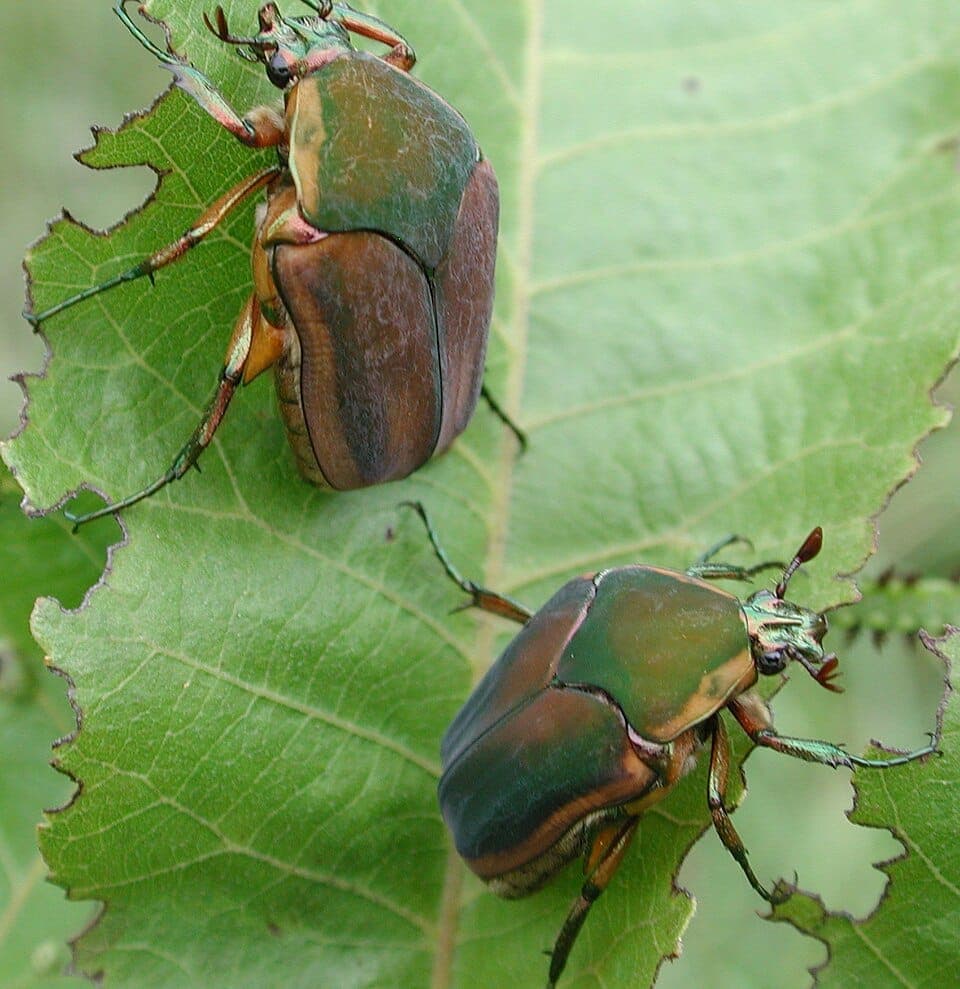
Late summer brings two flashy green beetles that people constantly mix up. One is big and loud, blundering around on heavy, buzzing wings on warm afternoons; the other is small, precise, and busy skeletonizing garden leaves in broad daylight. Because both are metallic green and show up at the same time of year, it is easy to lump them together — but the green June beetle and the Japanese beetle are different insects, and telling them apart tells you whether you are looking at a mostly harmless flier or a genuine garden pest.
Size and Sound Sort Them Out Fast
The quickest tells are how big the beetle is and how it behaves in the air:
- Green June beetle: large, about an inch long, and a heavy flier — its loud, low buzz is often mistaken for a bumblebee or a small hummingbird as it bumbles around lawns, gardens, and porch lights
- Japanese beetle: much smaller, roughly a third to half an inch, and a comparatively quiet, unremarkable flier that you notice sitting on plants rather than dive-bombing you
- If a shiny green beetle just crashed into you or your window with an audible thud, it is almost certainly a green June beetle; if you found a little green-and-copper beetle calmly eating a leaf, it is a Japanese beetle
Color and Markings Up Close
When you can get a good look, the color patterns are distinct:
- Green June beetle: a fairly uniform velvety to metallic green on top, often with dull bronze or yellowish edges along the wing covers, and a bright, shinier green-and-orange underside
- Japanese beetle: a metallic green head and thorax with contrasting copper-bronze wing covers, plus the clincher — small tufts of white hair sticking out along each side of the abdomen and a pair near the tip, visible from above
- Those five white side-tufts are the single most reliable Japanese beetle mark; the green June beetle has no such white tufts
Try Spotter Free on iOS & Android
Plants, animals, fungi, and rocks — all from a photo. 5 free identifications every day, no credit card required.
Different Habits, Different Concerns
The two beetles make their living in different ways. Japanese beetles are a well-known invasive pest: adults feed in groups and chew the tissue between leaf veins, leaving a lacy, skeletonized look on roses, grapes, lindens, and hundreds of other plants, while their grubs feed on grass roots and can damage lawns. Green June beetles are native and generally far less destructive to foliage; the adults are drawn to ripening and overripe fruit — figs, peaches, tomatoes, grapes — and their large grubs live in rich soil and compost, occasionally disturbing the surface of a lawn as they crawl. So the same "shiny green beetle" can be either a leaf-shredding garden problem or a mostly harmless summer bumbler, depending on which one you have.
A Few Look-Alikes to Keep in Mind
Several other beetles wear metallic green in summer, including some harmless native scarabs and the tiny, brilliant dogbane beetle. Size, the presence or absence of white abdominal tufts, and whether the beetle is feeding on leaves or on fruit will usually settle it. When in doubt, resist the urge to squash first and identify later — plenty of green beetles are beneficial or benign.
Not sure whether the green beetle in your yard is the harmless June beetle or a leaf-eating Japanese beetle? Snap a photo and let Spotter identify it, so you know whether to shrug it off or check your roses.
Try Spotter Free on iOS & Android
Plants, animals, fungi, and rocks — all from a photo. 5 free identifications every day, no credit card required.