You are enjoying a stand of blooming goldenrod on a cool late-summer or early-fall morning when a striking insect catches your eye: a slim, elongated body about three-quarters of an inch long, jet black and crossed with bright yellow bands, waving a pair of very long antennae as it crawls over the flowers. Your first instinct is wasp — the colors say "keep back" — but the long antennae and the way it grazes calmly on pollen give it away. This is the locust borer (Megacyllene robiniae), a native longhorned beetle that appears on goldenrod almost on schedule every autumn across much of the eastern and central United States. Here is how to identify it and understand why it is suddenly all over your flowers.
How to Identify a Locust Borer
The locust borer is one of the more elegant beetles you will meet in a fall field, and a handful of features separate it from the wasps and bees it mimics:
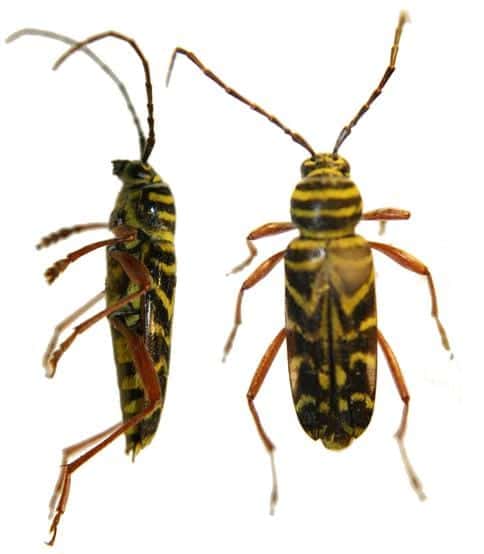
- The body: slender and cylindrical, about 3/4 inch long, jet black overall and crossed by a series of bright yellow bands
- The pattern: the yellow bands on the wing covers bend into distinct shapes — often described as a "W" near the base and V-shaped bands farther back — a more angular, geometric look than a bee's fuzzy stripes
- The antennae: long and thread-like, roughly half the body length or more, and constantly in motion — the classic sign of a longhorned beetle (family Cerambycidae) and something no wasp or bee has
- The legs: often yellow to reddish, matching the warm tones of the antennae
- The behavior: found feeding on goldenrod pollen in the morning hours in late summer and fall, moving deliberately over the blooms rather than darting like a wasp
A slim black beetle with sharp yellow bands, very long antennae, and a habit of grazing on goldenrod pollen in fall is a locust borer. The angular yellow markings and the long, waving antennae are the quickest way to separate it from the yellowjackets and bees sharing the same flowers.
Try Spotter free on iPhone or Android
Plants, animals, fungi and rocks from one photo. 5 free identifications every day, no card required.


Why It Looks Like a Wasp
The locust borer is a textbook example of Batesian mimicry — a harmless insect wearing the warning colors of a dangerous one. It has no sting and cannot hurt you; the bold black-and-yellow pattern simply borrows the reputation of stinging wasps to make birds and other predators think twice. The disguise is good enough that most people walk right past a locust borer assuming it is a wasp, which is exactly the point. Watch one for a moment, though, and the illusion breaks: it lacks a wasp's pinched waist and frantic energy, and those long antennae are pure beetle.
Why It Is on Your Goldenrod
The timing is no accident. Adult locust borers emerge in late summer and fall precisely when goldenrod comes into peak bloom, and they rely on that late-season pollen as a food source before the season ends. Goldenrod is one of the most important fall nectar and pollen plants for insects generally, which is why a single flowering patch can host locust borers, soldier beetles, bees, wasps, butterflies, and ambush bugs all at once — a whole community drawn to the last big food supply of the year. If you want to find locust borers, a sunny patch of blooming goldenrod on a September morning is the place to look.
A Note on the Name and the Trees
The adult beetle you see on flowers is harmless, but the "borer" in its name refers to its life underground. The species' only host is black locust (Robinia pseudoacacia), a common native tree. Females lay eggs in bark crevices in fall, and the larvae tunnel into the wood, which can weaken or damage black locust trees over time — the beetle's one real impact, and only on that single tree species. For anyone simply admiring insects on goldenrod, there is nothing to worry about: the locust borer will not sting, bite, or bother you, and it is one of the most photogenic finds of the fall field.
Spotted a wasp-striped beetle with long antennae working your goldenrod and want to be sure it is a locust borer? Snap a clear photo of the flowers and their visitor and let Spotter help you identify it — a great way to start putting names to the busy community of insects that gather on autumn's last big bloom.
Try Spotter free on iPhone or Android
Plants, animals, fungi and rocks from one photo. 5 free identifications every day, no card required.