
You went out to check the tomatoes and whole branches are suddenly bare — stems stripped down to nubs, a few leaves reduced to stubs, maybe a chewed green fruit. You look and look and see nothing. Late July and early August are peak season for the culprit: the tomato hornworm, a caterpillar so well camouflaged it can devour a plant in plain sight. Here is how to find it and what to do.
How to Identify a Tomato Hornworm
Tomato hornworms are big — up to four inches long and as thick as your thumb — soft-bodied, and a green so close to a tomato leaf that they seem to vanish against the foliage. The name comes from the single curved "horn" at the tail end, which is harmless and cannot sting. Look for:
- A fat, smooth, bright-green body up to about 4 inches long
- A row of pale V-shaped or diagonal white markings down each side
- A single soft horn projecting from the rear (blue-black on the tomato hornworm, reddish on its near-twin the tobacco hornworm)
- Several pairs of stubby, gripping legs clamped tightly to a stem
Signs to Look For Before You See the Caterpillar
Because the caterpillar itself is nearly invisible, hunt for its calling cards instead. The two most reliable are heavy chewing damage near the top of the plant — whole upper leaves and stems gone, rather than scattered holes — and frass: dark green or black pellets of droppings scattered on lower leaves and the soil below. Follow the frass and damage upward and you will usually find the hornworm clinging just above it. Scouting at dusk or with a flashlight after dark makes them easier to spot, since they feed more openly then.
What It Turns Into
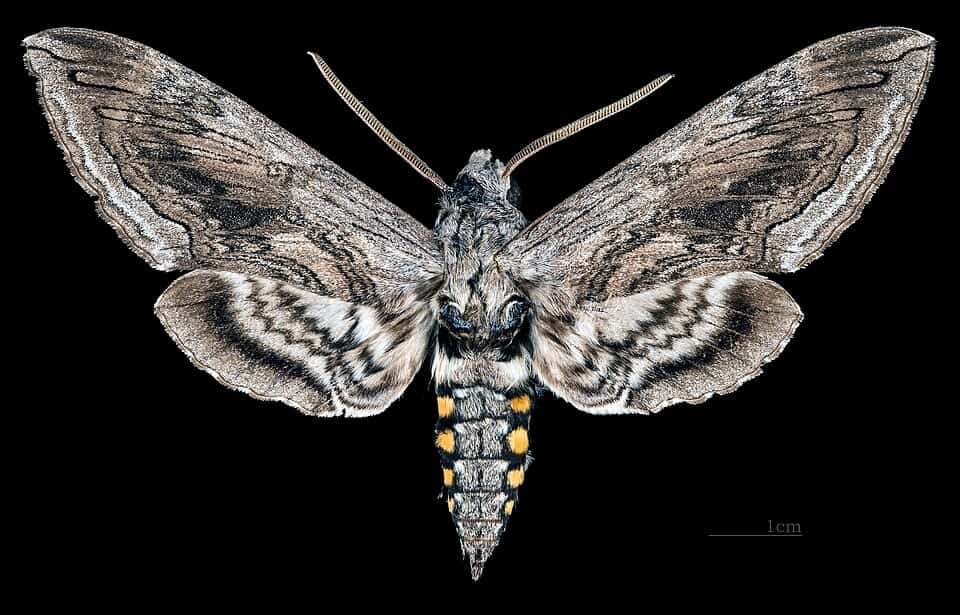
The hornworm is the larval stage of a large, fast-flying hawk moth — often called a sphinx or hummingbird moth — with mottled gray-brown wings that can span four to five inches. These moths hover at flowers at dusk much like hummingbirds and are harmless pollinators. So the same insect is a serious garden pest as a caterpillar and a striking, beneficial visitor as an adult.
The One Look-Alike Worth Leaving Alone
If you find a hornworm studded with rows of small white rice-like capsules on its back, leave it be. Those are the cocoons of a parasitic braconid wasp, a natural predator. That caterpillar is already doomed and will soon stop feeding, and letting the wasps hatch releases more of them to control future hornworms in your garden.
What to Do If You Find Them
- Hand-pick them off — they hold on firmly, so a gentle twist frees them — and drop them in soapy water, or relocate them far from the garden if you would rather not kill them
- For small caterpillars, a product containing Bacillus thuringiensis (Bt) labeled for caterpillars works well; it is least effective once they are large
- Lightly tilling the soil in fall exposes the overwintering pupae to weather and predators, reducing next year’s numbers
Not sure whether that green caterpillar on your tomatoes is a hornworm, a harmless native, or something else entirely? Snap a photo and Spotter will identify it in seconds and tell you whether it is a garden pest where you live.
Try Spotter free on iPhone or Android
Plants, animals, fungi and rocks from one photo. 5 free identifications every day, no card required.