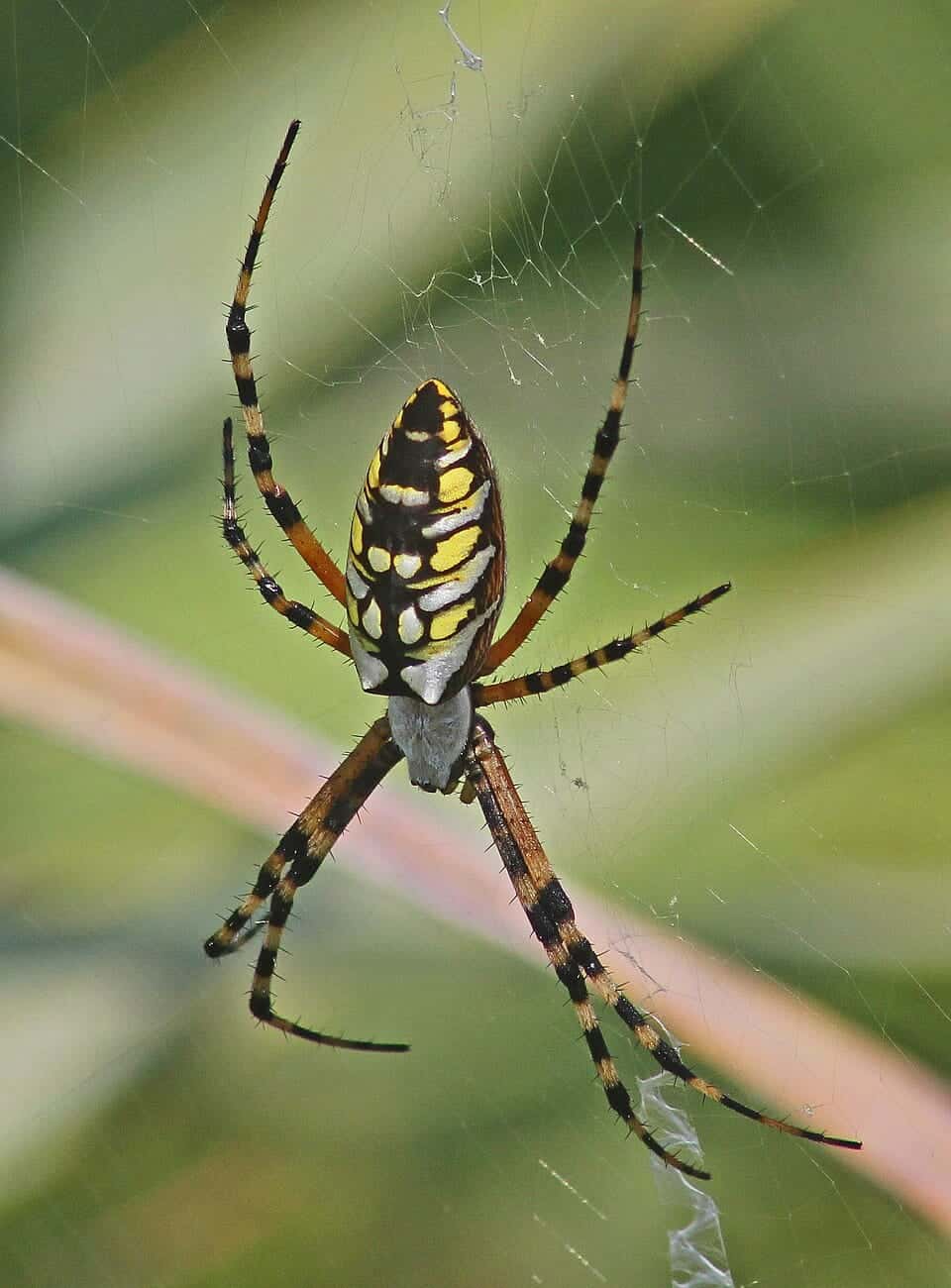
In late summer, a striking spider seems to appear overnight in gardens, tall grass, and along house eaves across most of North America: a big, boldly patterned black-and-yellow creature sitting head-down in the center of a large circular web. This is the yellow garden spider (Argiope aurantia), also called the writing spider, corn spider, or black-and-yellow garden spider. It looks dramatic, but it is a harmless native and one of the most useful predators in your garden.
How to Identify a Yellow Garden Spider
The mature female — the one people notice — is large and unmistakable:
- A large body, up to about an inch long, with a leg span that can reach three inches
- A shiny black abdomen marked with bold yellow or orange patches
- A silvery, hair-covered front section (the cephalothorax)
- Long legs that are black with reddish or yellowish bands near the body
- A large, circular (orb) web, often with a dense zigzag ribbon of white silk running vertically through the center
That zigzag of thick silk is called a stabilimentum, and it is the feature that earns the spider its "writing spider" nickname. Males are much smaller, drabber, and build small webs at the edge of the female's. Related Argiope species, like the banded garden spider, share the same general look with different banding, so an exact species ID can come down to the abdomen pattern.
Are Yellow Garden Spiders Dangerous?
No. Yellow garden spiders are not medically dangerous to humans. Like nearly all spiders they have venom to subdue insect prey, but they are not aggressive, their bite is rare, and on the uncommon occasion one does bite a person who handles it, the effect is typically compared to a bee sting — brief local pain and redness. They have no interest in people and will sit motionless in the web or drop to the ground and hide if disturbed.
Try Spotter free on iPhone or Android
Plants, animals, fungi and rocks from one photo. 5 free identifications every day, no card required.


Why They Show Up in Late Summer
These spiders are around all season, but they are tiny and unnoticed through spring and early summer. By August and September the females have grown to full size and built their largest webs, right as their insect prey is most abundant — which is why they seem to "appear" suddenly in late summer. A single female will often hold the same web location for weeks, repairing the web daily and eating the old silk.
They are worth leaving alone. A garden spider catches a steady stream of flies, mosquitoes, grasshoppers, and moths, and does it without any of the plant damage that pest insects cause. If one has strung a web across a doorway or path where it is genuinely in the way, you can gently relocate it on a stick to a nearby shrub rather than killing it.
Telling It Apart From Spiders That Do Matter
The yellow garden spider is sometimes confused, by pattern alone, with spiders people actually worry about — but the differences are clear. A black widow is glossy solid black with a red hourglass on the underside and builds a messy, irregular web, not a neat wheel. A brown recluse is small, uniformly tan, and has no bold pattern at all. If your spider is large, black-and-yellow, and sitting in a tidy circular web outdoors, it is a garden spider, not a widow or recluse.
Found a big spider in a wheel-shaped web and want to be sure what it is? Take a photo and Spotter will identify it, tell you whether it is harmless, and explain what it is doing in your garden.
Try Spotter free on iPhone or Android
Plants, animals, fungi and rocks from one photo. 5 free identifications every day, no card required.