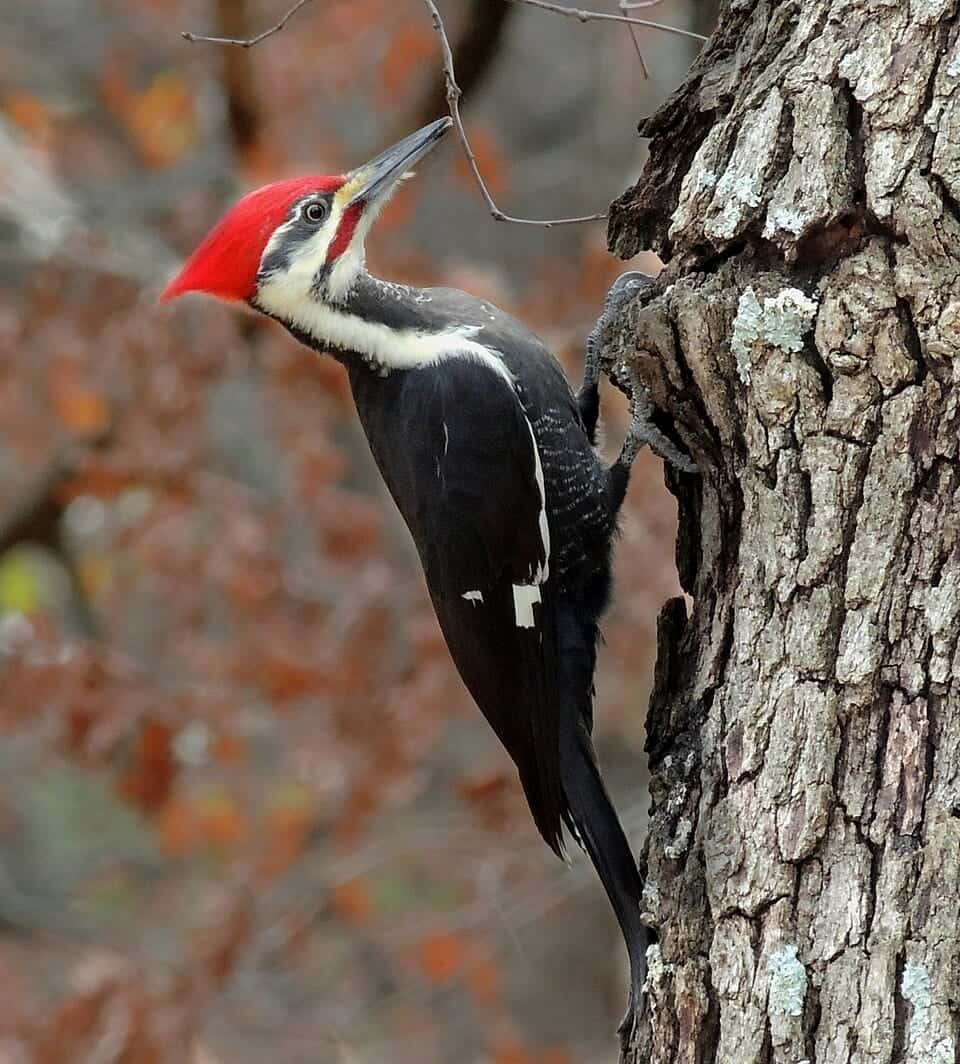
Most backyard woodpeckers are sparrow- to robin-sized birds that scoot up a trunk and tap politely for grubs. Then one day something much bigger crosses the yard — a bird the size of a crow, flying in slow, deep, almost floppy swoops — and lands on a dead tree with a thump you can almost feel. It is boldly black and white, and rising off the top of its head is a pointed crest of brilliant, flaming red. When it starts to feed, it does not tap; it chisels, flinging out chips of wood and carving a hole big enough to put your fist in. That is a pileated woodpecker, the largest woodpecker most people in North America will ever see, and once you have watched one work a log you never mistake it for anything else. Here is how to identify it.
How to Identify a Pileated Woodpecker
Everything about a pileated is oversized and dramatic, which makes it one of the easier birds to name once you get a look:
- The size: nearly crow-sized — roughly 16 to 19 inches long — dwarfing the downy, hairy, and red-bellied woodpeckers at your feeder
- The crest: a tall, pointed, flaming-red crest that sweeps up and back off the head, the single most eye-catching feature
- The body: mostly sooty black with bold white stripes down the sides of the neck and face, and large white patches that flash on the undersides of the wings in flight
- The flight: strong and slow with deep, irregular, almost crow-like wingbeats, not the tight up-and-down bounding of smaller woodpeckers
- The bill: long, straight, and chisel-like — heavy enough to tear deep into solid wood
- The voice: a loud, ringing, laughing "kuk-kuk-kuk-kuk" that carries through the woods, plus slow, powerful, resonant drumming on hollow trees
Male vs. Female
The two sexes look nearly identical at a glance, and the difference is all on the face:
- Male: red extends all the way from the crest down to the bill, plus a red "mustache" stripe running back from the base of the bill
- Female: a black forehead in front of the red crest, and a black mustache stripe instead of a red one
A crow-sized black woodpecker with a pointed red crest, white neck stripes, and a loud laughing call is a pileated — the biggest, boldest woodpecker in the everyday woods.
Try Spotter free on iPhone or Android
Plants, animals, fungi and rocks from one photo. 5 free identifications every day, no card required.


Read the Holes: The Sign That Gives It Away
Even when you never see the bird, a pileated leaves an unmistakable signature. While smaller woodpeckers drill small round holes, a pileated chisels large, distinctly rectangular or oblong excavations — cavities several inches long carved deep into dead and dying trunks, with a scatter of big, blocky wood chips piled at the base of the tree. It is digging for its favorite food: carpenter ants and wood-boring beetle larvae tunneling inside the wood. A fresh, fist-sized rectangular hole with coarse chips below it is one of the surest signs a pileated is working your woods, even if the bird has already moved on.
Rule of thumb: small round holes mean a small woodpecker; a big rectangular hole with a pile of chunky wood chips beneath it means a pileated has been chiseling for carpenter ants.
Where and When You’ll See One
Pileated woodpeckers live year-round across much of the eastern United States, the Upper Midwest, parts of the Pacific Northwest, and the forests of Canada — they do not migrate, so a fall sighting is a resident bird, not a passing traveler. They favor mature woods with plenty of large, dead, and decaying trees, but they have adapted well to wooded suburbs and parks, and they will visit suet feeders, especially in fall and winter when insects get harder to find. Autumn is a fine time to look and listen: the woods are quieter, leaves are thinning, and that loud ringing call and heavy drumming carry a long way. Watch dead snags and the bases of big trees, and follow the sound of serious hammering — much louder and slower than the rapid tapping of smaller birds.
Not sure whether the big woodpecker that just crossed your yard was a pileated, or what left those fist-sized rectangular holes in the dead tree out back? Snap a photo of the bird or the excavation and let Spotter help you confirm it — the pileated is one of the most rewarding birds to learn, because once you know it, the woods feel a little wilder.
Try Spotter free on iPhone or Android
Plants, animals, fungi and rocks from one photo. 5 free identifications every day, no card required.