
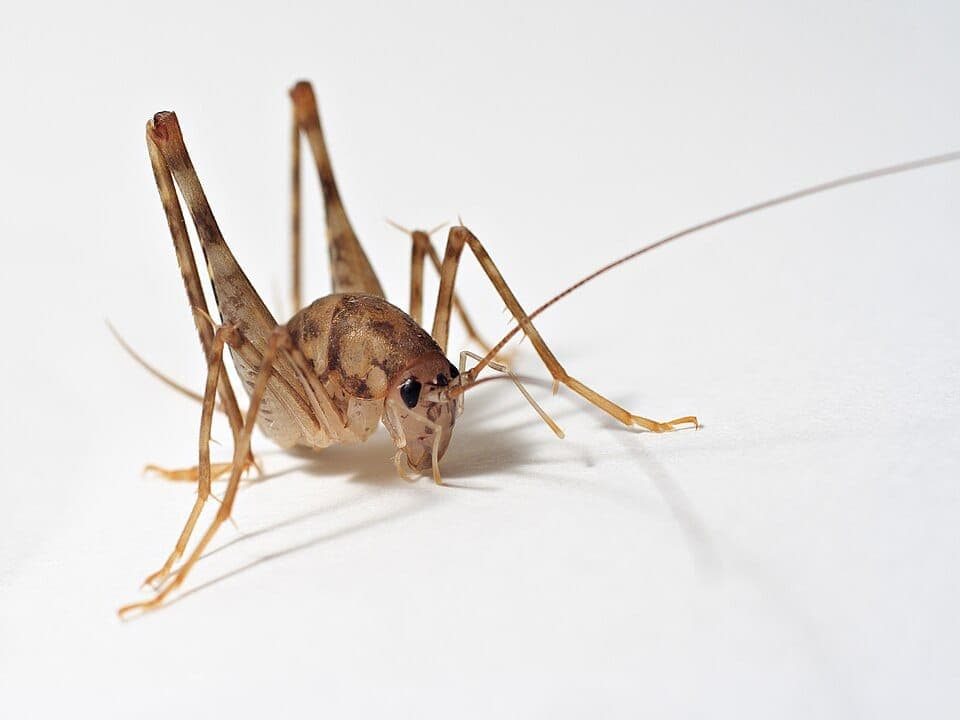
You go down to the basement, flip on the light, and something the size of a quarter launches straight at you on long, spindly legs. It has no wings, a strange hunched back, and antennae longer than its whole body — and it seems to jump toward you on purpose. It is one of the most startling bugs people find inside their homes, and it shows up by the dozen every fall. That leggy, hump-backed jumper is a camel cricket, also known as a spider cricket or cave cricket. Alarming as it looks, it is completely harmless. Here is how to identify it.
How to Identify a Camel Cricket
Camel crickets (family Rhaphidophoridae) are easy to recognize once you know the key features, and they look quite different from the black field crickets that chirp outside:
- Body: humpbacked and arched — the "camel" in the name — usually tan, light brown, or dark reddish-brown, often faintly banded or mottled
- Legs: very long, spindly, spider-like legs, with greatly enlarged hind legs built for jumping — the spidery look is why many people call them spider crickets
- Antennae: extremely long, thread-like antennae, often longer than the body, waving out in front
- No wings: unlike field crickets, camel crickets are completely wingless — which means they cannot chirp; a silent, jumping "cricket" indoors is this one
- Size: roughly half an inch to over an inch long, appearing bigger because of the sprawling legs
The combination of a hunched back, no wings, spider-like legs, and total silence is the giveaway. Because they cannot make sound, you will never hear them the way you hear the crickets and katydids singing outdoors at night — you just suddenly find them.
Try Spotter Free on iOS & Android
Plants, animals, fungi, and rocks — all from a photo. 5 free identifications every day, no credit card required.
Why They Show Up Indoors in Fall
Camel crickets love cool, dark, damp places. Outdoors they live under logs, stones, and leaf litter and in caves and animal burrows; indoors they gravitate to basements, crawl spaces, garages, sheds, and utility rooms — anywhere humid and dim. They turn up most in late summer and fall, roughly August through October, when cooling temperatures and drying conditions outside push them to seek the moisture and shelter of your foundation. A damp basement or crawl space is exactly the microclimate they are looking for, which is why a single building can end up with a lot of them at once.
Are Camel Crickets Dangerous?
No. Camel crickets do not bite people in any meaningful way, they are not venomous, and they carry no disease of concern. Their alarming habit of jumping toward you is not aggression — they simply leap blindly away from whatever startles them, and with no wings and poor aim they sometimes launch in your direction. It feels like a charge, but it is pure panic on their part. The main downside is nuisance: in large numbers they can chew on stored fabric, cardboard, and paper in a basement, so they are worth discouraging even though they pose no threat to you or pets.
Keeping Them Out
Because camel crickets are drawn to damp, the durable fix is to make the space less inviting rather than to chase individual bugs:
- Reduce moisture: run a dehumidifier in the basement or crawl space, fix leaks, and improve drainage away from the foundation — a drier space is far less attractive
- Seal entry points: caulk gaps around foundation cracks, vents, doors, and where pipes enter, since that is how they get in
- Declutter: clear out damp cardboard, stored paper, and piles they can hide and feed in
- Manage the perimeter: move leaf litter, mulch, and firewood away from the foundation so there is less habitat right against the house
Not sure whether the leggy jumper in your basement is a harmless camel cricket, a spider, or something else? Snap a photo and let Spotter identify it as a starting point — so you know exactly what is springing around down there.
Try Spotter Free on iOS & Android
Plants, animals, fungi, and rocks — all from a photo. 5 free identifications every day, no credit card required.