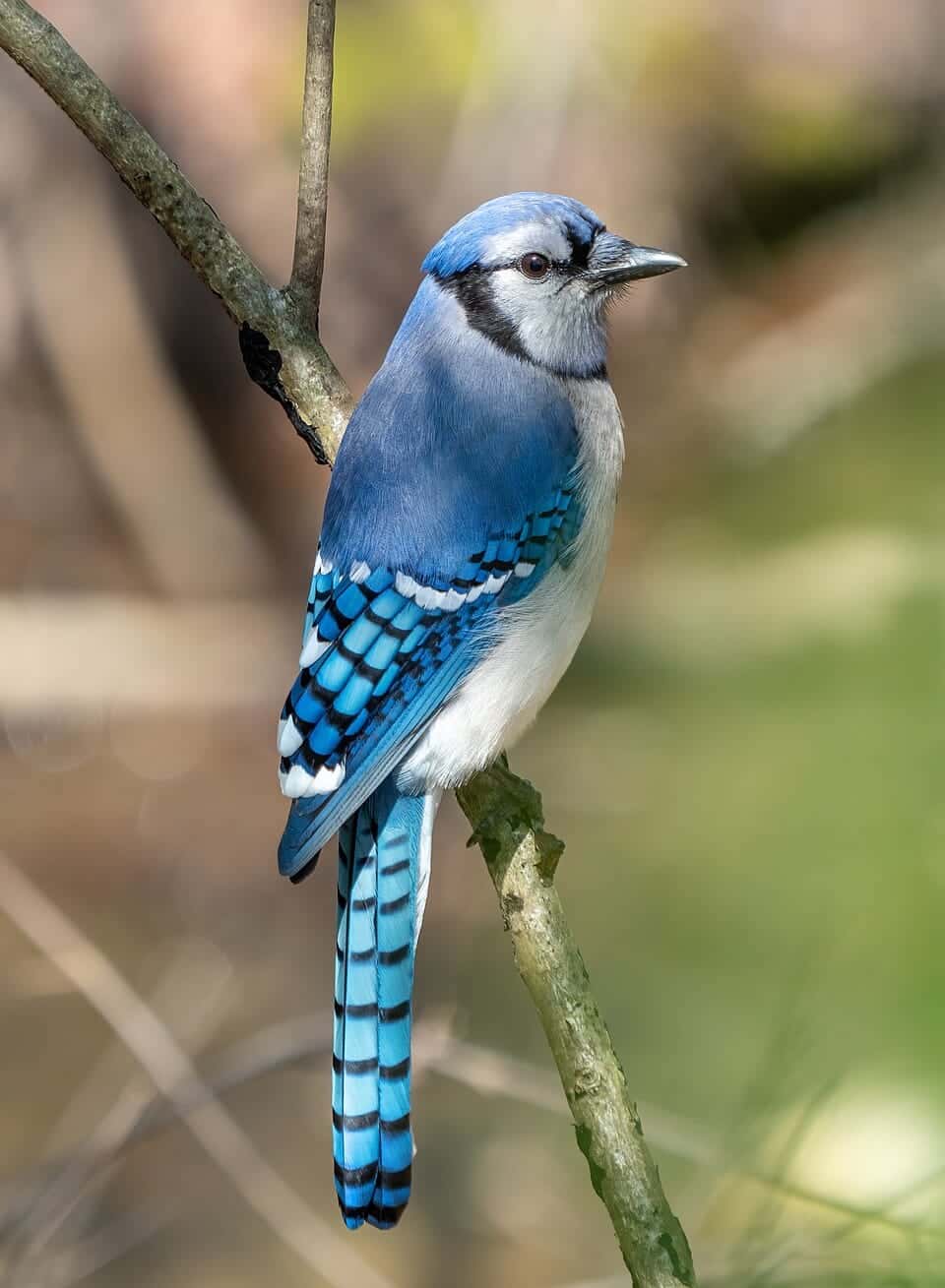
A blue jay is a large, crested songbird with brilliant blue upperparts, a crisp black "necklace" across the throat, and bold white markings on its wings and tail — and it announces itself with a loud, ringing "jay! jay!" scream you can hear across the yard. It is one of the most recognizable backyard birds in eastern and central North America: robin-sized but chunkier, with a pointed blue crest it can raise and lower, a stout black bill, and a long blue tail barred with black. If you see a jay-sized blue bird with a crest and a black collar bullying the feeder, you have a blue jay. Here is how to confirm it by sight and sound, and tell it from the other blue birds people mix it up with.
How to Identify a Blue Jay
Blue jays (Cyanocitta cristata) are members of the crow and jay family, and it shows — they are bold, loud, intelligent, and social. They are common year-round across the eastern two-thirds of the United States and southern Canada, in woodlands, parks, suburbs, and anywhere there are oak trees. Work through size and shape, the color pattern, the crest, the voice, and the behavior, and a blue jay is unmistakable.
Size and shape
A blue jay is a substantial songbird, nine to twelve inches long with a wingspan of thirteen to seventeen inches — noticeably bigger and bulkier than a robin, and far larger than a sparrow, finch, or chickadee. The silhouette is distinctive on its own: a full, pointed crest on the head, a stout, straight black bill, a plump body, and a long, broad tail. Even as a shadow on a wire, that crested head and long tail read as jay.
Color and markings
The color pattern is the clincher. The upperparts — head, back, wings, and tail — are a soft lavender-blue to bright azure, while the face and underparts are pale gray to dirty white. A narrow black line runs from the bill through the eye, and a bold black "necklace" loops down across the throat and up the sides of the head, framing the pale face. The wings and tail are the showstopper: bright blue crossed with black bars, with vivid white patches on the wing and white corners on the tail. No other common blue bird in its range combines a crest, a black necklace, and black-barred blue-and-white wings.
The crest and what it tells you
The crest is both a field mark and a mood ring. A blue jay can raise its pointed crest into a tall peak or lower it flat against its head, and the position signals how worked up the bird is. A high, erect crest means an excited, aggressive, or alarmed jay; a crest held at a moderate angle is a bird going calmly about its business; a crest flattened all the way down usually means a jay feeding peacefully or sitting quietly with its flock. If you are watching a crested blue bird change the shape of its head, you are watching a jay react to the world around it.
Calls and sounds
Blue jays are among the noisiest birds in the yard and are often heard before they are seen. The signature call is a loud, harsh, descending "jay! jay!" or "jeer! jeer!" — the sound that gave the bird its name — repeated in a scolding series. But that is only the start of their vocabulary: they also give a musical, bell-like "queedle-queedle" that sounds like a tiny rusty pump handle, a variety of clicks and whirrs, and startlingly accurate imitations of hawks, especially the scream of a red-shouldered or red-tailed hawk. A clear hawk scream coming from a feeder full of suddenly empty perches is very often a blue jay.
Habitat, range, and season
Blue jays live year-round across eastern and central North America, from the Atlantic coast west to the Great Plains and from southern Canada to the Gulf. They favor oak and beech woods, forest edges, parks, and leafy neighborhoods, and they are drawn to feeders stocked with sunflower seeds, peanuts, and corn. Many northern jays migrate in loose daytime flocks in fall, which is why you may suddenly see streams of them moving along ridgelines and lakeshores in September and October. In the West, the blue jay is largely replaced by its darker cousin, the Steller’s jay.
Quick checks
- Size and shape: a chunky, crested, long-tailed bird bigger than a robin.
- Color: blue above, pale gray-white below, with a black necklace and a black line through the eye.
- Wings and tail: bright blue barred with black, marked with bold white patches and spots.
- Crest: a pointed crest it raises and lowers — no other common blue bird in the East has one.
- Voice: a loud, harsh "jay! jay!" scream, plus bell-like notes and dead-on hawk imitations.
Try Spotter free on iPhone or Android
Plants, animals, fungi and rocks from one photo. 5 free identifications every day, no card required.


Blue Jay vs. Other Blue Birds
People often call any blue bird a "blue jay," but several very different species wear blue. Here is how the blue jay stands apart:
- Eastern bluebird — much smaller and rounder with no crest; the male has a brick-red breast and a plain blue back, and it perches quietly in open fields rather than screaming at feeders.
- Indigo bunting — a tiny, finch-sized bird that is deep, uniform blue all over, with no crest, no black necklace, and a small conical seed-eater’s bill.
- Steller’s jay — the blue jay’s western replacement; crested like a blue jay but with a charcoal-black head and shoulders blending into deep blue, found in the mountains and conifer forests of the West.
- Florida scrub-jay — blue and gray but crestless, with a pale back, restricted to the scrub of central Florida; the only bird species unique to the state.
- Belted kingfisher — also blue-gray and shaggy-crested, but much larger-headed with a huge dagger bill, found along water, where it dives for fish.
- Blue grosbeak — deep blue like an indigo bunting but larger, with rusty wing bars and a massive silver bill; no crest or necklace.
Why Blue Jays Matter
Blue jays are more than backyard noise. They are champion oak planters: a single jay can cache thousands of acorns each fall, burying them one by one across the landscape, and the ones it never comes back for sprout into oak trees. Ecologists credit jays with helping oak forests spread northward after the last Ice Age. They are also the neighborhood alarm system — their raucous mobbing calls alert every bird and squirrel around to a prowling cat, hawk, or owl, and their hawk imitations may be a clever way to scatter competitors from a food source. If blue jays are screaming in your yard, it is worth looking up to see what predator they have spotted. A clear photo is all Spotter needs to confirm the bird and tell you more about what it is doing.
Frequently Asked Questions
Are blue jays actually blue?
Not in the way they look. A blue jay’s feathers contain no blue pigment — the color comes from the microscopic structure of the feathers, which scatters light so that only blue reaches your eye. Grind up a blue jay feather and the blue disappears, leaving dull brown. This "structural color" is why a jay can look grayish in shade and electric blue in direct sun.
What does a blue jay’s call mean?
The loud "jay! jay!" is usually an alarm or a scold, often aimed at a predator or an intruding bird, and it doubles as a contact call to the flock. The softer, musical "queedle" notes are used in calmer social situations. Jays also mimic hawks, which may warn the flock of real danger or trick other birds into fleeing a feeder.
Why do blue jays imitate hawks?
Blue jays are expert mimics and regularly copy the screams of red-shouldered and red-tailed hawks. The leading ideas are that the imitation warns other jays that a hawk is nearby, or that it scares competing birds off a food source so the jay can feed. It may serve both purposes depending on the moment.
Are blue jays aggressive?
Blue jays are bold and will dominate a feeder, chase smaller birds, and loudly mob cats, hawks, and owls, but they are not especially dangerous. They occasionally raid other birds’ nests for eggs or nestlings, though studies show this makes up only a small part of their mostly plant-and-insect diet. Most of their "aggression" is noise and bluster.
Try Spotter free on iPhone or Android
Plants, animals, fungi and rocks from one photo. 5 free identifications every day, no card required.