
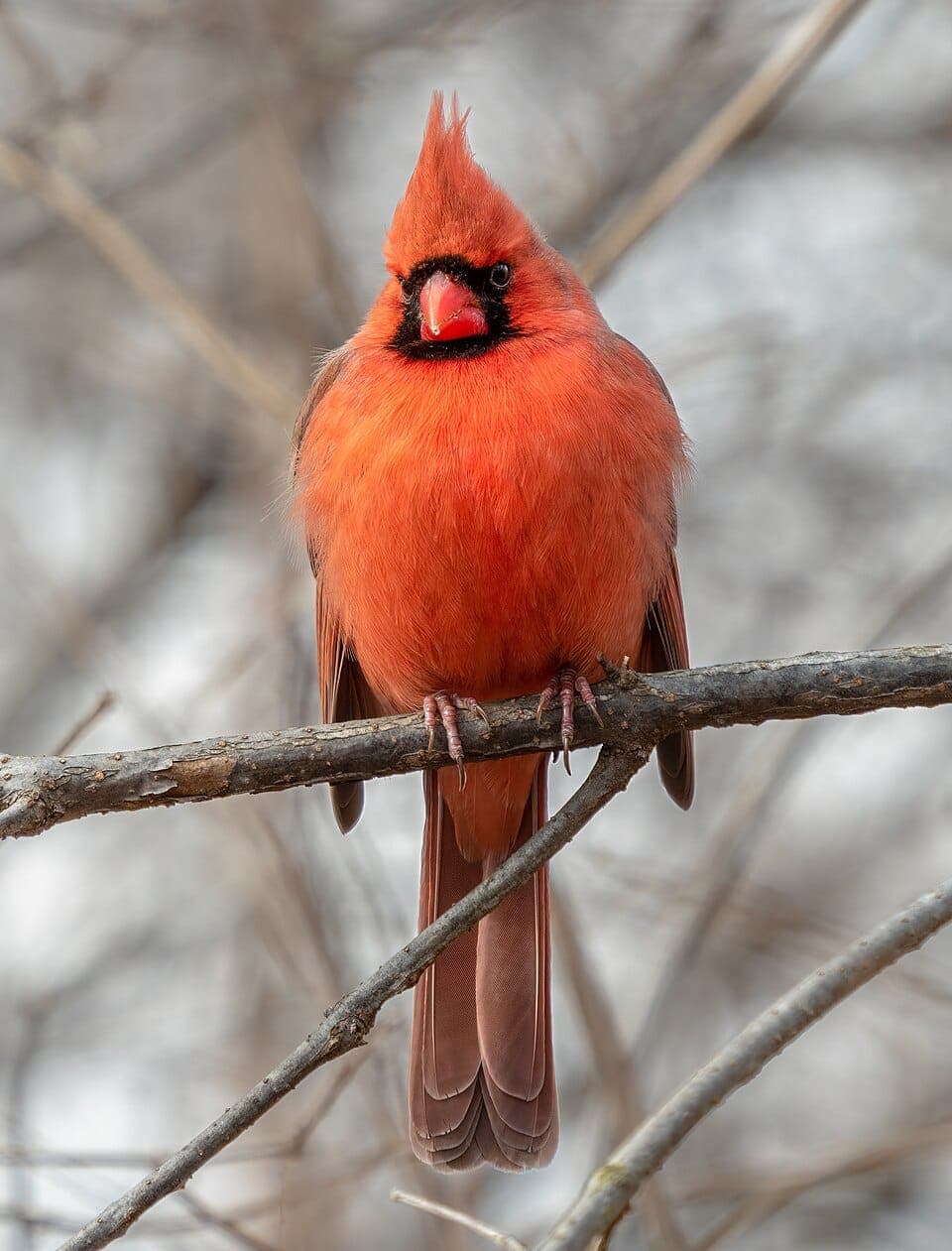
A northern cardinal is the crested, thick-billed songbird in which the male is brilliant all-over red with a black mask around the face, and the female is a warm tan-brown with red washes in the wings, tail, and crest. Both sexes share the same unmistakable shape — a tall pointed crest, a stout cone-shaped orange-red bill, and a long tail — so once you learn the silhouette you can name a cardinal even when the color throws you off. Cardinals do not migrate, so they brighten feeders all year, and the red male against winter snow is one of the most recognized birds in North America. Here is how to identify a cardinal for certain, tell the males from the females, and separate them from the handful of birds they get confused with.
How to Identify a Northern Cardinal
Cardinals are medium-sized songbirds, a little chunkier than a sparrow and slightly smaller than a robin, roughly eight to nine inches long. The crest and the heavy bill are on both sexes and are the features to lock onto first — color varies by sex and age, but the shape does not.
Size, shape, and that crest
Look for a plump, long-tailed songbird with a prominent pointed crest on top of the head that it can raise or lower with its mood, and a short, very thick, triangular bill built for cracking seeds. That cone-shaped bill is bright orange-red to coral in adults and is one of the quickest confirmations you are looking at a cardinal and not some other red or brown bird. The tail is long and often held at a slight downward angle.
The male: all-over red with a black face
The adult male is the famous one: vivid red from crest to tail, slightly deeper and duskier on the back and wings, with a sharp black mask covering the face and throat around the base of the bill. The red is genuinely all-over — not a patch or a blush — and in good light it is almost impossible to mistake for anything else in most of the country.
The female: tan-brown with red accents
The female is subtler but just as distinctive once you know her. She is a warm pale brown to grayish-tan overall, with reddish or orange tints in the wings, tail, and crest, and a dark shadowy mask around her orange-red bill. The same crest and heavy bill as the male give her away — she is essentially a male cardinal repainted in soft browns, which is why "brown bird with a crest and an orange beak" almost always means a female cardinal.
Juveniles
Young cardinals look much like the female — brownish with a crest — but with one big tell: their bill is blackish or dark gray rather than orange-red. A crested, dull brown bird with a dark bill hanging around a feeder in late summer or fall is almost always a juvenile cardinal that has not yet grown into its adult colors.
Song and calls
Cardinals are loud, clear whistlers, and both sexes sing — unusual among songbirds. Listen for ringing phrases often written as "birdy-birdy-birdy," "cheer-cheer-cheer," or "what-cheer, what-cheer," carrying from a treetop or a wire. The common contact note is a sharp, metallic "chip" you will hear around feeders and shrubs all year. Hearing those clear whistles is often how you notice a cardinal before you see it.
Habitat and when you will see one
Cardinals love shrubby edges, thickets, hedgerows, woodland borders, parks, and backyards, and they are permanent residents across the eastern and central United States and the Southwest, expanding slowly northward. Because they do not migrate, they are at feeders twelve months a year and are especially noticeable in winter, when a red male on a snowy branch stands out against the bare landscape. They feed low and often, favoring sunflower and safflower seeds, and are frequently the first birds at a feeder at dawn and the last at dusk.
Try Spotter Free on iOS & Android
Plants, animals, fungi, and rocks — all from a photo. 5 free identifications every day, no credit card required.
How to Tell a Cardinal From Its Look-Alikes
A few other birds get mistaken for cardinals, mostly either other red birds or other crested brown ones. Here is how to separate them:
- Pyrrhuloxia — a desert relative of the Southwest, often called the "desert cardinal." It has the same crest and shape but is mostly gray with red accents, and a stubby, strongly curved yellowish bill rather than the cardinal’s straight orange-red one.
- Summer and scarlet tanagers — the males are red but have no crest and no black face mask, and their bills are paler and less massive. A red bird with a smooth, round head and no crest is a tanager, not a cardinal.
- Vermilion flycatcher — a small red-and-brown bird of the Southwest that lacks the crest and the thick seed-cracking bill, and sits upright catching insects in flight rather than feeding on seeds.
- Cedar waxwing — crested like a cardinal, which fools people, but it is sleek fawn-gray with a black mask, waxy red wingtips, and a yellow-tipped tail, not a brown bird with an orange bill.
- House finch (female) — a streaky brown feeder bird that sometimes gets called a female cardinal, but it is much smaller, has no crest, and has a small finch bill rather than the cardinal’s heavy triangular one.
Frequently Asked Questions
What does a female cardinal look like?
A female cardinal is a warm tan-brown overall with reddish tints in the wings, tail, and crest, a dark mask around an orange-red bill, and the same pointed crest and heavy triangular bill as the male. "Brown crested bird with an orange beak" is almost always a female cardinal.
Do cardinals migrate?
No. Northern cardinals are year-round residents and stay in the same area through all four seasons, which is why they are such reliable winter feeder birds. The bright red male against snow is a familiar sight precisely because the birds never leave.
What do cardinals eat at feeders?
Cardinals are seed specialists and strongly favor black-oil sunflower and safflower seeds, which their heavy bills crack with ease. They prefer to feed low — on the ground, on platform feeders, or on sturdy perches — rather than clinging to small hanging feeders.
Why is a cardinal attacking my window?
In spring and early summer a cardinal may repeatedly fly at a window or mirror because it sees its own reflection and mistakes it for a rival defending its territory. It is harmless to you and usually stops once the breeding season ends; breaking up the reflection from outside can help.
Not sure whether the red or brown bird at your feeder is a cardinal, a tanager, or something else? Snap a photo and let Spotter help you identify it as a starting point, then confirm it with the crest, the heavy orange bill, and the clear whistled song.
Try Spotter Free on iOS & Android
Plants, animals, fungi, and rocks — all from a photo. 5 free identifications every day, no credit card required.