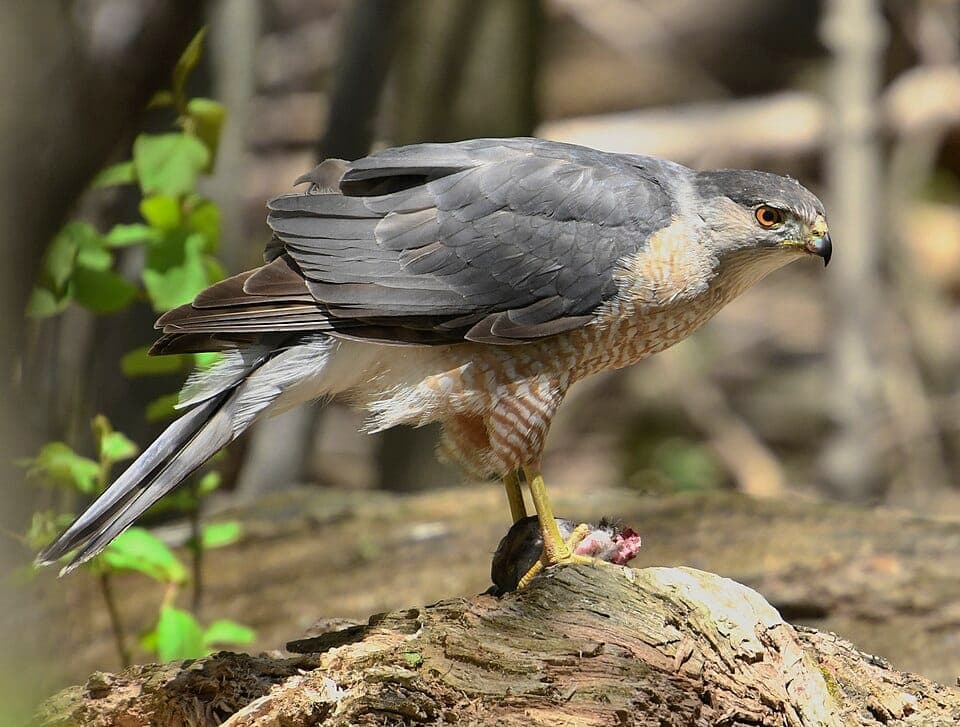
It is one of the most dramatic things that can happen at a bird feeder: the chickadees and finches explode off the perches all at once, and a moment later a lean, long-tailed hawk is sitting in the open where a sparrow used to be. The two hawks most likely to do this in a backyard are the Cooper’s hawk and the sharp-shinned hawk — close cousins that look almost the same, hunt the same way, and are the classic "which one is it?" puzzle of North American birding. Telling them apart is genuinely tricky, but a few features narrow it down most of the time.
They Are Not After Your Seed
Both of these are accipiters — woodland hawks with short, rounded wings and long, rudder-like tails, built to chase small birds through branches and around obstacles. When one shows up at your feeder, it is not there for the sunflower seed. It is there because a busy feeder is a reliable buffet of songbirds. This is normal, natural behavior, and it is a sign of a healthy little ecosystem in your yard, even if it is hard to watch. Both species are also most conspicuous in late summer and fall, when young birds are dispersing and migration is getting underway across the continent.
Start With Size — but Don’t Trust It Alone
The textbook difference is size, and it is a good starting point as long as you know its limits:
- A Cooper’s hawk is roughly crow-sized, with a noticeably long tail and a substantial, heavy-chested look
- A sharp-shinned hawk is roughly blue-jay-sized — small, compact, and delicate-looking, the smallest hawk in most of its range
- The catch: in both species the female is about a third larger than the male, so a big female sharp-shinned can overlap a small male Cooper’s in size
- Because a lone hawk gives you nothing to compare it to, size alone is rarely enough — use it together with shape
Try Spotter Free on iOS & Android
Plants, animals, fungi, and rocks — all from a photo. 5 free identifications every day, no credit card required.
Head and Neck: The Most Reliable Clue
When the bird is perched, look hard at the head and how it sits on the shoulders. This is where experienced birders usually settle it:
- Cooper’s hawk: a large, blocky head that projects well forward of the wings, often with a flat crown and a "capped" look — a darker cap on top contrasting with a paler nape
- Sharp-shinned hawk: a small, rounded head that barely sticks out past the shoulders, giving a hunched, "no-neck" silhouette, with the dark crown blending into the back rather than standing out as a cap
- Because the Cooper’s head is bigger and pushed forward, the eye looks like it sits closer to the middle of the head; on a sharp-shinned the eye looks large and set well forward on a small face
- A useful shorthand: Cooper’s looks like it has a long neck and a big head thrust ahead; a sharpie looks like its small head is tucked down into its shoulders
Check the Tail
The tail tip is another strong tell, especially in flight or when the bird fans its tail on landing:
- Cooper’s hawk: the tail tip looks rounded, with the outer feathers shorter than the central ones, and it usually shows a wider white band at the very end
- Sharp-shinned hawk: the tail tip looks square or even slightly notched, with the feathers roughly the same length, and a thinner, less obvious white tip
- Leg thickness helps too, if you can see it: the sharp-shinned is named for its thin, pencil-like "shins," while a Cooper’s has distinctly thicker legs
- In flight, a sharpie tends to flap in quick, buoyant bursts and glide, while a Cooper’s uses steadier, stiffer wingbeats
Should You Be Worried?
A hawk hunting at your feeder is not doing anything wrong, and it is not a problem you need to fix. Both species are native, migratory birds protected by law, and picking off the occasional house sparrow or finch is exactly what they are built to do. If watching it genuinely bothers you, the humane and effective move is to simply take your feeders down for a week or two — with the crowd gone, the hawk moves on to hunt elsewhere, and you can put the feeders back up afterward. What you should not do is try to harm or harass the hawk, which is both illegal and unnecessary.
Caught a quick look at the raptor that raided your feeder and not sure which one it was? Snap a photo — even a distant one of it perched — and let Spotter help you narrow down whether you hosted a Cooper’s hawk or a sharp-shinned, so you can log one of the backyard’s most impressive visitors.
Try Spotter Free on iOS & Android
Plants, animals, fungi, and rocks — all from a photo. 5 free identifications every day, no credit card required.