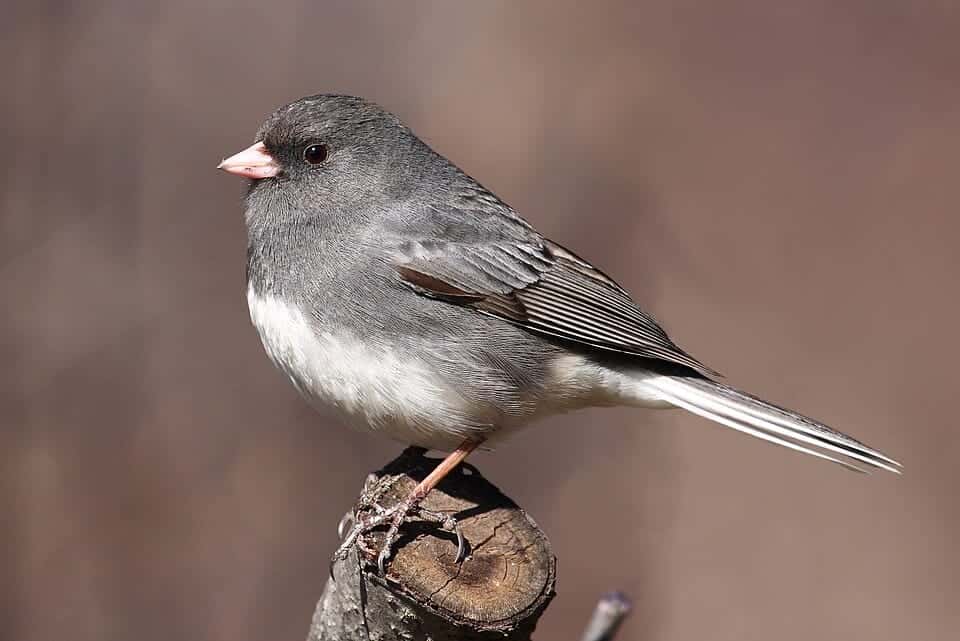
One cool morning in fall you look out at the yard and there is a bird you do not remember seeing all summer: small and round, slate-gray on top and clean white underneath, hopping along the ground under the feeder or at the edge of a shrub. When it flushes, a pair of bright white outer tail feathers flash open like a signal. Over the next few weeks there are more of them, scratching in the leaf litter and scattered across the lawn. That is a dark-eyed junco, a small sparrow that many people know only by its nickname — the "snowbird" — because it turns up right as the weather turns cold. Fall migrants begin trickling in during late August and September and build toward peak numbers by mid- to late fall. Here is how to identify juncos and make sense of their sudden arrival.
How to Identify a Dark-Eyed Junco
Juncos are plain at first glance, but they carry a tidy, two-toned look and a few habits that give them away:
- The classic pattern: over much of the East and North, a crisp dark slate-gray hood, back, and chest that ends in a clean line against a white belly — often described as "gray sky above, snow below"
- The tail flash: bright white outer tail feathers that spring open when the bird flies, one of the most reliable marks as a junco darts away low across the ground
- The bill: small, conical, and pale pink, well suited to cracking small seeds
- The size and shape: a small, rounded, fairly long-tailed sparrow, roughly sparrow-sized, that looks compact and neat rather than streaky
- Regional variation: juncos vary a lot across the country — some western birds show warm brown backs, rusty sides, or a darker "hooded" head — but the pink bill, white belly, and flashing white tail feathers travel with all of them
A small, round, gray-and-white ground-feeding bird with a pink bill and white outer tail feathers that flash when it flies is almost certainly a dark-eyed junco — especially if it showed up as the weather cooled.
Try Spotter free on iPhone or Android
Plants, animals, fungi and rocks from one photo. 5 free identifications every day, no card required.


Why Juncos Arrive in Fall
For much of the United States, juncos are a winter bird — hence "snowbird." Many nest in the boreal forests of Canada and in cool mountain woods, then move south and downhill as fall sets in, spreading across yards, woodland edges, and fields for the cold months before heading back north to breed in spring. That is why they can seem to appear from nowhere: they were simply somewhere colder and higher all summer. In parts of the mountain West and the far North, some juncos are present year-round, but for most backyards the first juncos of the season are a genuine sign that fall has arrived. Their numbers usually build from a few early birds in September to a steady flock by late fall.
Where and How to Watch Them
Juncos are ground birds. They hop and scratch through leaf litter and grass looking for fallen seeds, and at feeders they usually feed on the ground beneath the trays rather than clinging to the ports above. To see them well, scatter a little seed on the ground or on a low platform, keep some brushy cover nearby for them to duck into, and watch the quieter edges of the yard in early morning. They often travel in loose flocks with other sparrows, giving soft smacking call notes and a musical, trilling song. Once you learn the flashing white tail and the tidy gray-and-white pattern, juncos become one of the easiest and most cheerful birds to recognize all winter long.
Not sure whether that little gray bird under the feeder is a junco, a female house finch, or one of the fall sparrows passing through? Snap a photo and let Spotter help you identify it, so the snowbirds become familiar faces the moment they arrive each fall.
Try Spotter free on iPhone or Android
Plants, animals, fungi and rocks from one photo. 5 free identifications every day, no card required.