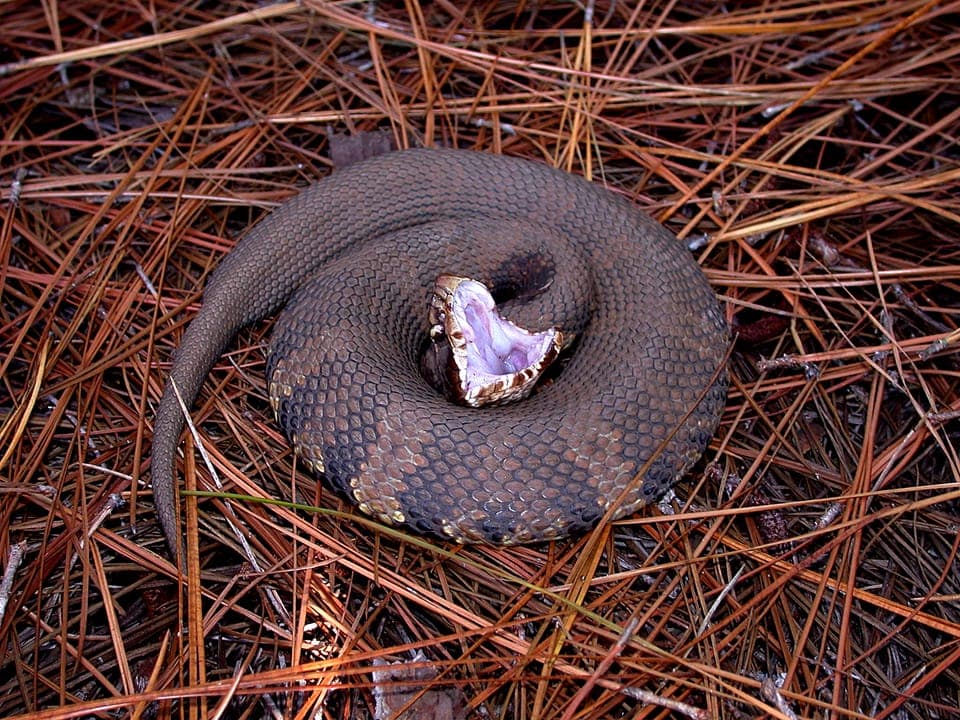
Late summer is peak snake-by-the-water season across much of the eastern and southern United States. Warm afternoons bring snakes out to bask on logs and rocks, and the same ponds, creeks, and swamp edges people swim and fish in are prime snake habitat. So a lot of nervous encounters happen right now: a dark, thick snake sliding off a bank, or coiled with its mouth hanging open, and the immediate question — is that a cottonmouth? The honest answer is that most water snakes people panic over are harmless, but cottonmouths are real and genuinely venomous, so it is worth knowing the difference. Just as importantly, it is worth knowing how to make that call without ever getting close.
First, the Only Safety Rule That Matters
Do not approach the snake to identify it, and never try to handle, poke, or move it. The large majority of snakebites happen when someone attempts to catch, kill, or harass a snake — not when a snake ambushes a person. If you keep your distance, both venomous and non-venomous snakes will almost always leave you alone. Everything below is meant to be judged from several feet away, or better yet from a zoomed-in photo, not from arm’s reach. If a snake is somewhere it needs to be removed from, call animal control or a local wildlife professional rather than dealing with it yourself.
Try Spotter Free on iOS & Android
Plants, animals, fungi, and rocks — all from a photo. 5 free identifications every day, no credit card required.
The Cottonmouth: What the Venomous One Looks Like
The cottonmouth (Agkistrodon piscivorus), also called the water moccasin, is a semi-aquatic pit viper native to the southeastern United States — roughly from Virginia down through Florida and west into Texas, plus parts of the lower Midwest. Outside that range, a snake in the water is almost certainly not a cottonmouth. Where they do live, look for this overall impression from a distance:
- A thick, heavy body that looks stout and muscular for its length, ending in a relatively short, quickly tapering tail
- A blocky, angular head noticeably wider than the neck, giving a distinct "arrowhead" or triangular look
- A dark band or stripe running through each eye on many individuals, and a generally dull, dark, olive-to-black body that often loses its pattern with age
- Eyes you usually cannot see from directly above, because a bony brow shields them — and vertical, cat-like pupils if you ever saw one up close (you should not)
- The famous defensive display: coiling and gaping to show a stark white "cotton" mouth lining as a warning
Behavior is another clue. Cottonmouths often hold their ground and may stand their position with that open-mouth threat rather than fleeing immediately. They also tend to swim with the body riding high and buoyant on the surface. But behavior alone is unreliable, and plenty of harmless snakes gape or flatten their heads to bluff — which is exactly why so many innocent water snakes get killed on suspicion.
The Harmless Water Snakes It Gets Confused With
Nonvenomous water snakes in the genus Nerodia — the northern water snake, banded water snake, and their relatives — are found across a much larger area of the country and are the snakes most often mistaken for cottonmouths. When threatened they can flatten their heads and bodies to look bigger and more triangular, and they will bite defensively, which fuels the confusion. But several features separate them:
- A more slender body for its length, tapering into a long, gradually thinning tail
- A narrower, more rounded head that blends into the neck without a sharp "arrowhead" step
- Round pupils and eyes that are clearly visible when you look down at the head from above
- No heat-sensing pit between the eye and the nostril (cottonmouths, as pit vipers, have one — but this is not something to check at close range)
- Often a bolder, more contrasting pattern of bands or blotches, especially on younger snakes, and a tendency to flee straight into the water and swim away with mostly just the head above the surface
A helpful rule of thumb: if the snake is well outside the cottonmouth’s southeastern range, it is not a cottonmouth no matter how menacing it looks. And if you are within that range but the snake is slender, round-eyed, boldly patterned, and bolts into the water to escape, you are very likely looking at a harmless water snake doing its best impression of a dangerous one.
When You Truly Cannot Tell
Some individuals are genuinely ambiguous, especially older cottonmouths that have gone uniformly dark and lost their pattern. The right move is not to get closer for a better look — it is to treat any snake you cannot confidently identify as if it could be venomous, back away, and give it space. That single habit prevents the overwhelming majority of bites. This article is for identification and awareness only, not medical advice; if anyone is bitten by a snake you cannot rule out as venomous, treat it as an emergency and seek medical care right away rather than waiting for symptoms.
From a safe distance, a clear zoomed-in photo is your best identification tool — it lets you check head shape, eye visibility, body proportions, and pattern without ever closing the gap. Snap that photo and let Spotter help you narrow down what you are looking at, so you can decide how much room to give it from a place of knowing rather than fear.
Try Spotter Free on iOS & Android
Plants, animals, fungi, and rocks — all from a photo. 5 free identifications every day, no credit card required.