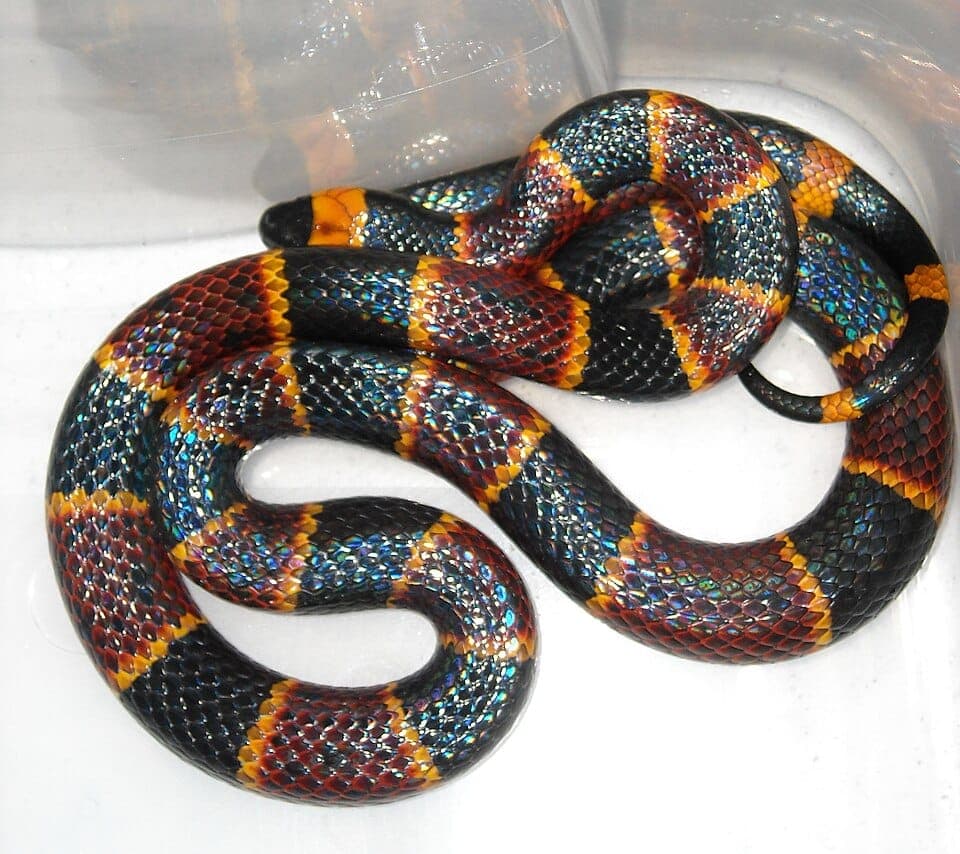
The fastest way to tell a coral snake from a milk snake is to look at which colors touch. On a venomous coral snake the red bands always touch the yellow bands; on a harmless milk snake the red touches black. That is the whole idea behind the old rhyme "red touches yellow, kills a fellow; red touches black, friend of Jack." It is a handy memory aid in the United States, but it is not foolproof and it does not work outside North America — so treat any red, black, and yellow banded snake with caution and identify it from a safe distance. Here is how to read the bands, the head, and the behavior to tell these two look-alikes apart.
How to Tell a Coral Snake From a Milk Snake
Both snakes are smooth-scaled, glossy, and ringed or blotched in red, black, and pale bands, which is exactly why they get confused. But a coral snake is one of North America’s few venomous snakes, while a milk snake is a completely harmless constrictor. Work through the marks below in order and, when in doubt, back away and let a photo do the identifying for you.
The color-band rule (red on yellow vs. red on black)
On the eastern coral snake the pattern runs red, yellow, black, yellow, red — the broad red and black rings are separated by narrow yellow (or cream) rings, so red always borders yellow. A milk snake instead shows red or reddish-brown saddles and blotches outlined in black, so the red touches black, never yellow. This is the single most useful field clue in the U.S., but treat it as a first hint rather than proof: some coral snakes have abnormal color, worn or muddy snakes are hard to read, and tropical coral snakes break the pattern entirely.
Head and eyes
Look at the snout. A coral snake has a small, blunt, solid-black head — the black extends from the nose back to just behind the eyes, where the first yellow band begins. A milk snake has a lighter, patterned head, often with a pale Y- or V-shaped mark, and its snout is never solid black. If the snake’s nose and the whole front of its face are jet black, that is a strong coral-snake sign.
Body shape, size, and how the rings wrap
Coral snakes are slender and typically 18 to 30 inches long, with bright rings that encircle the entire body, belly included. Milk snakes are often larger and heavier-bodied, commonly 24 to 52 inches, and their blotches frequently do not wrap all the way around — the belly is usually a black-and-white checkerboard rather than continuous rings. If you can safely see the underside and the color goes all the way around, lean coral snake; a checkered belly points to a milk snake or another harmless mimic.
Behavior and habitat
Coral snakes are shy and secretive burrowers that spend most of their lives underground or hidden in leaf litter, emerging mainly at dawn, dusk, or after rain. In the U.S. the eastern coral snake lives in the Southeast (the Carolinas to Florida and west to Texas), with a separate western species in Arizona and New Mexico. Milk snakes are far more widespread and adaptable, turning up in fields, woods, barns, and basements across much of the country, where they hunt rodents. A milk snake that feels threatened may vibrate its tail, strike, and release a musky smell, but it cannot hurt you.
Try Spotter Free on iOS & Android
Plants, animals, fungi, and rocks — all from a photo. 5 free identifications every day, no credit card required.
Snakes That Mimic the Coral Snake
Several harmless snakes copy the coral snake’s warning colors, a survival trick called mimicry. These are the ones people most often mistake for the real thing:
- Scarlet kingsnake — bright red, black, and yellow bands, but the red touches black; a classic coral-snake mimic across the Southeast and a favorite reason the rhyme exists.
- Scarlet snake — red, black, and whitish blotches with a pointed red snout and a plain, unmarked belly; the red borders black, not yellow.
- Milk snake — reddish-brown saddles edged in black on a gray or tan body; often not obviously "banded," but still red-on-black.
- A key caveat: the "red touches yellow" rhyme only applies to snakes in the United States. Coral snakes in Central and South America can have patterns that ignore the rule completely, so never rely on it while traveling.
Coral Snake Safety: What to Do
Coral snakes carry potent neurotoxic venom, but bites are genuinely rare. The snake is reclusive and reluctant to bite, and its short, fixed fangs and small mouth make it hard for it to inject venom unless it is picked up or stepped on barefoot. The rule is simple: never handle or provoke any banded snake, even one you believe is a harmless mimic. If you find one, stop, step back, and give it room to leave — it wants nothing to do with you. Keep children and pets away, and photograph it from a safe distance rather than trying to catch it. If someone is bitten, treat it as an emergency and get to medical care right away; do not attempt any home treatment or try to capture the snake.
Frequently Asked Questions
Does "red touches yellow" always mean a coral snake?
In the United States it is a good rule of thumb, but it is not 100 percent reliable — some coral snakes have unusual patterns, and the rhyme fails entirely outside North America. Use it as a first clue, keep your distance, and confirm with a photo instead of a hand.
How venomous is a coral snake?
Coral snakes have powerful neurotoxic venom, but bites are uncommon and rarely fatal today because the snakes are shy and would rather flee than fight. Most bites happen only when someone tries to pick one up, which is exactly why the advice is never to handle one.
Are milk snakes dangerous?
No. Milk snakes are nonvenomous constrictors that are harmless to people and helpful to have around barns and homes because they eat mice and rats. They may bite or musk if grabbed, but they cannot seriously hurt you.
Why is it called a milk snake?
The name comes from an old myth that these snakes sneak into barns to suck milk from cows — which is not true. They hang around barns because barns attract the mice and rats they actually hunt.
Not sure whether the banded snake you spotted is a harmless mimic or the venomous real thing? Keep your distance, take a photo from a safe spot, and let Spotter help you identify it — so you know exactly what is living in your yard or crossing your trail.
Try Spotter Free on iOS & Android
Plants, animals, fungi, and rocks — all from a photo. 5 free identifications every day, no credit card required.