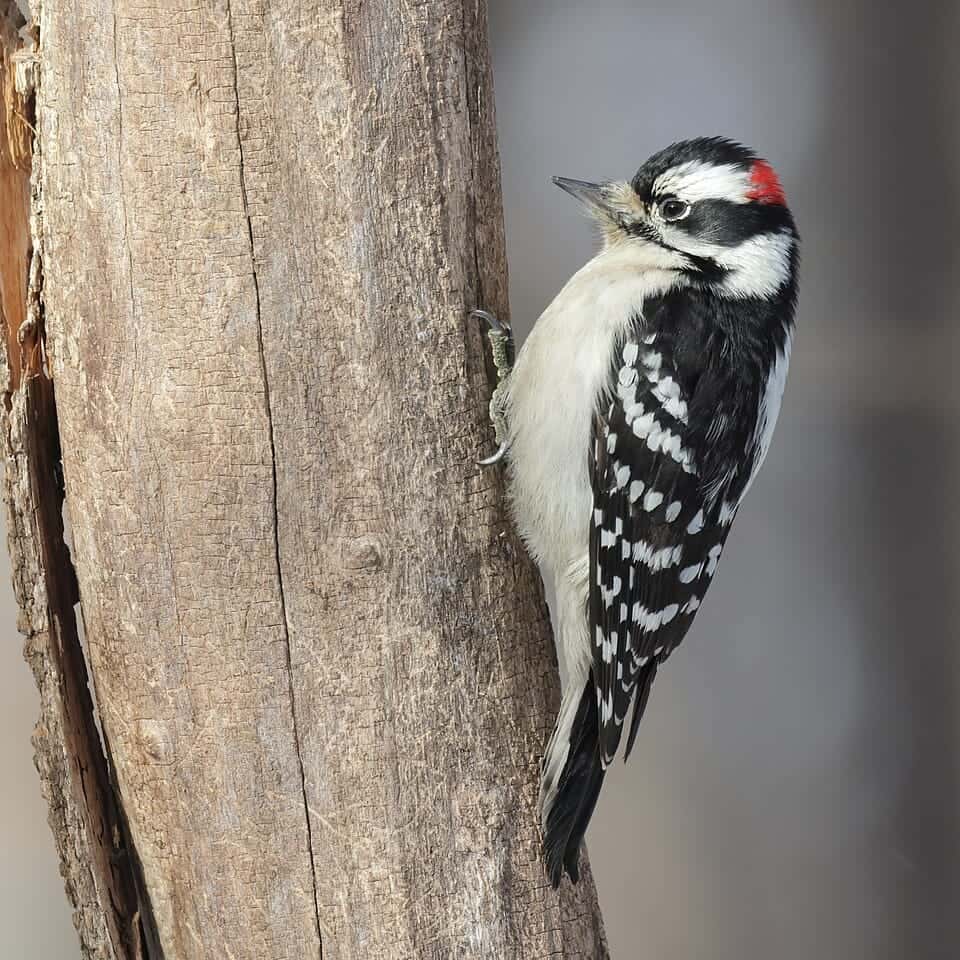
A neat little black-and-white woodpecker hitches up to your suet feeder, taps around, and flies off — and if you birdwatch at all, you have probably called it a downy woodpecker without a second thought. Then, some days, a bird that looks almost exactly the same but distinctly larger, with a heavier bill, lands in the same spot, and suddenly the easy ID is not so easy. The downy woodpecker and the hairy woodpecker are the most famous look-alike pair in North American backyard birding: same crisp black-and-white plumage, same red patch on the back of the male’s head, same feeder habits, just built at two different scales. Both are around all year, but they become especially conspicuous at feeders in fall and winter. Here is how to separate them.
Why These Two Are So Easy to Confuse
Downy and hairy woodpeckers are not close relatives despite looking like clones of each other — their near-identical patterns are a striking case of two species converging on the same look. Both wear a checkerboard of black and white across the back and wings, a bold white stripe down the center of the back, a white or pale belly, and a boldly striped face. In both, the adult male has a small red patch on the back of the head that the female lacks. Seen alone, with nothing nearby for scale, either one can be genuinely hard to name — which is exactly why the size trick everyone reaches for first is also the one that fools people most often.
Size Is the First Clue — but the Trickiest
The textbook difference is overall size, and it is real, but it is only useful when you have something to compare against:
- The downy is small — roughly sparrow-sized, about 6 to 7 inches long — and looks dainty and compact on the feeder
- The hairy is noticeably bigger — closer to robin-sized, about 9 to 10 inches long — and looks longer, leaner, and more powerful
- The catch: a lone bird gives you nothing to scale against, and a photo with no reference object can make a downy look like a hairy or vice versa
- When both happen to be at your feeders at once, the size gap is obvious and the ID nearly settles itself — so it pays to wait for that side-by-side moment
Try Spotter free on iPhone or Android
Plants, animals, fungi and rocks from one photo. 5 free identifications every day, no card required.


The Bill: The Most Reliable Single Feature
Most experienced birders stop trusting size and go straight to the bill, because the proportions are consistent no matter how far away the bird is:
- Downy: a short, dainty bill only about one-third the length of the head — it looks like a little stub, almost too small for the bird
- Hairy: a long, heavy, chisel-like bill nearly as long as the head is wide — often described as looking like a railroad spike by comparison
- The trick is to judge the bill against the head, not against the whole bird, so distance and scale stop mattering
- Once you train your eye on the bill-to-head ratio, it becomes the fastest way to call the bird even in a quick glimpse
Check the Outer Tail Feathers
If the bird holds still long enough to show its tail, there is a second reliable tell in the white feathers along the edges:
- Downy: the white outer tail feathers are marked with small black bars or spots
- Hairy: the white outer tail feathers are usually clean and unmarked white
- This one takes a decent look or a clear photo, but when you can see it, it confirms the ID on its own
- The calls differ too: the downy gives a soft, gentle "pik" and a descending, horse-like whinny that falls in pitch, while the hairy gives a sharper, louder "peek!" and a rattle that stays level
Habitat and Behavior Hints
Where and how you see the bird nudges the odds even before you get a good look. Downies are the more suburban of the two, comfortable in small parks, backyards, weedy fields, and on thin stems like goldenrod and cattails that could never support a bigger bird. Hairies lean toward larger trees and more mature or heavily wooded areas, and are somewhat less common at feeders in many neighborhoods. Neither rule is absolute — hairies do visit suet feeders and downies do live in forests — but combined with bill shape and size, the setting helps you commit to an answer.
Watched a black-and-white woodpecker at your suet and cannot decide if it was a downy or a hairy? Snap a photo — ideally one that shows the bill next to the head, or the bird next to something for scale — and let Spotter help you narrow down which of the two feeder look-alikes you hosted, so you can log one of the backyard’s most satisfying ID puzzles.
Try Spotter free on iPhone or Android
Plants, animals, fungi and rocks from one photo. 5 free identifications every day, no card required.