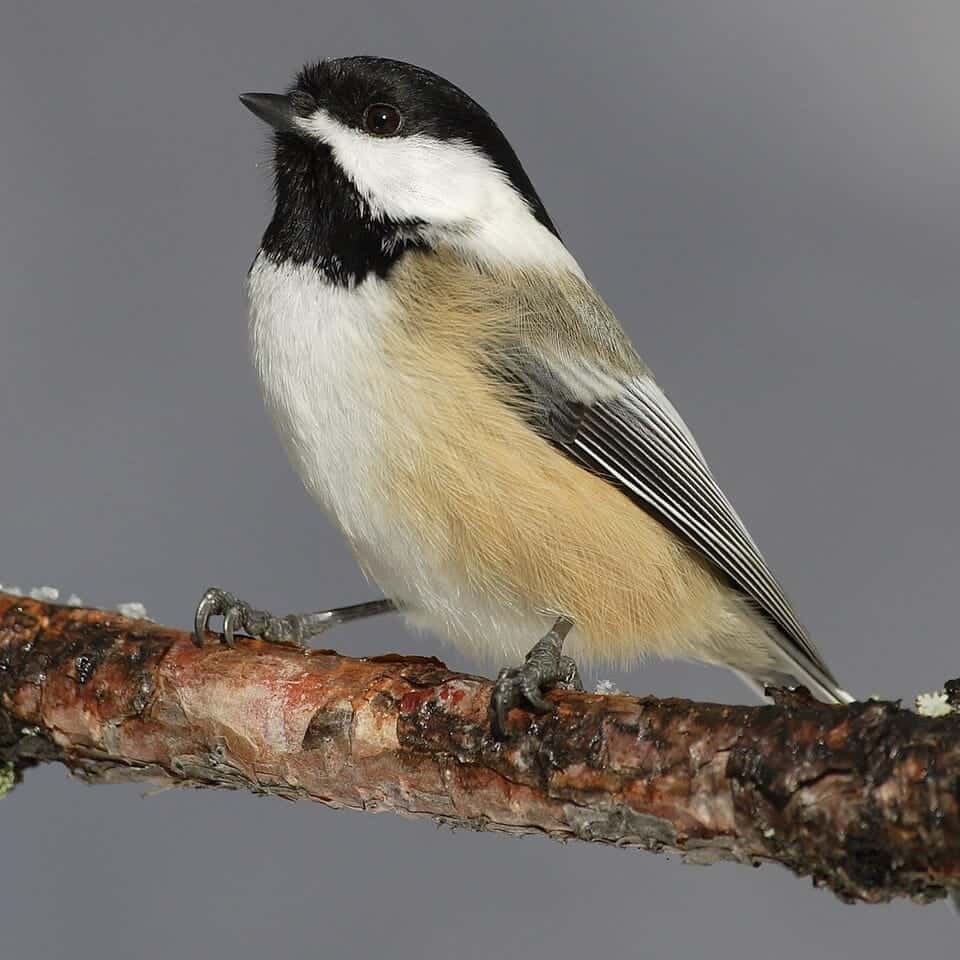
If one bird owns the fall feeder, it is the chickadee. Small, round, and almost comically energetic, it zips in from a nearby branch, grabs a single sunflower seed, and rockets back to cover to hammer it open — then repeats the trip again and again, often the first bird to find a new feeder and the tamest one in the yard. It has a crisp, tidy look: a solid black cap pulled down over the eyes, a black bib under the chin, and bright white cheeks in between, over a soft gray back and pale, buffy sides. And it announces itself constantly with the cheerful, scolding call that gave it its name — "chick-a-dee-dee-dee." As the weather cools and insects fade, chickadees swing hard toward feeders, so autumn is prime chickadee season. Here is how to know one.
How to Identify a Chickadee
Chickadees are small and plain-colored, but the head pattern and their restless habits make them easy to pick out:
- The head: a solid black cap and a black bib (throat patch) separated by clean white cheeks — a tidy, almost masked face that is the key mark
- The body: soft gray above and pale below, with a warm buffy wash along the sides and no bold streaks or spots
- The size and shape: tiny and round, with a short bill, a longish tail, and a puffed-up, big-headed look, weighing about as much as a few coins
- The behavior: acrobatic and fearless — hanging upside down from twigs, hovering, and taking one seed at a time to eat or hide
- The voice: a clear whistled "fee-bee" song and the namesake "chick-a-dee-dee-dee" call, where more "dee" notes signal a more alarming threat
Black-Capped vs. Carolina Chickadee
Two nearly identical chickadees split most of the eastern and northern United States, and where you live is often the best first clue:
- Black-capped chickadee: the northern bird — across the northern U.S. and Canada — slightly larger, with more obvious white edging on the wing feathers and a slower, clearer two-note "fee-bee" whistle
- Carolina chickadee: the southeastern bird, a touch smaller and neater, with a faster four-note song and less white in the wing
- The overlap zone: across a band through the mid-Atlantic and lower Midwest the two meet, sometimes interbreed, and can be genuinely hard to separate — here, range and song matter more than plumage
A tiny, round, gray bird with a black cap, black bib, and white cheeks, grabbing one seed at a time and calling "chick-a-dee," is a chickadee. In the North it is almost certainly black-capped; in the Southeast, Carolina.
Try Spotter free on iPhone or Android
Plants, animals, fungi and rocks from one photo. 5 free identifications every day, no card required.


Why Chickadees Take Over the Feeders in Fall
Chickadees do not migrate — they tough out the winter right where they live — so as fall arrives they shift from a summer diet heavy on insects and caterpillars toward the seeds and suet that will carry them through the cold. That is why they seem to suddenly claim your feeders in autumn. They are also relentless food-hoarders: a chickadee will cache thousands of individual seeds in bark crevices, under lichen, and in curled leaves, and it can remember where it hid them for weeks — even growing extra brain capacity for the task. Grabbing one seed and flying off to stash or eat it is not fussiness; it is a survival strategy. In fall you will also notice chickadees moving in loose flocks, often leading mixed groups of nuthatches, titmice, kinglets, and small woodpeckers through the trees — the chickadees act as the noisy core that other birds follow.
How to Bring Them In
Chickadees are one of the easiest birds to attract and among the most likely to eventually feed from your hand. Offer black-oil sunflower seeds — their clear favorite — along with peanuts and suet, which become especially valuable as the weather turns cold. Place feeders within a short flight of trees or shrubs so the birds have cover to duck into and a perch to open seeds on, and keep a little brushy habitat nearby. Because they stay all winter, a feeder that chickadees adopt in fall will keep them as daily visitors for months. Not sure whether that little black-capped bird is a chickadee, a titmouse, or something passing through with the flock? Snap a photo and let Spotter help you tell them apart, so the whole busy feeder crowd becomes familiar.
Try Spotter free on iPhone or Android
Plants, animals, fungi and rocks from one photo. 5 free identifications every day, no card required.