
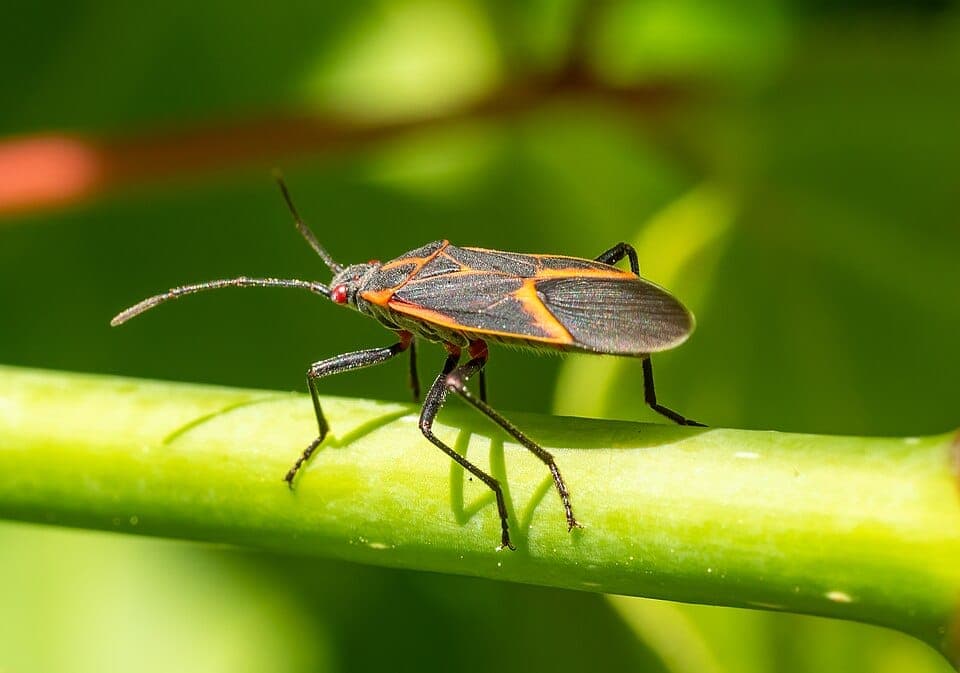
One of the most common late-summer "what is this bug?" questions comes from people who walk out to find the warm side of their house covered in flat black insects marked with vivid red-orange lines. They cluster on siding, foundations, and window frames in the afternoon sun and seem to appear out of nowhere. These are boxelder bugs, native true bugs that are harmless but hard to ignore once they start gathering. Their sudden crowds in August and September are not a sign of an infestation in your walls — they are the insects responding to the changing season.
How to Identify a Boxelder Bug
Adult boxelder bugs are easy to recognize once you know the color pattern:
- About half an inch long, flat, and elongated-oval in shape
- Charcoal-black to dark brown overall, with three thin red-orange stripes on the shield-shaped area right behind the head
- Bold red-orange lines outlining the edges of the wings, forming a rough "V" or X pattern when the wings are folded flat over the back
- Bright red, wingless nymphs — the young bugs are almost entirely red and much smaller, darkening as they grow
A common point of confusion is the large milkweed bug, which is also black and orange but is found on milkweed pods rather than crowded on the sunny side of a building, and shows a broad black band across an orange back rather than fine stripes. Boxelder bugs get their name from the boxelder tree (a type of maple) whose seeds they feed on, so they are often most numerous near boxelder, maple, or ash trees.
Try Spotter Free on iOS & Android
Plants, animals, fungi, and rocks — all from a photo. 5 free identifications every day, no credit card required.
Why They Gather in Late Summer and Fall
The clustering that alarms people is simple overwintering behavior. As days shorten and nights cool, boxelder bugs leave their host trees and move toward warmth, congregating on the south- and west-facing walls that soak up the most afternoon sun. There they bask in large groups, and some find their way through cracks, gaps, and vents into wall voids and attics to wait out the winter. On warm days later in the season they may wander indoors, appearing at windows as they try to get back outside. This is why a house can suddenly seem to host a swarm even though the bugs have been in the neighborhood all summer.
Are They Harmful?
Boxelder bugs are a nuisance, not a danger. They do not bite or sting people, they do not damage the structure of a house, and they do not eat stored food or fabrics. They do not reproduce indoors, so the ones overwintering in a wall will not multiply there. Their main drawback is the numbers and the fact that crushing them can leave a stain and a faint odor. Sealing gaps around windows, doors, vents, and the foundation before fall is the most effective way to keep them from moving in — a far better approach than trying to spray a wall covered in hundreds of them.
Seeing a crowd of black-and-red bugs and want to be sure they are harmless boxelder bugs and not something else? Snap a photo and let Spotter identify them, so you know exactly what is basking on your wall before the weather turns.
Try Spotter Free on iOS & Android
Plants, animals, fungi, and rocks — all from a photo. 5 free identifications every day, no credit card required.