
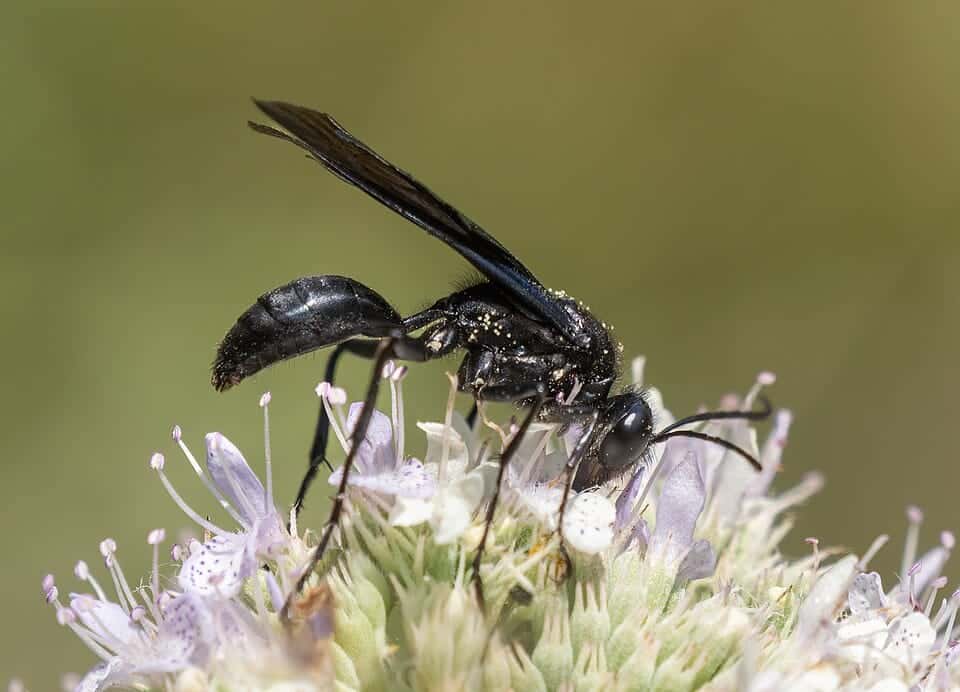
Late summer is peak season for a common "what is that huge scary wasp?" moment. You are near a flowering patch — mountain mint, goldenrod, boneset, milkweed, or a garden full of blooms — and a big, glossy, entirely black wasp well over an inch long drops onto the flowers with a low hum. Its wings are a smoky, iridescent blue-black that flash in the sun, its body is long and slender with a narrow waist, and its size alone is enough to make you step back. But watch it for a minute and you will notice it is completely absorbed in the flowers, paying you no attention at all. This is very likely the great black wasp, one of several large, harmless black wasps that visit late-summer blooms. Here is how to identify it.
How to Identify a Great Black Wasp
The great black wasp (Sphex pensylvanicus) is a large solitary wasp, a member of the digger-wasp family, found across much of the United States and often seen nectaring on flowers in July, August, and September. Look for this combination of traits:
- The size: big and unmistakably so for a wasp — roughly one to one and a half inches long, noticeably larger than a yellowjacket or a paper wasp
- The color: entirely satiny black, with no yellow, orange, or red markings anywhere on the body — a uniform glossy black from head to tail
- The wings: smoky and dark, with a distinct bluish or violet iridescent sheen that catches the light
- The shape: long and slender, with a narrow "thread-waisted" connection between the thorax and abdomen and long, spiny black legs it lets dangle in flight
- The behavior: a solitary flower-visitor, usually seen alone rather than in a swarm, methodically working nectar-rich blooms with a low, heavy hum
The pairing of a large, all-black body with smoky blue-black wings and a thread-waisted shape, seen calmly visiting flowers by itself, is the signature look. Unlike yellowjackets and hornets, which are boldly patterned and live in defensive colonies, this is a lone insect with nothing to guard around the flowers.
Try Spotter free on iPhone or Android
Plants, animals, fungi and rocks from one photo. 5 free identifications every day, no card required.


Telling It From Other Big Black Wasps
A few other large dark wasps show up on late-summer flowers and get confused with the great black wasp. The steel-blue cricket hunter (Chlorion aerarium) is similar in size and habits but has a striking metallic blue or blue-green body rather than a flat black one. The blue mud dauber (Chalybion californicum) is a slimmer, brilliantly metallic blue wasp that builds mud nests. The great golden digger wasp, a close relative that visits the very same flowers, has an orange-red segment on its abdomen and orange legs instead of an all-black body. And the cicada killer — covered in its own guide — is much bulkier with bold yellow markings and a habit of digging burrows in lawns. If your wasp is large, entirely black with smoky bluish wings, and quietly working flowers, the great black wasp is the best fit.
Why It Is Actually a Gardener’s Friend
Despite its intimidating size, the great black wasp is a solitary, non-aggressive insect and a genuinely beneficial one. Females dig underground burrows and hunt katydids and large grasshoppers to provision their nests, helping keep those plant-eaters in check, while the adults spend much of their time drinking nectar and, in the process, pollinating flowers. Because it is solitary, it has no colony to defend and is not interested in your food or your picnic the way yellowjackets are. It simply wants the flowers. In a pollinator or native-plant garden, a great black wasp working the blooms is a sign of a healthy late-summer habitat, not a threat.
A Safety-First Word
A great black wasp can sting — females are equipped to subdue prey — but they are famously reluctant to use it on people and sting only if grabbed, stepped on, or seriously provoked. The right approach is the easy one: give it room and let it work the flowers. Do not swat at it, and do not try to handle it. As with any stinging insect, anyone with a known venom allergy should keep their distance and treat a sting as a medical matter. For everyone else, the great black wasp is best enjoyed as one of the more impressive and useful visitors to a late-summer garden — admired, not feared.
Not sure whether the big black wasp on your flowers is a harmless great black wasp or something else? Snap a photo from a comfortable distance and let Spotter help you identify the insect, so you can tell a beneficial pollinator from a wasp worth giving wider berth.
Try Spotter free on iPhone or Android
Plants, animals, fungi and rocks from one photo. 5 free identifications every day, no card required.