
It is a warm, breezy afternoon in late summer or early fall and the air is suddenly full of dragonflies. Not the usual one or two hawking back and forth over the flower bed, but dozens — sometimes hundreds — all loosely drifting in the same direction, skimming low over an open field, a lakeshore, a mowed park, or even a shopping-center parking lot. They weave and hover and dart after insects as they go, but the whole loose cloud keeps sliding steadily one way, like a slow, ragged river flowing through the air. If you have never seen it, it can be startling: dragonflies are supposed to be a summer thing tied to a pond, so why are there so many, all traveling together, out over dry ground? What you are almost certainly watching is migration. A handful of North American dragonflies actually migrate south for the winter, and the standout is the common green darner. Here is how to recognize it and understand what is going on overhead.
How to Identify a Common Green Darner
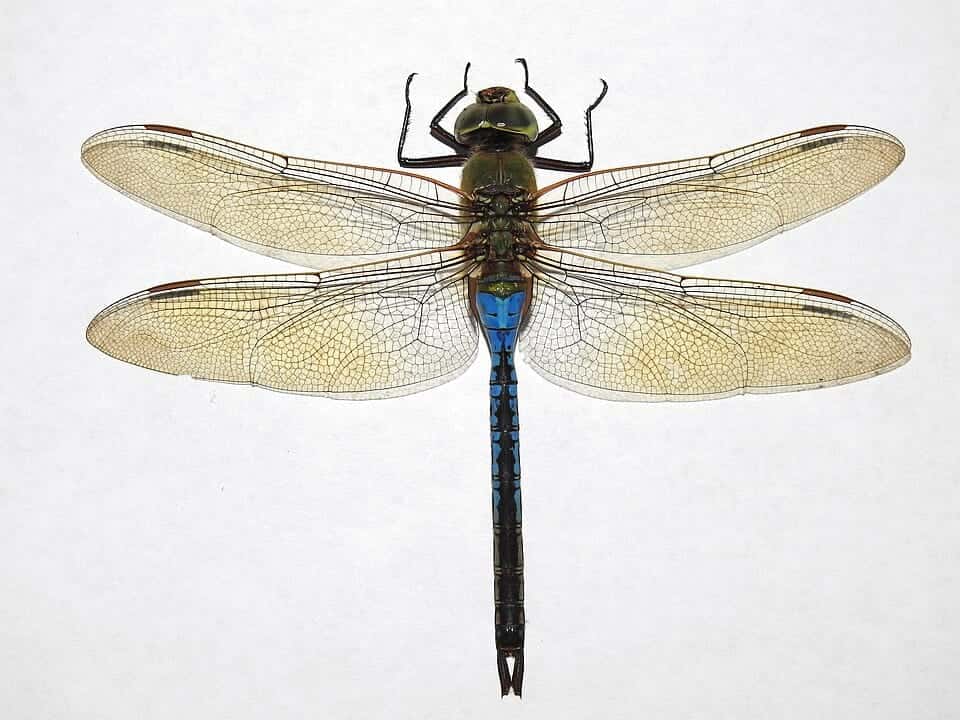
The common green darner (Anax junius) is one of our largest and most widespread dragonflies, and it is the classic migrant. A single hovering darner is not always easy to name at speed, but this species has a distinctive size, color, and behavior:
- The size: a big, powerful dragonfly, roughly three inches long with a wingspan of about four inches — noticeably larger than most of the dragonflies zipping around a typical pond
- The thorax: a bright, unmarked apple-green thorax (the section right behind the head) is the best single field mark and the source of the name
- The abdomen: males show a long blue-to-purplish abdomen, while females and immatures are more grayish, greenish, or reddish-brown — so color of the tail alone varies
- The "bullseye": a small dark spot ringed with blue-green on the front of the face, between the eyes, giving the look of a target or bullseye
- The behavior: strong, tireless fliers that cruise and glide rather than staying pinned to one pond, and in fall they gather into loose, one-directional groups moving over open country
A large, green-thoraxed dragonfly cruising steadily in a loose flock over an open field or shoreline in late summer or fall is the signature of a migrating green darner. Other migratory species mix into the flights — wandering gliders, black saddlebags, and variegated meadowhawks travel too — but the green darner is the one most people notice, because it is big, common, and moves in the biggest numbers.
Try Spotter free on iPhone or Android
Plants, animals, fungi and rocks from one photo. 5 free identifications every day, no card required.


Why Dragonflies Migrate
Like monarch butterflies, green darners complete their migration across multiple generations rather than as single round-trip travelers. A generation that hatched up north in summer flies south in the fall, sometimes more than a thousand miles, toward the southern United States, Mexico, and the Caribbean. There they breed, and their offspring make the return trip north the following spring; a third generation lives through the northern summer and starts the cycle again. Because they hunt as they go — picking off smaller flying insects the whole way — a migrating darner is both traveler and predator, and the journey can take weeks. They ride favorable winds after cold fronts, which is why the biggest movements often show up on breezy days when the weather has just shifted, and why they concentrate along coastlines, lakeshores, and ridgelines that funnel them along. The flights do not go unnoticed by predators, either: migrating falcons like American kestrels and merlins follow the darners south and snatch them out of the air, dining on the wing.
Migration or Just a Feeding Swarm?
Dragonflies gather in numbers for two very different reasons, and it is worth telling them apart. A true migratory flight is directional: the whole loose group drifts steadily one way — generally toward the south in fall — often low over open ground far from any pond, and it may keep passing for a long time. A feeding swarm, by contrast, is a static free-for-all: dozens of dragonflies of mixed kinds milling in one spot with no shared direction, usually over a freshly mowed field, a hatch of gnats, or a spot where a lawnmower or grazing animals have stirred up insects. Both are worth watching, but only the steady, one-directional river over open country in fall is the migration proper. Either way, dragonflies are harmless to people — they do not sting, and they are voracious predators of mosquitoes and other biting insects, so a yard full of darners is good news.
Caught a big green-shouldered dragonfly hovering in a crowd of others drifting south and want to know if you have witnessed the darner migration? Snap a clear photo showing the green thorax and let Spotter help you identify it as a starting point, so you can put a name to the river of wings passing over this fall.
Try Spotter free on iPhone or Android
Plants, animals, fungi and rocks from one photo. 5 free identifications every day, no card required.