
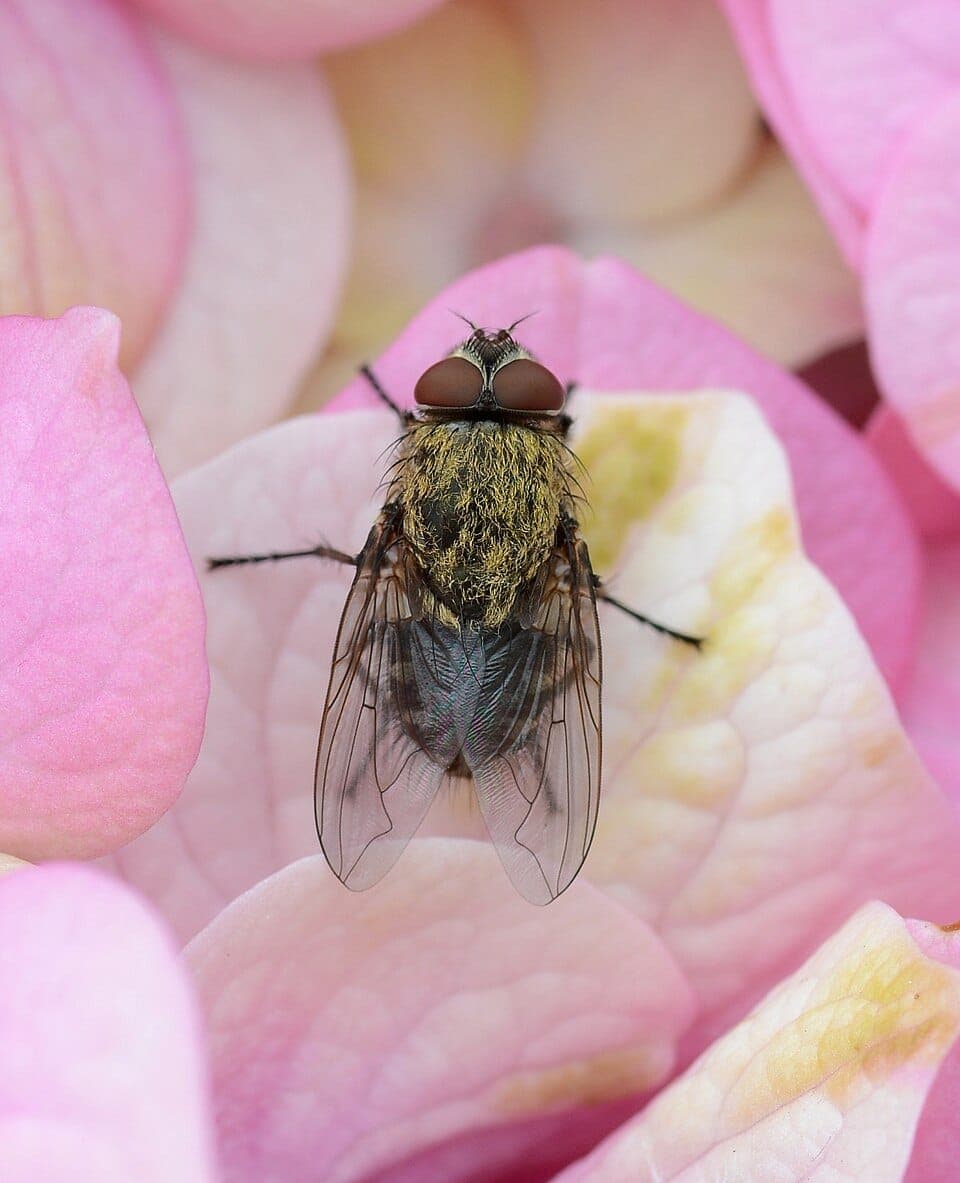
It is a familiar autumn scene: you notice a handful of dark flies gathered on the inside of a sunny window, or bumbling slowly around an upstairs room and a light fixture, on a cool day when there is no food, garbage, or obvious reason for flies to be indoors. They are a little bigger than a housefly, noticeably slow and clumsy, easy to swat, and they keep turning up in the same warm, bright spots — sometimes a few, sometimes dozens. Those are cluster flies, one of the most common insects to move into homes as the weather cools. Here is how to identify them and why they are suddenly inside.
How to Identify a Cluster Fly
Cluster flies (genus Pollenia) look broadly like a housefly at a glance, but a few features separate them once you know what to look for:
- Size: a bit larger than a common housefly — roughly a third to a half inch long
- Color: dull gray to olive-gray and dark, without the crisp four black stripes on the back that houseflies have
- Golden hairs: short, wavy, golden-yellow hairs on the thorax (behind the head), which can give a faint golden sheen — a key clue up close
- Wings at rest: the wings overlap over the back, giving a slim, tapered look rather than being held apart
- Movement: slow, sluggish, and clumsy — they fly lazily, bump into windows, and are easy to catch, unlike the fast, darting housefly
- Behavior: they gather ("cluster") at sunny windows, in attics and upper rooms, and in wall voids, especially on the warm south and west sides of a building
The most useful field test is behavior plus location: a slow, easy-to-swat gray fly crowding a sunny upstairs window on a cool day, with no food source nearby, is almost certainly a cluster fly rather than a housefly. Houseflies are fast, stay near food, waste, and moisture, and rarely gather at windows in cold weather the way cluster flies do.
Try Spotter Free on iOS & Android
Plants, animals, fungi, and rocks — all from a photo. 5 free identifications every day, no credit card required.
Why They Invade Homes in Fall
Cluster flies are not breeding in your house, and they are not coming from your garbage. Their life cycle is tied to the outdoors: the females lay eggs in soil, and the larvae develop as parasites inside earthworms through the summer. When the last generation of adults emerges in late summer and early fall, they face the coming cold — and their survival strategy is to find a sheltered place to wait out the winter. As temperatures drop, they gather on sun-warmed exterior walls (especially the south and west sides) and squeeze in through tiny gaps around windows, eaves, siding, and utility openings, then settle into attics, wall voids, and quiet upper rooms to overwinter.
That is why they seem to reappear from nowhere. Tucked in a wall or attic, they stay dormant on cold days, but a stretch of winter sun or the warmth of your heating tricks some of them into waking up. They head toward light and end up buzzing lazily at the nearest window, which is why you often see them on mild days in fall, winter, and again in early spring as they try to get back outside.
Are Cluster Flies Harmful?
Cluster flies are a nuisance, not a health threat. They do not bite people or pets, they are not venomous, and unlike houseflies they are not tied to filth, so they are not known for spreading disease. They do not lay eggs indoors, do not feed on your food, and do not damage the house structure or wiring. Their downsides are mostly cosmetic: large numbers can leave small dark spots (droppings) near windows and in attics, dead flies can accumulate in wall voids and window sills, and a big overwintering group can smell faintly musty. In short, they are unpleasant to have around in numbers, but harmless.
Because they do not breed inside, the practical fix is exclusion rather than spraying. Sealing is what actually works: caulk gaps around windows, doors, eaves, siding, and where pipes and cables enter, repair torn screens, and screen attic and soffit vents to close the entry points before fall. Once flies are already inside, a vacuum is the simplest way to remove the ones at your windows. Sealing them out ahead of the cold season does far more than any indoor spray.
Cluster Fly Look-Alikes
A few other insects turn up indoors in fall and get confused with cluster flies:
- Houseflies: faster, smaller, with four dark stripes on the thorax and no golden hairs, and they stay near food and waste rather than clustering at cold-weather windows
- Face flies: closely related to cluster flies and similar in look, but more associated with livestock and pastures
- Flesh flies and blow flies: larger or metallic (blow flies are shiny blue or green), and typically linked to decaying material rather than overwintering in walls
- Other fall invaders: boxelder bugs, Asian lady beetles, brown marmorated stink bugs, and western conifer seed bugs also crowd into homes to overwinter, but these are true bugs and beetles, not flies, and are easy to tell apart by shape
Not sure whether the slow flies at your window are cluster flies, houseflies, or another fall home invader? Snap a photo and let Spotter identify it as a starting point for figuring out what has moved in and how to keep it out.
Try Spotter Free on iOS & Android
Plants, animals, fungi, and rocks — all from a photo. 5 free identifications every day, no credit card required.