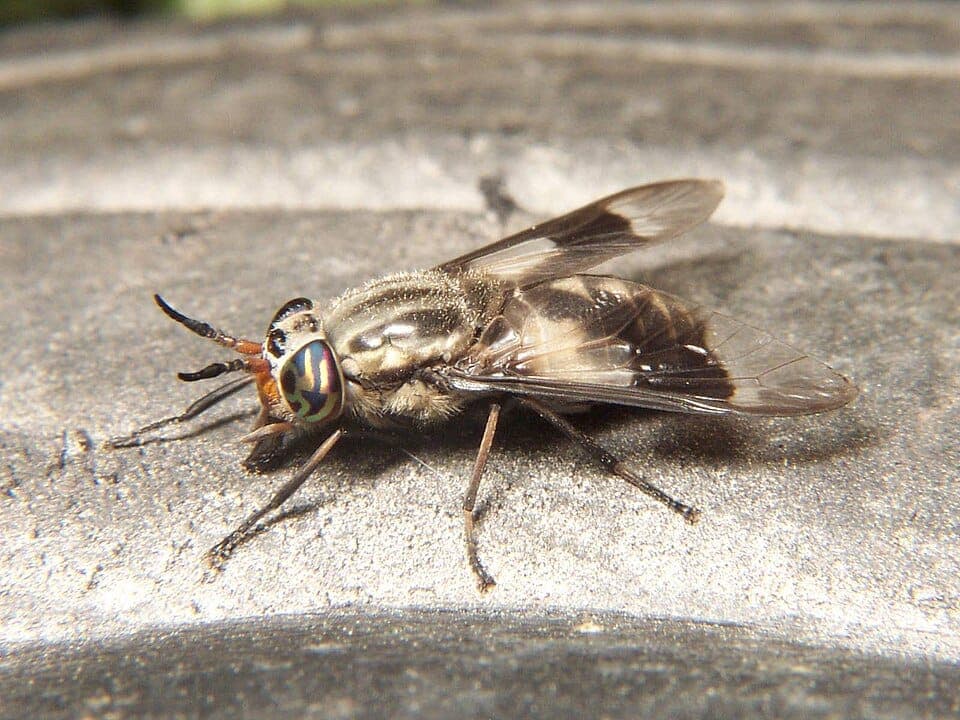
There is a particular kind of misery that defines late-summer afternoons near water: a fly that will not quit. It circles your head, lands silently, and delivers a bite sharp enough to make you jump — then dodges every swat and comes right back. This is not a mosquito. It is almost certainly a deer fly or its bigger cousin the horse fly, and from midsummer into early fall they are at peak numbers around lakes, marshes, trails, and pastures. Knowing what you are dealing with makes it easier to avoid the worst of them.
How to Identify Deer Flies and Horse Flies
Both belong to the same family (Tabanidae) and share a stout, powerful build, but they differ in size and pattern:
- Deer flies are the smaller of the two, roughly the size of a housefly, with clear wings crossed by dark bands or smoky patches and often brilliant iridescent green or gold eyes
- Horse flies are much larger and bulkier — some as big as a bumblebee — with a broad head, huge often-colorful eyes, and mostly clear or dark wings
- Both have a heavy, robust body and short antennae, unlike the long, delicate build of a mosquito or crane fly
- They are strong, fast, persistent fliers that circle and land repeatedly rather than drifting like a gnat
- You typically feel them before you see them — the bite comes first, then the fly is already on you
A quick tell: if the flier tormenting you is fly-sized with banded wings and shining green eyes, it is a deer fly; if it is startlingly large and heavy-bodied with a loud, low buzz, it is a horse fly.
Try Spotter Free on iOS & Android
Plants, animals, fungi, and rocks — all from a photo. 5 free identifications every day, no credit card required.
Why the Bite Hurts So Much
Mosquitoes slip in a fine needle-like mouthpart and sip quietly. Deer flies and horse flies do the opposite: only the females bite, and they use scissor-like mouthparts to slice the skin open and then lap up the blood that pools out. That cutting action is why the bite is instantly, sharply painful rather than an itch you notice later, and why it can bleed a little and leave a sore, swollen welt. They are drawn to movement, dark colors, warmth, and the carbon dioxide you breathe out, which is why they fixate on a hiker’s head or a swimmer climbing out of the lake. They generally are not considered major disease spreaders to people the way mosquitoes and ticks are, but the bites are genuinely unpleasant and can get irritated.
How to Be a Less Appealing Target
You cannot reason with a deer fly, but you can make yourself harder to find and reach. A few things that help: wear light-colored clothing, since they are strongly drawn to dark, moving shapes; cover up with long sleeves and a hat on buggy trails; and keep moving, as they often lag behind a steady walker and swarm most when you stop. Some hikers have real success with a hat trick — a sticky patch or an inverted cup on the back of a cap catches the flies that habitually target the highest point of a moving person. Insect repellents can help somewhat, though these flies are notoriously stubborn compared with mosquitoes. If a bite does swell or itch, treat it like any insect bite: clean it, use a cold compress, and avoid scratching it open.
Not sure whether the biting flier ruining your lake day is a deer fly, a horse fly, or something else entirely? Snap a photo and let Spotter identify the insect, so you know exactly what has been circling your head all afternoon.
Try Spotter Free on iOS & Android
Plants, animals, fungi, and rocks — all from a photo. 5 free identifications every day, no credit card required.