
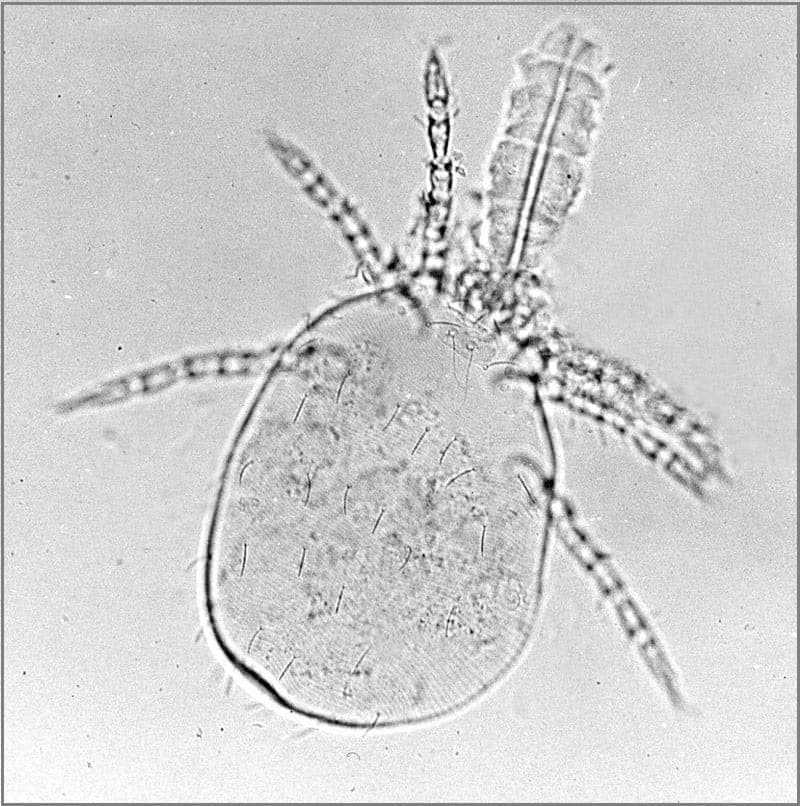
It is one of late summer’s cruelest surprises: you walk through a weedy field, sit in the grass at a ballgame, or weed the garden, and you feel nothing at all. Then a few hours later — often at bedtime — a cluster of tiny, intensely itchy red bumps flares up around your ankles, waistband, or the soft skin behind your knees, and the itch is bad enough to keep you awake. You never saw an insect land on you. In much of the country, the invisible cause is a chigger: the larval stage of a tiny mite that is most active from late spring through early fall, with a peak that lands squarely in the hot, humid weeks of August.
What a Chigger Actually Is
Chiggers are not insects — they are the six-legged larvae of a group of mites, which makes them relatives of spiders and ticks. The larvae are only about 1/150th of an inch across, so you essentially cannot see an individual one without magnification; people sometimes notice a faint reddish or orange speck moving on their skin, and that is about it. They live in grassy, weedy, brushy places, especially where it is damp — overgrown lawns, field edges, berry patches, and the transition zone between mowed grass and taller cover. They climb onto a passing host from the tips of vegetation, then wander to a spot where clothing fits snugly against skin.
The most persistent myth is that chiggers burrow under your skin and have to be dug out. They do not. A chigger latches onto the surface, attaches at a skin pore or hair follicle, and injects saliva that liquefies skin cells so it can feed on the fluid. Your body reacts to that saliva by hardening a little tube around the feeding site, and it is that reaction — not a buried bug — that causes the swelling and the maddening itch. The chigger itself is usually scratched off or falls away within a day or two; the itch outlasts it by far.
Try Spotter Free on iOS & Android
Plants, animals, fungi, and rocks — all from a photo. 5 free identifications every day, no credit card required.
How to Recognize Chigger Bites
Because you rarely catch a chigger in the act, you identify them by the pattern the bites make:
- Small, red, raised bumps that can look like pimples, blisters, or hives, often with a brighter red dot in the center
- Clustered in groups, frequently in a line or band where clothing presses against skin — around the ankles and lower legs, the waistband, the groin, behind the knees, and in the armpits
- A delayed onset: the itch usually builds a few hours after exposure and is often most intense one to two days later
- Itching that is out of all proportion to the size of the bumps and can last a week or more
- A history of sitting or walking in tall grass, weeds, or brushy field edges shortly beforehand
That combination — clusters of tiny, ferociously itchy bumps concentrated where clothing is tight, appearing hours after time in grassy cover — is the signature. Ticks, by contrast, are large enough to see and are usually found singly, attached and slowly feeding; mosquito bites tend to be more scattered and appear right away. If you find an actual attached bug rather than just bumps, it is worth ruling a tick in or out.
A Sensible, Safety-First Word
Chigger bites are miserable but, in North America, they do not transmit disease to people — the main risk is that scratching breaks the skin and invites a secondary infection. General comfort measures people rely on include washing thoroughly with soap and water soon after being in chigger habitat, keeping the bites clean, and resisting the urge to scratch; over-the-counter anti-itch products help many people. This article is for identification, not medical advice — if bites become very swollen, spread, ooze, or come with fever, or if you are ever unsure what bit you, check with a healthcare professional. Long pants tucked into socks and insect repellent go a long way toward avoiding them in the first place.
Not sure whether those clustered welts point to chiggers, or whether the speck you found is a chigger, a tick, or something else entirely? Snap a photo of the bug or the affected area and let Spotter help you identify what you are dealing with, so you can respond sensibly instead of guessing.
Try Spotter Free on iOS & Android
Plants, animals, fungi, and rocks — all from a photo. 5 free identifications every day, no credit card required.