You are walking a damp woodland trail after a rain — the kind of gray, drippy day when the forest floor is soaked — and there, out in the middle of the open path, is a tiny, brilliant orange creature strolling along without a care in the world. It is no longer than your finger, shaped a bit like a small lizard, and it moves slowly and deliberately, making no attempt to hide or dash for cover even as you lean in for a look. Most small animals in the woods flee the moment you appear; this one all but ignores you. If you have found a vivid orange, soft-bodied little "lizard" wandering a wet trail in daylight, you have almost certainly met a red eft — the terrestrial youth stage of the eastern newt, and one of the most beloved and recognizable amphibians of eastern forests. Here is how to identify it and why it is so boldly colored.
How to Identify a Red Eft
The red eft is the juvenile land stage of the eastern (or red-spotted) newt, Notophthalmus viridescens. It is an amphibian, not a reptile, and a few traits pin it down:
- The color: bright orange to orange-red or reddish-brown all over — an unmistakable, almost fluorescent warning color that stands out against dark leaf litter
- The spots: a row of small red spots, each neatly rimmed in black, running down each side of the back — the single best confirming mark
- The skin: rough, dry-looking, and slightly bumpy, not slick and wet like most salamanders, and lacking the shiny scales of a true lizard
- The size and shape: small, usually one to three inches long, with a rounded body, short legs, golden eyes, and a thin tail
- The behavior: active in the open by day, especially after rain, and remarkably slow and unafraid — it walks rather than darts and does not flee the way a lizard would
A little orange, dry-skinned creature with black-ringed red spots ambling across a wet trail in daylight is a red eft and almost nothing else. The easiest confusion is with a small lizard, but lizards have smooth, shiny scales, clawed toes, and lightning-fast escape reflexes, while the eft has soft, bumpy skin, no claws, and an almost tame slowness. Other salamanders you might turn up under logs are typically drab browns and grays and stay hidden and moist — none share the eft’s brazen orange, daytime, out-in-the-open habits.
Try Spotter free on iPhone or Android
Plants, animals, fungi and rocks from one photo. 5 free identifications every day, no card required.


One Animal, Three Lives
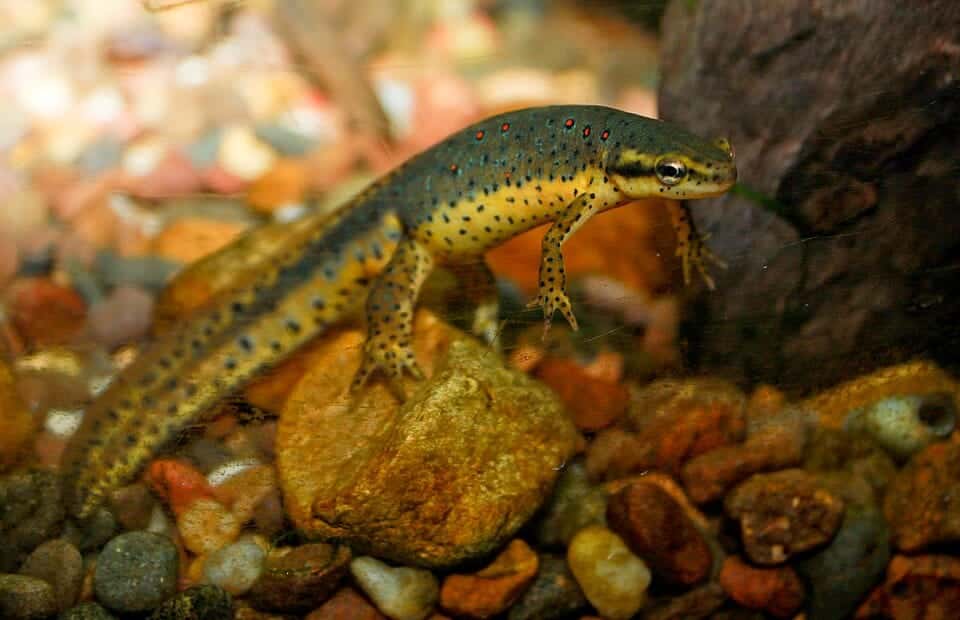
What makes the red eft so remarkable is that it is only a middle chapter in one of the strangest life cycles in the animal world. The eastern newt hatches in a pond as an aquatic, gilled larva. Then, instead of simply growing into a water-dwelling adult, it transforms into the bright-orange red eft and crawls out onto land, where it may wander the forest floor for one to three years — sometimes longer — as a terrestrial juvenile. Finally it changes a third time, shifting to a greenish or olive-brown, smooth-skinned aquatic adult (still keeping those black-ringed red spots) and returns to the water to live out its life and breed. So the vivid orange eft on the trail and the drab olive newt swimming in the pond are the same species at different stages — a fact that surprises even seasoned hikers. This long land-roving youth is also how the newt colonizes new ponds, since the wandering efts can travel well away from the water they hatched in.
Why It Is So Bold — and a Word on Safety
The red eft’s fearlessness is not naivety — it is advertising. Its skin secretes toxins (including tetrodotoxin, the same class of poison found in pufferfish) that make it distasteful and dangerous to eat, and the brilliant orange color is a classic warning signal telling predators to leave it alone. That is why it can afford to stroll across an open trail in daylight while other small creatures hide. For a hiker, the eft is completely harmless to admire, but the sensible rule is look, don’t lick: the toxins are only a hazard if the animal is eaten or if you rub your eyes or mouth after handling one. If you must move an eft off a road or trail, do it gently with clean, wet hands and wash afterward — and better yet, simply let it walk. Its skin is delicate and absorbs whatever is on your hands, so the kindest thing is usually to leave it be and enjoy the sighting.
Found a tiny orange "lizard" walking a wet trail and not sure whether it is a red eft, a salamander, or an actual lizard? Snap a photo — ideally showing the black-ringed red spots down the back — and let Spotter help you identify it as a starting point, so you can put a name to one of the forest’s most charming after-the-rain surprises.
Try Spotter free on iPhone or Android
Plants, animals, fungi and rocks from one photo. 5 free identifications every day, no card required.