
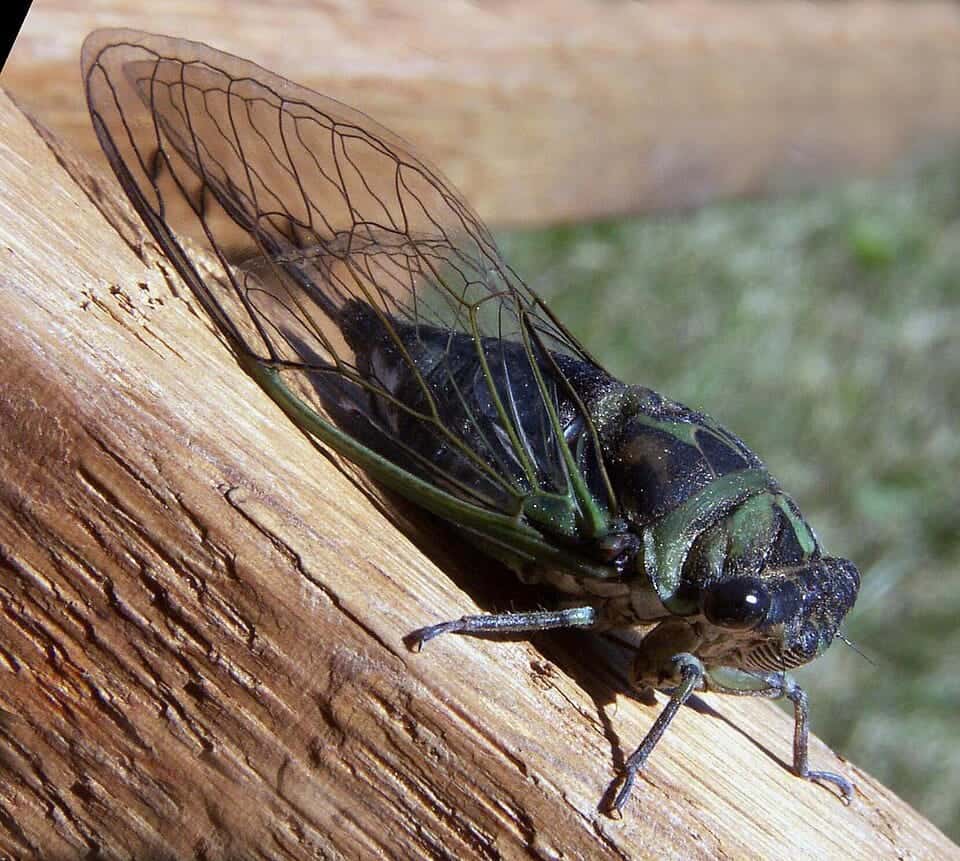
If you have stepped outside on a hot late-July afternoon and heard a loud, pulsing drone rising and falling in the treetops, you have almost certainly heard a cicada. These big, clumsy-flying insects are the sound of high summer across most of North America — the so-called "dog days" are named for the same stretch of the calendar the dog-day cicada is named after. Here is how to identify them and the crunchy shells they leave behind.
How to Identify a Cicada
Cicadas are large — roughly 1 to 2 inches long — with a stout body, a broad blunt head, and clear, prominently veined wings held like a tent over the back. The annual "dog-day" cicadas you hear all summer are typically green, brown, and black with a whitish, powdery bloom on the underside. Look for these features:
- A stocky body with a wide, blunt head and large, wide-set eyes
- Clear wings with strong veins, held roof-like over the body at rest
- Green-to-brown camouflage coloring (dog-day cicadas) rather than bright red eyes
- A loud, mechanical buzzing or droning call — each species has its own distinct song
Dog-Day vs. Periodical Cicadas
There are two broad groups, and telling them apart is easy once you know the trick. Annual or "dog-day" cicadas emerge every summer in small numbers and are the green-and-brown insects droning overhead right now. Periodical cicadas are different: they emerge all at once in enormous synchronized broods every 13 or 17 years, they have striking black bodies with bright red eyes and orange wing veins, and they appear in spring rather than the dog days of late summer. If it is late July and the insect is green and solitary, it is a dog-day cicada.
What About Those Crunchy Shells?
The hollow, amber-brown husks you find clinging to tree trunks, fence posts, and siding are the shed exoskeletons of cicada nymphs. After years underground feeding on root sap, the nymph climbs out, splits its old skin down the back, and emerges as a winged adult — leaving the empty shell behind. They are completely harmless, and finding a split one is a sure sign a cicada recently emerged nearby.
Are Cicadas Dangerous?
No. Cicadas do not bite or sting, they are not venomous, and they do not damage healthy mature trees in any meaningful way. They are clumsy fliers that sometimes bump into people, which startles more than it harms. The large "cicada killer" wasps you may see patrolling lawns in July are hunting cicadas, not people — they are also generally docile toward humans.
Curious what is making all that noise, or found a mystery shell on your porch? Snap a photo and Spotter will identify the cicada or its cast-off shell in seconds and tell you what species is singing in your neighborhood.
Try Spotter free on iPhone or Android
Plants, animals, fungi and rocks from one photo. 5 free identifications every day, no card required.