
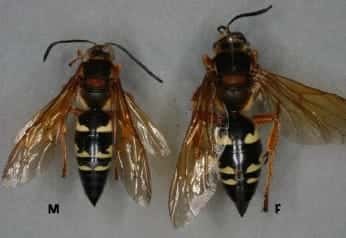
Every July and August the same panic spreads across backyards: a wasp the size of your thumb is cruising low over the lawn, or dozens of them are tumbling around patches of bare soil near the patio. They look like something that could send you to the hospital. In almost every case, they are eastern cicada killers (Sphecius speciosus) — one of the largest wasps in North America, and one of the least dangerous to people.
How to Identify a Cicada Killer
Cicada killers are unmistakable once you know the marks, mostly because of their sheer size:
- Very large — roughly 1.5 to 2 inches long, noticeably bigger than a yellowjacket or paper wasp
- A rusty reddish-brown body and reddish, amber-tinted wings
- Black abdomen with broken yellow bands or blotches down the sides (not the neat continuous bands of a yellowjacket)
- Reddish-orange legs
- Seen flying low over lawns, or hovering around nickel-sized holes in bare, dry, sandy soil
People often confuse them with the northern giant hornet (the so-called "murder hornet"), but cicada killers are native, widespread, and far less aggressive. The giant hornet has a broad orange head and neat body banding, lives in social colonies, and is genuinely rare in North America. If you are seeing a big wasp digging solo burrows in your yard in mid-summer, it is a cicada killer, not a giant hornet.
Are Cicada Killers Dangerous?
Realistically, no. Despite their alarming size, cicada killers are solitary wasps with no colony and no hive to defend, so they lack the group defensiveness that makes yellowjackets and hornets sting readily. The large wasps patrolling the lawn are almost all males, which are territorial and will fly right up to your face to investigate — but males have no stinger at all and cannot hurt you. Females do have a stinger (they use it to paralyze cicadas), but they are docile toward people and rarely sting unless grabbed or stepped on barefoot.
Try Spotter free on iPhone or Android
Plants, animals, fungi and rocks from one photo. 5 free identifications every day, no card required.


Why They Are Digging in Your Yard
The name is literal. A female cicada killer hunts annual cicadas, paralyzes one with her sting, flies it back to a burrow she has dug, and seals it in a chamber with a single egg. When the larva hatches, it eats the cicada. This is why the wasps concentrate in areas with loose, dry, sparsely vegetated soil — south-facing slopes, sandy garden beds, edges of patios and sidewalks, and thin patches of lawn. The little mounds of excavated dirt beside each hole are the giveaway.
They are, on balance, beneficial: they control cicada numbers and their burrowing aerates soil. The colonies of holes look worse than they are and disappear on their own by early fall when the adults die off. If you want to discourage them from returning, the durable fix is a thicker, healthier lawn or mulch cover — they nest in bare, dry ground, so eliminating the bare patches removes the habitat far better than spraying does.
When to Take a Closer Look
The one lookalike worth ruling out is the northern giant hornet, because it is an invasive species that authorities actively track. If a big wasp has a distinctly broad orange or yellow head, appears in a group defending a hidden nest rather than digging solitary burrows, or you simply want to be certain, get a photo from a safe distance rather than getting close.
Not sure whether the giant wasp in your yard is a harmless cicada killer or something you should report? Take a photo and Spotter will identify it, tell you whether it is dangerous, and explain what it is doing there.
Try Spotter free on iPhone or Android
Plants, animals, fungi and rocks from one photo. 5 free identifications every day, no card required.