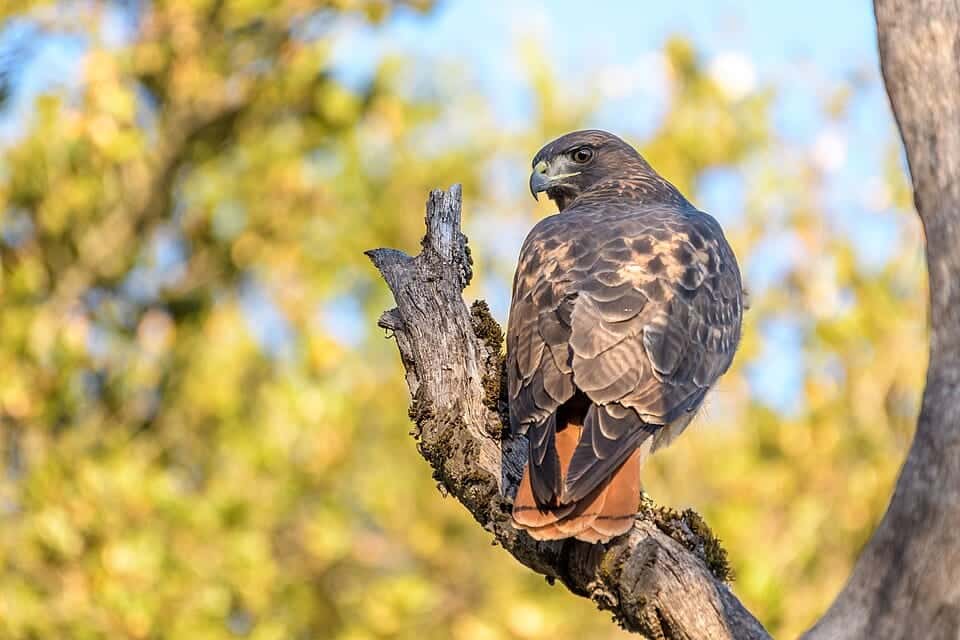
You are driving a country road or an open stretch of highway in early fall when you notice it: a big, chunky hawk sitting bolt upright on a telephone pole, a fence post, or a bare snag, scanning the grass below. Or maybe it is overhead — a broad-winged bird turning slow, patient circles high above a mowed field, barely flapping. Big hawks are especially easy to spot now, when young birds from this year are out hunting on their own and cooler weather sends raptors drifting south. Across most of North America, the single most likely identity for that large, open-country hawk is the red-tailed hawk (Buteo jamaicensis) — the continent’s most common and most widespread big hawk. Here is how to recognize it and separate it from the other raptors you might be looking at.
How to Identify a Red-Tailed Hawk
Red-tailed hawks are famously variable in color, but a handful of features hold true across almost all of them:
- The size and shape: a large, bulky hawk with a big head and broad, rounded wings held in a shallow V or flat while soaring — heavier and more thickset than a crow
- The underside: a pale chest with a distinct band of dark streaks across the belly, forming a "belly band" that is one of the best marks on a perched or flying bird
- The tail: in adults, a warm brick-red upper tail that gives the bird its name — best seen from above or when the tail fans in flight; young birds have a brown, finely barred tail instead
- The dark patagial bars: from below, a dark leading edge on the inner part of each wing (the "patagial mark") — a reliable red-tail signature even when the red tail is hidden
- The perch and behavior: often sitting still and upright on a pole, wire, fence post, or exposed branch beside open fields, watching for rodents below
A large, thickset hawk on a roadside perch or soaring on broad rounded wings, showing a pale chest with a dark belly band and — in adults — a rusty red tail, is a red-tailed hawk. The belly band and the dark patagial bars on the underwing are the quickest tells when the tail color is not visible.
Try Spotter free on iPhone or Android
Plants, animals, fungi and rocks from one photo. 5 free identifications every day, no card required.


Why You See Them Everywhere in Fall
Red-tailed hawks are open-country hunters, and our roadsides are perfect for them: mowed shoulders, medians, and grassy fields are full of mice, voles, rabbits, and other small mammals, and every pole and fence post is a ready-made hunting perch. That is why highway drives so often turn up one big hawk after another. Fall makes them even more obvious. This year’s young birds are now hunting on their own — often perching conspicuously and calling a lot — and northern red-tails begin drifting south, joining the general movement of raptors along ridges and coastlines. If you have started noticing "a hawk on every other pole," the season, not a sudden population boom, is why.
The Famous Scream
If you have ever heard a raptor let loose a long, harsh, descending scream in a movie — over a soaring bald eagle, no less — you have heard a red-tailed hawk. The eagle’s real call is a surprisingly weak, chittering whistle, so filmmakers routinely dub in the red-tail’s dramatic "kee-eeeee-arr" instead. In real life you will hear that same scream from a red-tail circling over a field or being harassed by crows. A hawk-like scream after dark, however, is worth a second thought: red-tails hunt by day, and a raptor-like cry heard at night is far more likely to be an owl.
Hawks That Get Confused With the Red-Tail
Several other raptors share the same skies, especially during fall migration:
- Red-shouldered hawk: a bit smaller and slimmer, with bold black-and-white banding on the wings and tail and a rusty, barred chest rather than a pale belly band; more a bird of wet woodlands than open highway edges
- Cooper’s and sharp-shinned hawks: much smaller, with short rounded wings and long tails, built for chasing birds through cover — the ones that raid feeders, not the ones sitting on highway poles
- Turkey vulture: often mistaken for a hawk at a distance, but it soars with wings in a strong V, teeters and wobbles, and has a tiny bare head — it flaps far less than a hawk
- Osprey and bald eagle: both larger; the osprey is a slim, white-bellied fish hawk near water, and the eagle is much bigger with a longer, plank-like wing profile
A quick safety note: red-tailed hawks, like all birds of prey in the United States, are protected by law and should be watched from a distance, never handled. If you find one that appears injured or grounded, do not try to catch it — contact a licensed wildlife rehabilitator. Enjoy them for what they are: powerful, patient hunters that put on a show from every fence post and thermal all autumn long.
Not sure whether the big hawk on that pole is a red-tail, a red-shouldered, or something else entirely? Snap a photo — even a distant one showing the underwing and tail — and let Spotter help you identify the bird, so you can start telling the raptors of the fall sky apart with confidence.
Try Spotter free on iPhone or Android
Plants, animals, fungi and rocks from one photo. 5 free identifications every day, no card required.