
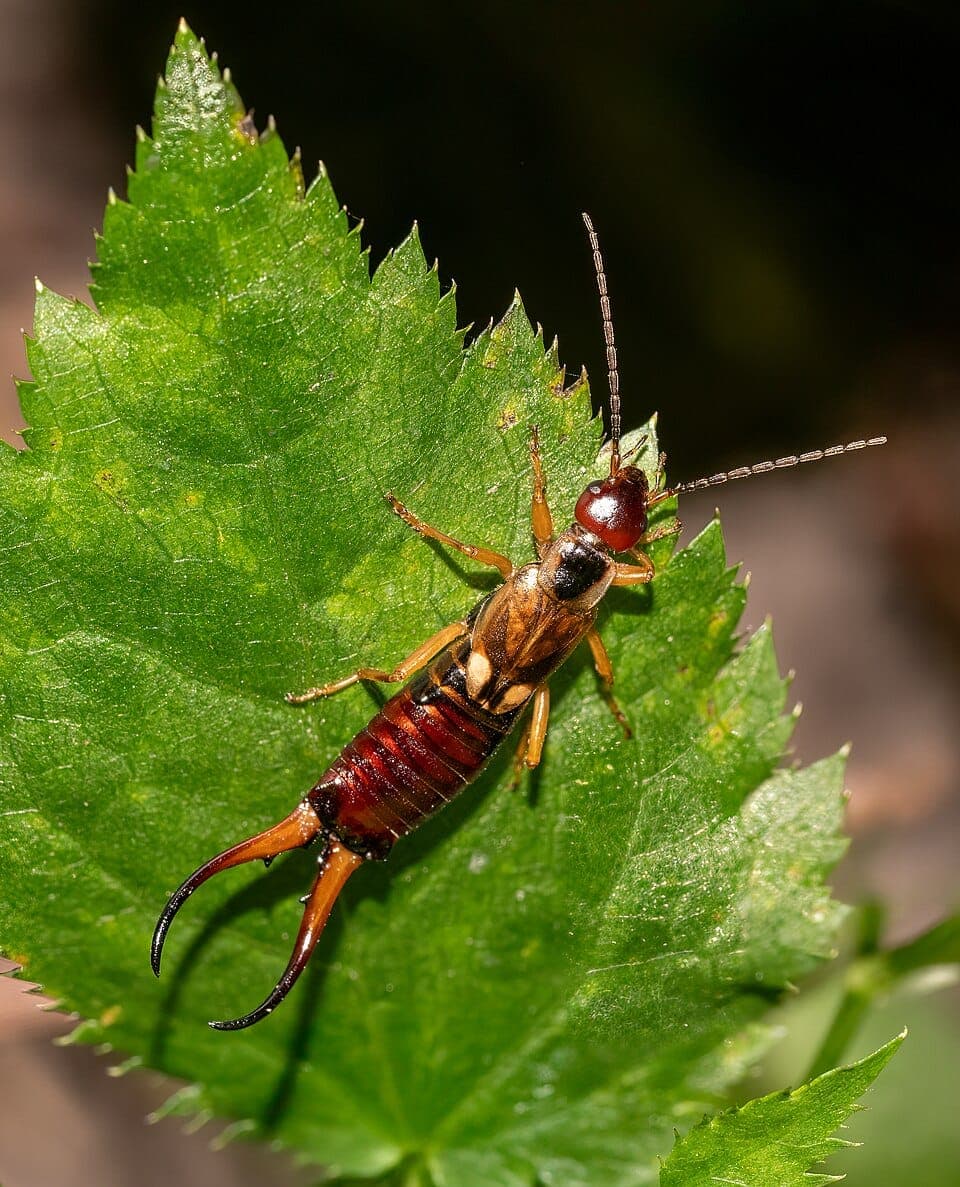
It is a classic late-summer startle: you tip up a flowerpot, pull a towel off the patio, or reach into the newspaper on the step, and a flat, shiny, reddish-brown bug darts out and vanishes into a crack — pausing just long enough to raise a pair of curved pincers off its rear like a miniature set of forceps. It looks like it means business, and its name does not help. The earwig is one of the insects people most often find suddenly sharing their home in August and September, and it is also one of the most misunderstood.
How to Identify an Earwig
Earwigs have one feature that settles the identification immediately, plus a few supporting traits:
- A pair of pincers (properly called cerci or forceps) sticking straight out from the tip of the abdomen — the single most reliable field mark
- A long, flat, narrow body, usually reddish-brown to dark brown, most commonly around a half to three-quarters of an inch long
- A distinct pair of thread-like antennae about half the body length
- Short, leathery wing covers over the middle of the back (many species can fly, but rarely do), giving the back a segmented look
- Fast, low scurrying and a strong preference for dark, damp, tight hiding spots
Those rear pincers are the giveaway. If you can see a small, elongated brown bug with forceps at the back end, you have almost certainly found an earwig and not a beetle, cockroach, or silverfish. A useful detail: males tend to have curved, caliper-like pincers, while females have straighter ones — a difference you can sometimes see with the naked eye.
Try Spotter Free on iOS & Android
Plants, animals, fungi, and rocks — all from a photo. 5 free identifications every day, no credit card required.
Are Earwigs Dangerous? And the Ear Myth
The name comes from an old European belief that earwigs crawl into people’s ears at night and burrow into the brain. It is not true. Earwigs have no interest in ears, do not tunnel into people, and pose no such threat — the myth is pure folklore. As for those intimidating pincers, they are used mainly for defense, for grappling with rivals, and for handling prey, not for attacking you. A large earwig can deliver a faint pinch if you trap it in your hand or sit on one, but it does not break the skin, does not sting, and does not transmit disease. In short, earwigs are a nuisance, not a hazard.
Why They Show Up Indoors in Late Summer
Earwigs are moisture-loving insects that spend their days hiding under mulch, leaf litter, stones, flowerpots, and boards, coming out at night to feed on decaying plant material, other small insects, and occasionally tender plants. They wander indoors mostly when conditions outside push them to — a dry spell that dries out their usual hiding spots, or heavy rain that floods them out — and they slip in through gaps around doors, foundations, and basement windows in search of the same cool, damp shelter they like outside. Reducing moisture and clutter against the house helps: move mulch, leaf piles, and compost away from the foundation, fix damp spots, and seal obvious entry gaps. Indoors they simply dry out and die; the ones you find are usually accidental wanderers rather than a colony living in your walls.
Found a flat brown bug with pincers and want to be sure it is a harmless earwig rather than something else that scurried past too fast to tell? Take a photo and let Spotter identify the insect, so you know exactly what turned up under the flowerpot.
Try Spotter Free on iOS & Android
Plants, animals, fungi, and rocks — all from a photo. 5 free identifications every day, no credit card required.