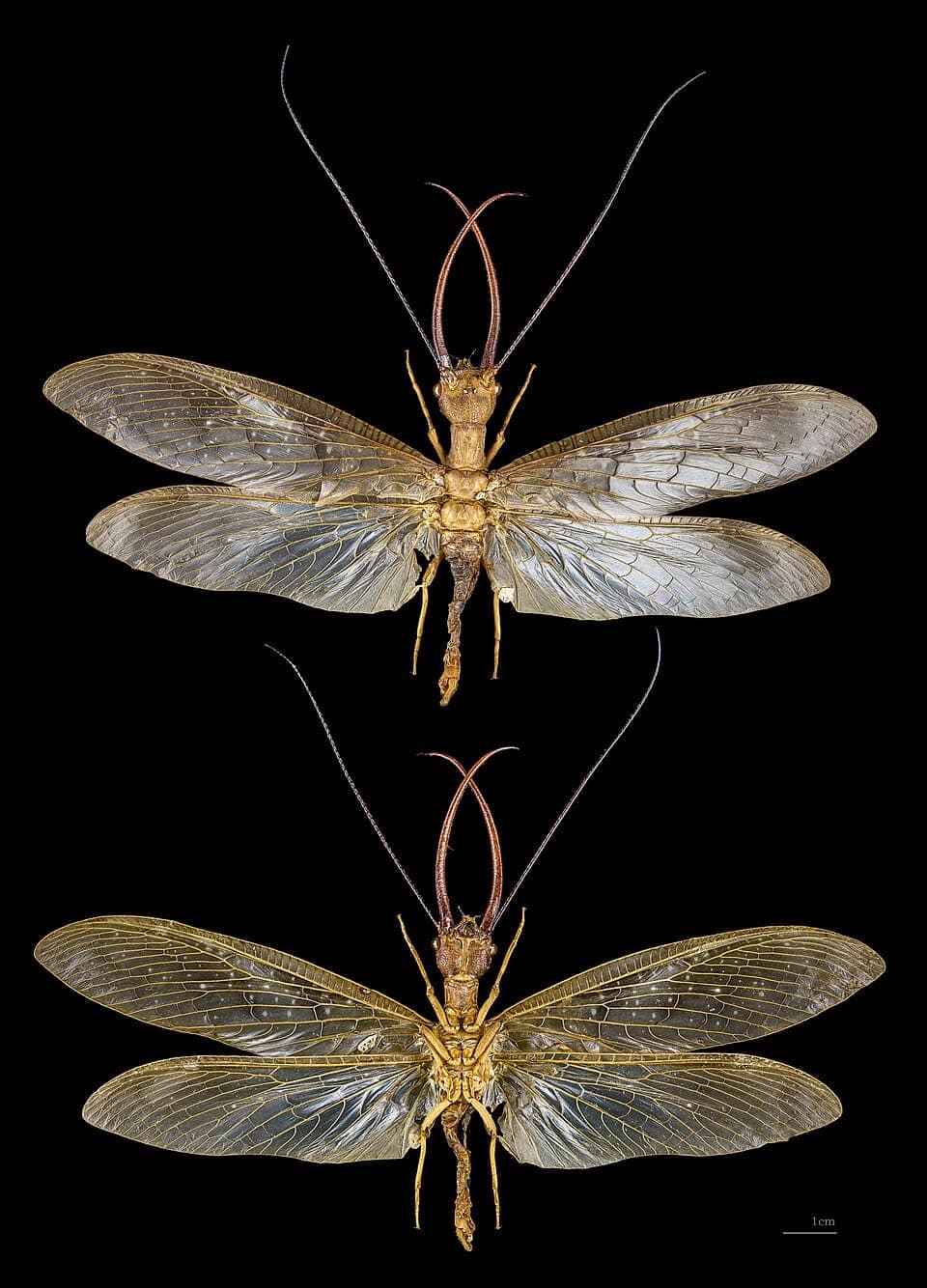
It is a warm, humid night in late summer and something enormous is fluttering around the porch light — big enough that at first glance you might mistake it for a bat or a small bird. When it finally lands you get a proper look: an insect three or four inches long, with long soft wings folded like a tent over its back, a pair of long antennae, and, on the males, a set of curved, sickle-shaped jaws jutting out ahead of the head that look genuinely menacing. It appears prehistoric and more than a little alarming. This is an eastern dobsonfly, and despite its fearsome equipment it is one of the most harmless big insects you will ever meet at a light.
How to Identify a Dobsonfly
Dobsonflies are among the largest insects in North America, and their size alone narrows things down fast. Look for this combination of traits:
- Large size: a body a couple of inches long and a wingspan that can approach 5 to 7 inches, making it one of the biggest insects you are likely to see at a light
- Long, soft wings held tent-like over the body when at rest, typically gray to grayish-brown and often faintly mottled or speckled
- A long, somewhat flattened body and thread-like antennae
- The jaws: males have dramatic, curved, sickle-like mandibles up to an inch long that arc out in front of the head; females have much shorter but stronger, business-like jaws
- Weak, fluttery flight — they are clumsy fliers that tend to bumble around lights and land heavily
Those oversized male jaws are the giveaway, and counterintuitively they are the reason to worry less, not more. They are so long and curved that they are nearly useless as weapons; males use them to grapple with rival males and to hold the female during mating, not to bite. The much shorter jaws of the female are the ones that can actually deliver a real pinch.
Try Spotter Free on iOS & Android
Plants, animals, fungi, and rocks — all from a photo. 5 free identifications every day, no credit card required.
Why Do Dobsonflies Appear at Lights in Late Summer?
The adult dobsonfly you see at the light is the brief final act of a long life spent almost entirely underwater. Dobsonflies spend most of their lives — often two to three years — as fierce aquatic larvae called hellgrammites, living under rocks in clean, fast-flowing streams and rivers where they hunt other aquatic insects. Anglers prize hellgrammites as bait, and their presence is a sign of good water quality. When they finally mature, the adults emerge near the water for just a week or so of life, during which they barely feed and focus entirely on mating. They are strongly drawn to lights, which is why a warm summer night near a stream or river can bring them thumping against porch lights, gas-station signs, and windows.
Because the adults live such a short time, sightings are seasonal and concentrated in the warm months, with late summer a common time to notice them. Finding one at your light is a good sign that there is healthy, flowing water somewhere nearby.
Can a Dobsonfly Hurt You?
Dobsonflies are not venomous, do not sting, and are not a pest — they will not damage your home, garden, or belongings, and they need no control. The only real caution is handling them: a female (and a large hellgrammite larva) can deliver a firm, surprising pinch with those short jaws if you pick her up, enough to break skin in some cases. The males, for all their intimidating hardware, cannot manage more than a harmless grip. The simplest approach is to leave the insect alone and admire it. If one blunders indoors, coax it onto a piece of paper or into a container and set it back outside rather than swatting it.
Staring at a giant, pincered insect on your screen door and not sure what you are looking at? Snap a photo and let Spotter identify the insect, so you can put a name to the visitor — and know for certain whether it is something harmless like a dobsonfly — without getting close to those jaws.
Try Spotter Free on iOS & Android
Plants, animals, fungi, and rocks — all from a photo. 5 free identifications every day, no credit card required.