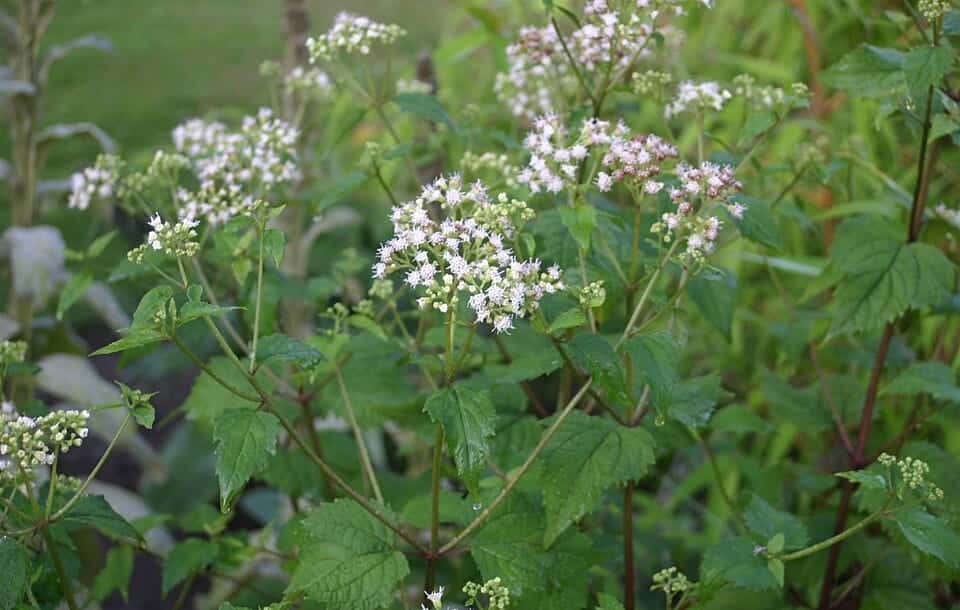
As the wildflowers of high summer fade, one plant seems to switch on along the shady borders of the woods: a bushy, waist-high mass topped with frothy, flat clusters of tiny bright-white flowers, glowing against the dark of the understory. It shows up where you would least expect a late bloomer — in the dappled shade under trees, along woodland trails, and at the edges of yards that back up to the forest, exactly where the sun-loving goldenrods and asters give out. On a still fall day the flower heads look almost luminous, and they draw in a steady traffic of small bees, flies, and butterflies. This is white snakeroot, one of the most common native wildflowers of the eastern fall — and a plant with one of the darkest histories in American botany. Here is how to identify it.
How to Identify White Snakeroot
White snakeroot (Ageratina altissima) is a member of the aster family, but instead of daisy-like rays it produces clusters of tiny, fuzzy, tubular flowers. Look for this combination of traits:
- The flowers: small, bright-white, fuzzy flower heads with no petal-like rays, packed into loose, flat-topped clusters at the top of the plant — the overall effect is a frothy white cloud
- The leaves: broad, opposite (paired) leaves that are sharply toothed along the edges, drawn out to a pointed tip, and rounded or slightly heart-shaped at the base, each on its own slender leaf stalk
- The habit: a bushy, branching plant, usually one to three feet tall, growing in shade to part shade rather than open sun
- The season and setting: blooming from late summer into fall, thriving in woodland edges, shady yards, and disturbed ground where few other fall flowers grow
- The seeds: the flowers give way to small seeds tipped with tiny white bristles that drift on the wind, letting the plant spread readily through shaded ground
A shade-loving, waist-high plant with paired toothed leaves and flat clusters of rayless white flowers in fall is the signature look. It has relatives it can be confused with — the bonesets and thoroughworts (also in genus Eupatorium and its kin) share the fuzzy white flower clusters — but those tend to grow in sunnier, wetter spots and often have stalkless or narrower leaves, while white snakeroot’s broad, toothed, distinctly stalked leaves and shady woodland-edge habitat set it apart. Because the look-alikes are close, a careful look at the leaves is worth the trouble with this particular plant.
Try Spotter free on iPhone or Android
Plants, animals, fungi and rocks from one photo. 5 free identifications every day, no card required.


A Deadly History: Milk Sickness
White snakeroot is not just another pretty fall flower — it is one of the most quietly dangerous native plants on the continent. The entire plant contains a toxin called tremetol. When cattle graze on white snakeroot, the poison passes into their milk and meat, and people who then drink that milk can be poisoned in turn — a condition nineteenth-century settlers called "milk sickness" or "the trembles." Before anyone understood the cause, milk sickness killed thousands of people across the frontier, striking whole families and emptying settlements; it is widely believed to have killed Nancy Hanks Lincoln, Abraham Lincoln’s mother, when he was a boy. The mystery was only solved when the plant was finally identified as the source, and modern dairy practices — mixing milk from many farms and keeping cows out of wooded pasture — have made human milk sickness extremely rare today.
A Word on Safety
For a backyard naturalist, white snakeroot is a plant to admire and identify, not to touch carelessly or ever taste. Every part of it is toxic if eaten, so it is worth knowing on sight if you keep livestock, and worth keeping curious children and pets from nibbling. This is an identification guide, not a foraging one: despite the "root" in its name and a history of folk uses, there is no safe home use of this plant, and it should be treated strictly as something to recognize and leave alone. That said, it is also a valuable native that feeds late-season pollinators, so where it is not a hazard to animals, it has a real place in the fall landscape — best appreciated with your eyes and a camera.
Not sure whether that cloud of little white flowers glowing at the edge of your woods is white snakeroot or one of its look-alikes? Snap a photo — of the flower clusters and the paired toothed leaves — and let Spotter help you identify it as a starting point, so you can put a name to one of fall’s most common and most storied wildflowers.
Try Spotter free on iPhone or Android
Plants, animals, fungi and rocks from one photo. 5 free identifications every day, no card required.