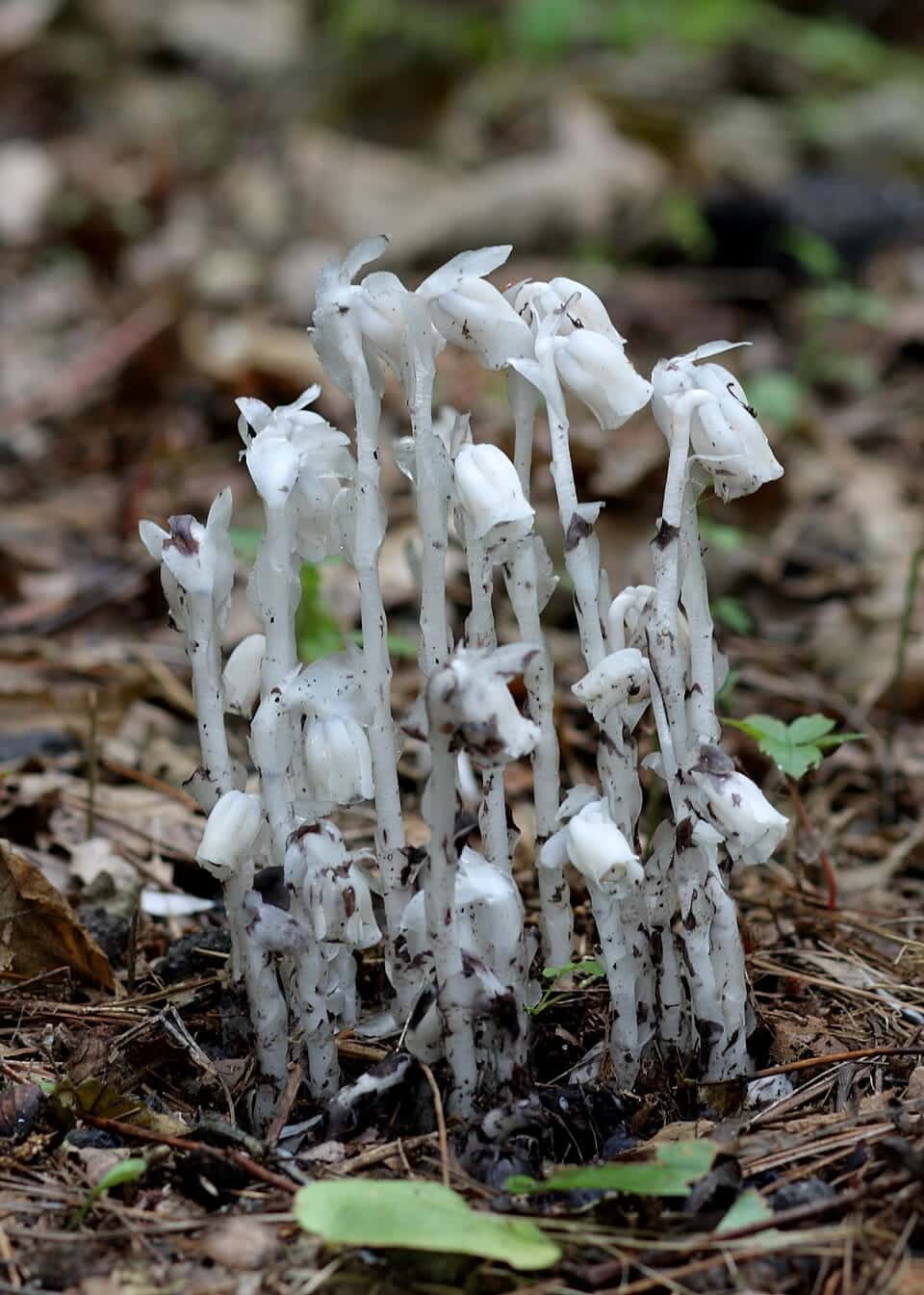
You are walking a shady trail through damp woods when a patch of white on the dim forest floor catches your eye. Up close it is genuinely strange: a small cluster of smooth, waxy stems, each two to eight inches tall and the color of candle wax or bone, every one nodding a single flower toward the ground like a little bowed smoking pipe. There is no green anywhere — no true leaves, only pale scales pressed to the stem — and the whole thing looks less like a plant than a small carving or a mushroom pretending to be a flower. This is Indian pipe (Monotropa uniflora), also called ghost plant or corpse plant, one of the most otherworldly native plants in North American woods. It is a real flowering plant, not a fungus, yet it has abandoned chlorophyll altogether and makes its living in a way almost no other plant does. Here is how to recognize it and understand what you are actually looking at.
How to Identify Indian Pipe
Nothing else in the woods looks quite like Indian pipe, and a handful of features make it unmistakable:
- The color: waxy, translucent white throughout — stem, scales, and flower — occasionally tinged with pale pink or black flecks, with no green anywhere, the single most striking trait
- The flower: a single nodding, bell-shaped flower drooping from the tip of each stem, so a fresh cluster looks like a group of small white pipes bowed toward the ground
- The lack of leaves: no true green leaves — only small, scale-like bracts clasping the stem, since the plant does not photosynthesize
- The growth: emerging in small clusters straight from the leaf litter and rich humus of shady, moist forests, often near rotting wood, from summer into early fall
- The change with age: as the flower is pollinated the stem straightens and the flower turns upward, and the whole plant eventually blackens and dries to a brittle, dark stalk
A leafless, pure-white plant with nodding pipe-shaped flowers rising from the shady forest floor is Indian pipe. Because it lacks chlorophyll it can thrive in deep shade where green plants cannot, which is why it so often appears in the darkest, dampest parts of the woods, seemingly out of nowhere after a rain.
Try Spotter free on iPhone or Android
Plants, animals, fungi and rocks from one photo. 5 free identifications every day, no card required.


A Plant That Doesn’t Eat Sunlight
The white color is the whole story. Nearly every plant is green because it is packed with chlorophyll, the pigment that captures sunlight to make sugar; Indian pipe has none, which is why it is ghostly white rather than green and why it does not need sunlight at all. So how does it eat? Indian pipe is a mycoheterotroph — a plant that steals its food through fungi. Its roots tap into the vast underground network of mycorrhizal fungi that thread through forest soil, and those same fungi are also partnered with the roots of nearby trees, trading nutrients with them. In effect, Indian pipe plugs into that fungal network and siphons off sugars that the trees originally made through photosynthesis, using the fungus as a living pipeline. It is a plant living on borrowed sunlight, three steps removed — tree to fungus to ghostly white flower — which is a genuinely rare way for a flowering plant to make a living. This dependence on a specific fungal partnership is also why Indian pipe cannot be dug up and transplanted or grown in a garden: separated from its underground network, it simply dies.
Look-Alikes and Relatives
Indian pipe has a close relative worth knowing: pinesap (Monotropa hypopitys, sometimes placed in its own genus), which grows the same ghostly way but is yellowish to reddish-tan rather than pure white and carries several flowers per stem instead of a single nodding one. People also sometimes mistake Indian pipe for a mushroom at a glance, given its pale, fleshy look and shady habitat — but a close look shows an obvious stem, scale-leaves, and a true flower with petals, not a cap and gills. And it should not be confused with the white, coral-like or club-shaped fungi that share the same forest floor. When you see nodding, pipe-shaped white flowers on leafless waxy stems, you have the real thing.
Should You Touch or Pick It?
The kindest thing to do with Indian pipe is to admire it and leave it be. The plant bruises and blackens almost as soon as it is handled or picked, so a picked stem quickly turns to an unlovely dark smear and cannot be kept — and because it depends entirely on that hidden fungal network, it will not survive being moved. It is not a plant to gather. As with any unfamiliar wild plant, do not eat it or assume anything about it based on folklore or a resemblance; enjoy it purely as one of the strangest and most beautiful sights the shady woods have to offer, and let the next hiker discover it too.
Found a cluster of ghostly white, leafless stems nodding on the forest floor and want to confirm what it is? Snap a clear photo of the whole plant — stem, scales, and flowers — and let Spotter help you identify it as a starting point for learning about one of the woods’ most remarkable plants.
Try Spotter free on iPhone or Android
Plants, animals, fungi and rocks from one photo. 5 free identifications every day, no card required.