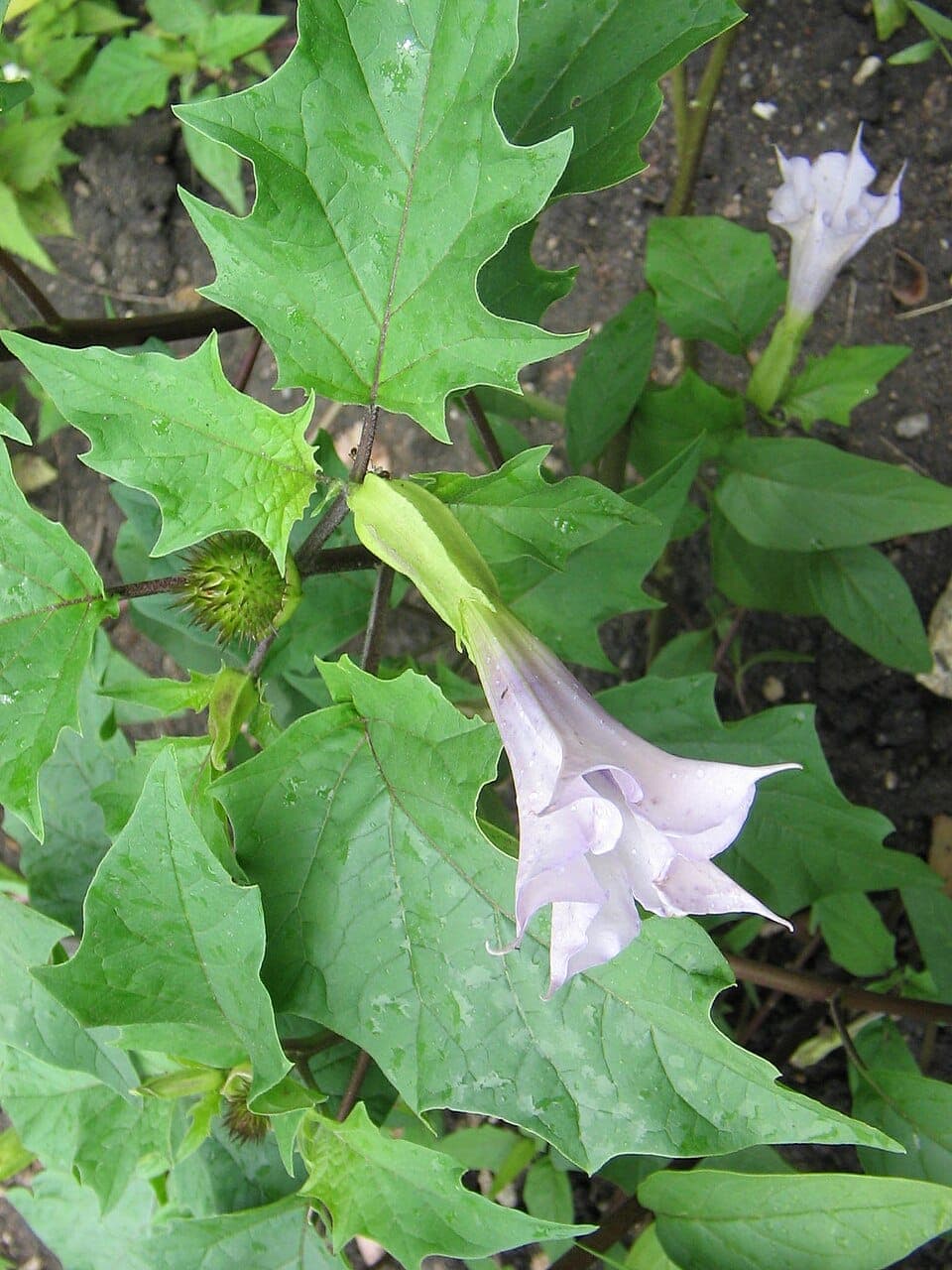
You spot it along a fence line, at the edge of the garden, or in a patch of freshly disturbed soil: a big, coarse weed, waist-high or taller, with jagged-toothed leaves and showy trumpet-shaped flowers — white, sometimes tinged lavender — that seem to open toward evening. A little later the flowers give way to distinctive egg-shaped pods bristling with sharp spines. This is jimsonweed, and it prompts a lot of late-summer searches because it is genuinely eye-catching. It is also important to know before you get too close: jimsonweed is highly poisonous in every part, so this is a plant to identify and admire from a respectful distance, not to handle casually.
How to Identify Jimsonweed
Jimsonweed (Datura stramonium) — also called thorn apple, devil’s trumpet, or Jamestown weed — has a combination of features that make it fairly recognizable:
- Flowers: large, funnel- or trumpet-shaped blooms 2–4 inches long, white to pale purple, often opening in the evening and closing in the heat of the day
- Seed pods: egg-shaped capsules about an inch or two across, covered in stiff sharp spines (the "thorn apple"), which split open when ripe to spill many small dark seeds
- Leaves: large, soft, and coarsely toothed with an irregular jagged edge, dark green, giving off a rank, unpleasant odor when crushed
- Stem and habit: stout, branching, often purple-tinged, growing knee-high to well over head-high in a single season
- Where it grows: disturbed ground — field edges, barnyards, roadsides, overgrazed pastures, gardens, and construction-disturbed soil — flowering from mid-to-late summer until frost
The pairing of dramatic evening trumpet flowers with spiny, egg-shaped pods and a foul smell is the giveaway. Few common weeds combine all three.
Why Jimsonweed Is Dangerous (Read This Part)
Every part of jimsonweed — leaves, flowers, stems, roots, and especially the seeds — contains potent tropane alkaloids (such as atropine, hyoscyamine, and scopolamine). Ingesting any part can cause serious poisoning, with symptoms that may include a racing heart, dilated pupils, flushed skin, confusion, hallucinations, seizures, and, in severe cases, death. Poisonings most often happen when people mistakenly treat it as an edible or medicinal plant, when children are drawn to the interesting pods and seeds, or when livestock graze it. This is not a plant to experiment with in any way — there is no safe home preparation of it, and the margin between doses is dangerously unpredictable.
Because of that, the safest approach is simple: do not eat, taste, brew, or otherwise ingest any part of jimsonweed, keep children and pets away from it, and if you suspect anyone has ingested it, treat it as an emergency and contact Poison Control or emergency services immediately. If you want to remove it from your property, wear gloves and long sleeves, avoid touching your face, pull or dig it before the pods release seeds, and wash up afterward.
Try Spotter Free on iOS & Android
Plants, animals, fungi, and rocks — all from a photo. 5 free identifications every day, no credit card required.
Jimsonweed Look-Alikes
A few plants share some of jimsonweed’s features, which is exactly why careful identification matters:
- Ornamental datura and moonflower (angel’s trumpet relatives): close cousins grown in gardens for their big trumpet flowers — also toxic, so the same caution applies
- Cocklebur: another weed of disturbed ground with spiny burs, but its burs are smaller and football-shaped and it lacks the big trumpet flowers
- Bindweed and morning glory: true trumpet-shaped flowers, but on thin twining vines, with no spiny pods and no rank odor
Not sure whether the trumpet-flowered weed at the edge of your yard is jimsonweed or a harmless look-alike? Snap a photo from a safe distance and let Spotter identify it as a starting point — and when a plant might be toxic, treat identification as a reason for caution, never a green light to handle or taste it.
Try Spotter Free on iOS & Android
Plants, animals, fungi, and rocks — all from a photo. 5 free identifications every day, no credit card required.