
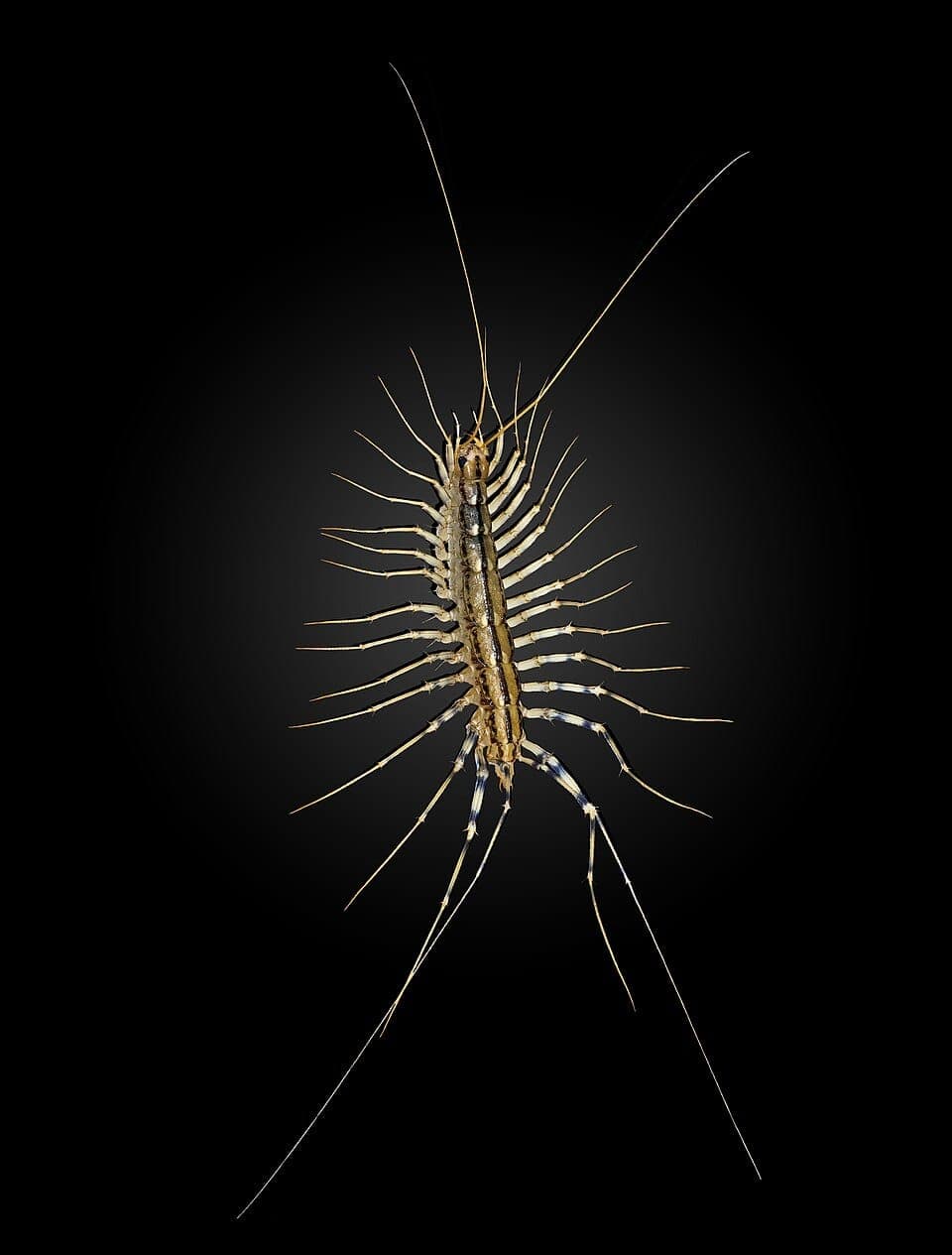
Few household encounters produce a faster jump than this one: you walk into the bathroom or basement at night, turn on the light, and a spindly, many-legged creature bursts across the wall or floor in a rippling blur and disappears into a crack before your brain has finished processing it. The speed and the sheer number of legs make it look far more menacing than almost anything else you find indoors. Nine times out of ten, the culprit is a house centipede — a leggy, fast-moving predator that is genuinely harmless and is often a sign of nothing worse than a little dampness.
How to Identify a House Centipede
The house centipede (Scutigera coleoptrata) looks unlike anything else that turns up in the home, which makes it easy to recognize once you know the marks:
- A flattened, yellowish to grayish-tan body only about an inch to an inch and a half long, with three dark stripes running lengthwise down the back
- 15 pairs of very long, thin legs that get longer toward the rear, rippling in waves as it runs
- A back pair of legs so long they look like a second set of antennae, making it genuinely hard to tell head from tail
- Extremely fast, almost liquid movement — it can cover more than a foot per second in short bursts
- A habit of appearing in damp rooms: bathrooms, basements, laundry rooms, and closets, usually at night
That combination — a striped, flattened body with a fringe of impossibly long legs and blistering speed — separates it from millipedes (which are slow, round-bodied, and curl up when disturbed) and from insects, which have six legs, not dozens. If it looked like a "bug made of eyelashes" moving faster than you could track, it was a house centipede.
Try Spotter Free on iOS & Android
Plants, animals, fungi, and rocks — all from a photo. 5 free identifications every day, no credit card required.
Are House Centipedes Dangerous?
For all the alarm they cause, house centipedes are essentially harmless to people. They are shy and want nothing to do with you — the frantic dash you see is the animal trying to escape, not attack. Technically they are predators with venom they use on small prey, but their fang-like mouthparts are tiny and struggle to break human skin; bites are very rare and, in the uncommon event one happens, usually amount to little more than a minor pinch. They do not damage your home, your food, or your belongings, and they carry no disease. In fact, they earn their keep: house centipedes hunt and eat other household pests, including cockroach nymphs, silverfish, ants, and small spiders. A house centipede is, in a real sense, free pest control that happens to be terrifying to look at.
Why One Showed Up Indoors
House centipedes are drawn to moisture and to prey, so an indoor sighting usually points to a damp spot and a supply of other small insects to eat. They favor humid, undisturbed places — under sinks, in floor drains, behind stored boxes, in basements and crawlspaces. If you would rather not share the house with them, the fixes are the same ones that discourage most damp-loving invaders: run a dehumidifier or fan in chronically damp rooms, fix leaks, reduce clutter where they hide, and seal gaps around pipes, doors, and the foundation. Cut down the moisture and the other bugs they feed on, and the centipedes tend to move on for lack of a reason to stay.
Caught a glimpse of something fast and many-legged and want to be sure it was a harmless house centipede and not something else? If you can manage a photo before it vanishes, let Spotter identify it, so you know exactly what shares your basement.
Try Spotter Free on iOS & Android
Plants, animals, fungi, and rocks — all from a photo. 5 free identifications every day, no credit card required.