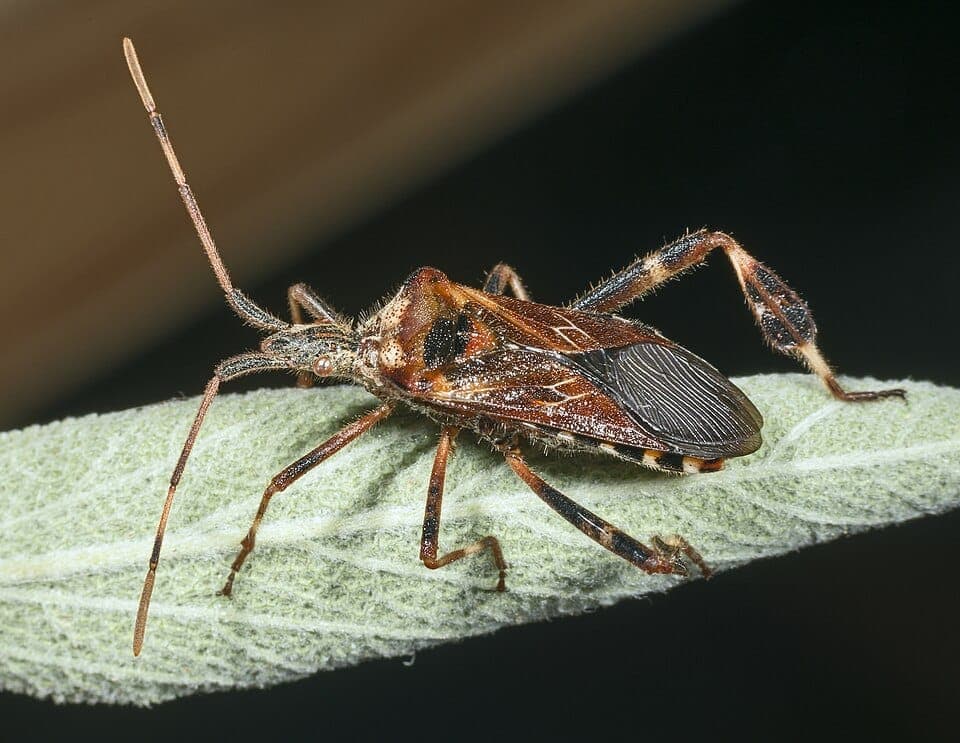
It is a classic late-summer and fall "what is this bug?" moment: a big, narrow brown insect about an inch long lands with a clumsy buzz on the sunny wall of your house, clings to a window screen, or turns up on your tomato or squash plants — and when you look closely, its back legs have strange little flattened flares that look like tiny leaves or paddles. This is a leaf-footed bug, named for exactly that feature, and across much of North America the one that starts trying to get indoors as the weather cools is usually the western conifer seed bug. Here is how to identify it and why it appears now.
How to Identify a Leaf-Footed Bug
Leaf-footed bugs are a group of true bugs (family Coreidae) that share an easy-to-spot body plan once you know what to look for:
- The size and shape: large for a common yard bug, roughly three-quarters of an inch to an inch long, narrow and elongated, and often looking a bit pointed at both ends
- The legs: the giveaway — the hind legs have a widened, flattened, leaf- or blade-shaped section on the lower segment, like a little paddle on each back leg
- The color: usually dull brown to grayish or reddish-brown; the western conifer seed bug adds a faint, thin, pale zigzag line across the middle of its back
- The antennae: long and thin, nearly as long as the body, with a slight kink or clubbed tip
- The flight and sound: a slow, heavy, buzzing flight, and a habit of basking on warm, sunlit surfaces on cool afternoons
The flattened, leaf-like hind legs are the single most reliable field mark. No other common household-invading bug has them, so once you spot those little paddles on the back legs, you can be confident you are looking at a leaf-footed bug rather than a beetle, a roach, or something to worry about.
Try Spotter Free on iOS & Android
Plants, animals, fungi, and rocks — all from a photo. 5 free identifications every day, no credit card required.
Leaf-Footed Bug vs. Stink Bug vs. Kissing Bug
Leaf-footed bugs are frequently confused with a few other insects, some harmless and one that causes a lot of needless alarm. Here is how to keep them straight:
- Brown marmorated stink bug: shorter, wider, and shield-shaped with a broad flat back, no leaf-shaped legs, and alternating light-and-dark banding along the edge of the abdomen and antennae; leaf-footed bugs are longer and narrower with those paddle legs
- Kissing (assassin) bugs: the scary look-alike people fear because a few species can transmit disease, but kissing bugs are more teardrop-shaped, often have flat orange-and-black banding around the abdomen edge, and lack the flattened leaf legs — the leg flares are your quick reassurance that you have the harmless bug
- Squash bugs: related and also garden pests, but smaller, flatter, and without the pronounced leaf-shaped hind legs
- Wheel bug and other assassin bugs: predatory true bugs, but distinguished by a spiny "cogwheel" crest on the back or a slender snout, not paddle legs
That comparison matters mostly for peace of mind: a leaf-footed bug is not a kissing bug and is not a threat to you or your home. It does not bite people, sting, feed on your house, spread disease, or reproduce indoors.
Why It Shows Up in Late Summer and Fall
Through the summer, leaf-footed bugs feed outdoors by piercing plants with their straw-like mouthparts — the western conifer seed bug drains developing seeds inside pine and other conifer cones, while other species sip on tomatoes, squash, and a range of fruits and ornamentals. As nights turn cool in late summer and fall, the adults look for a sheltered, frost-free place to spend the winter. Warm, sun-facing walls draw them in, and after dark they slip through gaps around siding, eaves, windows, and the foundation into wall voids and attics — the same overwintering strategy used by boxelder bugs, Asian lady beetles, brown marmorated stink bugs, and cluster flies.
Indoors they are a harmless nuisance rather than a pest: they will not damage anything, but if you handle or squash one it can release a piney, pungent odor from its scent glands, so the tidiest approach is to sweep or vacuum them up or gently carry them back outside, and to seal cracks and gaps to keep the next ones out. Out in the garden, leaf-footed bugs feeding on fruit can cause cosmetic damage, but a few of them are nothing to panic over.
Not sure whether the big brown bug on your window screen is a leaf-footed bug, a stink bug, or something else entirely? Snap a photo and let Spotter identify it as a starting point — and let the little leaf-shaped legs put your mind at ease.
Try Spotter Free on iOS & Android
Plants, animals, fungi, and rocks — all from a photo. 5 free identifications every day, no credit card required.