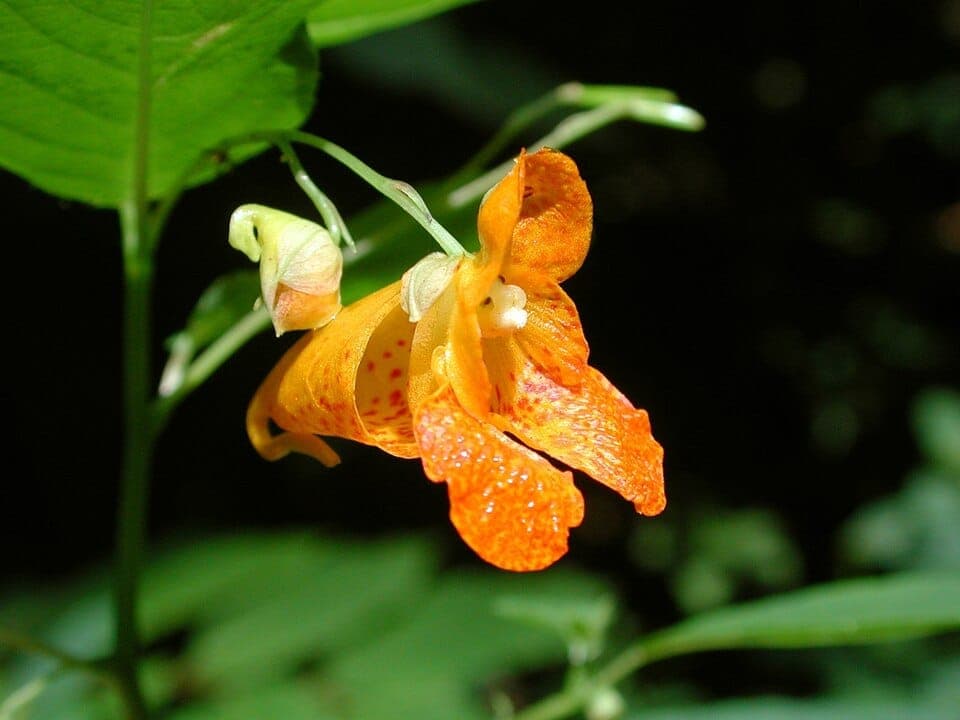
Walk along a shady stream bank, a wet ditch, or the damp edge of a woodland in late summer and you may push through a stand of tall, soft, watery-stemmed plants hung with small orange flowers — each one shaped like a little cornucopia or hanging trumpet, freckled with reddish-brown spots and dangling on a thin stalk. Touch one of the fat, ripe green seed pods and it snaps and coils in an instant, flinging seeds several feet in every direction. This is jewelweed, also known as spotted touch-me-not, and it is one of the most delightful and recognizable wildflowers of the late-summer wetland edge. Here is how to identify it.
How to Identify Jewelweed
The most common species across the eastern and central states is spotted jewelweed (Impatiens capensis), a native annual in the same family as garden impatiens. Look for this combination of traits:
- The flowers: small, roughly one inch long, orange to orange-yellow and speckled with reddish-brown or dark orange spots, shaped like a horn or cornucopia with a curled nectar spur at the back, hanging from slender stalks along the upper stems
- The stems: pale green, smooth, hairless, and noticeably succulent — juicy and almost translucent, so soft they crush easily and ooze a watery sap when broken
- The leaves: oval with softly toothed edges, one to three inches long, alternate along the stem, often bluish-green and slightly waxy so water beads up and rolls off in silvery droplets — the shimmer that likely gives "jewelweed" its name
- The height and habit: two to five feet tall, often forming dense colonies that lean and sprawl together in a soft, leafy tangle
- The seed pods: slender green capsules that swell as they ripen and burst open at the lightest touch, springing into coils and scattering seeds — the "touch-me-not" trick
A close relative, pale jewelweed (Impatiens pallida), looks nearly identical but has larger, clear yellow flowers with few or no spots, and tends to grow in richer, shadier woods. Both share the same juicy stems, the same water-beading leaves, and the same exploding pods, so either one is easy to place as a jewelweed.
Try Spotter Free on iOS & Android
Plants, animals, fungi, and rocks — all from a photo. 5 free identifications every day, no credit card required.
Where and When You Find It
Jewelweed is a plant of wet feet and shade. It thrives in the moist, low ground along streams, springs, seeps, pond and marsh margins, roadside ditches, and the damp edges of woods, often in the same places you find poison ivy, stinging nettle, and other rich-soil plants. It is an annual, sprouting fresh each spring, growing fast through summer, blooming from about midsummer into fall, and dying back with the first hard frost. Because it reseeds itself so heavily — with a little help from those spring-loaded pods — it usually returns to the same damp patches year after year in ever-larger colonies.
Those hanging orange flowers are also a magnet for pollinators. Bumblebees back into the horn-shaped blooms to reach the nectar spur, and jewelweed is a well-known favorite of ruby-throated hummingbirds, whose fall migration overlaps neatly with the plant’s peak bloom. A streamside stand of jewelweed buzzing with bees and visited by hummingbirds is one of the small pleasures of a late-summer walk.
Why the Seed Pods Explode
The "touch-me-not" name comes from the plant’s remarkable way of spreading its seeds. As each narrow pod ripens, tension builds along its walls. The slightest disturbance — a raindrop, a passing animal, or a curious finger — triggers the pod to split and curl back on itself explosively, catapulting the seeds several feet away from the parent plant. It is one of the easiest bits of botany to demonstrate to a child, and endlessly satisfying: brush a ripe pod and feel it pop and squirm in your hand. This built-in slingshot is exactly why jewelweed forms such dense, expanding colonies along the water’s edge.
The Folklore About Jewelweed Sap
Jewelweed has a long folk reputation as a soothing remedy: the crushed, juicy stems are traditionally rubbed on the skin to calm the itch of poison ivy, stinging nettle, and insect bites, and it often grows conveniently right beside the poison ivy it is said to counter. Scientific results are mixed — some studies find little effect from the sap against poison-ivy oil beyond simply washing the area — so treat this as interesting folklore rather than proven medicine, and see a doctor for any serious or spreading rash. This is an identification guide, not a foraging or medical one: jewelweed is not a wild food, and you should never eat a wild plant based on an app, a photo, or an article. The safe way to enjoy jewelweed is to admire the flowers, pop a few pods, and leave it at that.
Not sure whether the orange, spotted, trumpet-shaped flowers along your favorite creek are jewelweed, or whether the leafy plant beside them is poison ivy or stinging nettle? Snap a photo and let Spotter identify the plant as a starting point — a good habit any time you are poking around a damp, brushy streambank.
Try Spotter Free on iOS & Android
Plants, animals, fungi, and rocks — all from a photo. 5 free identifications every day, no credit card required.