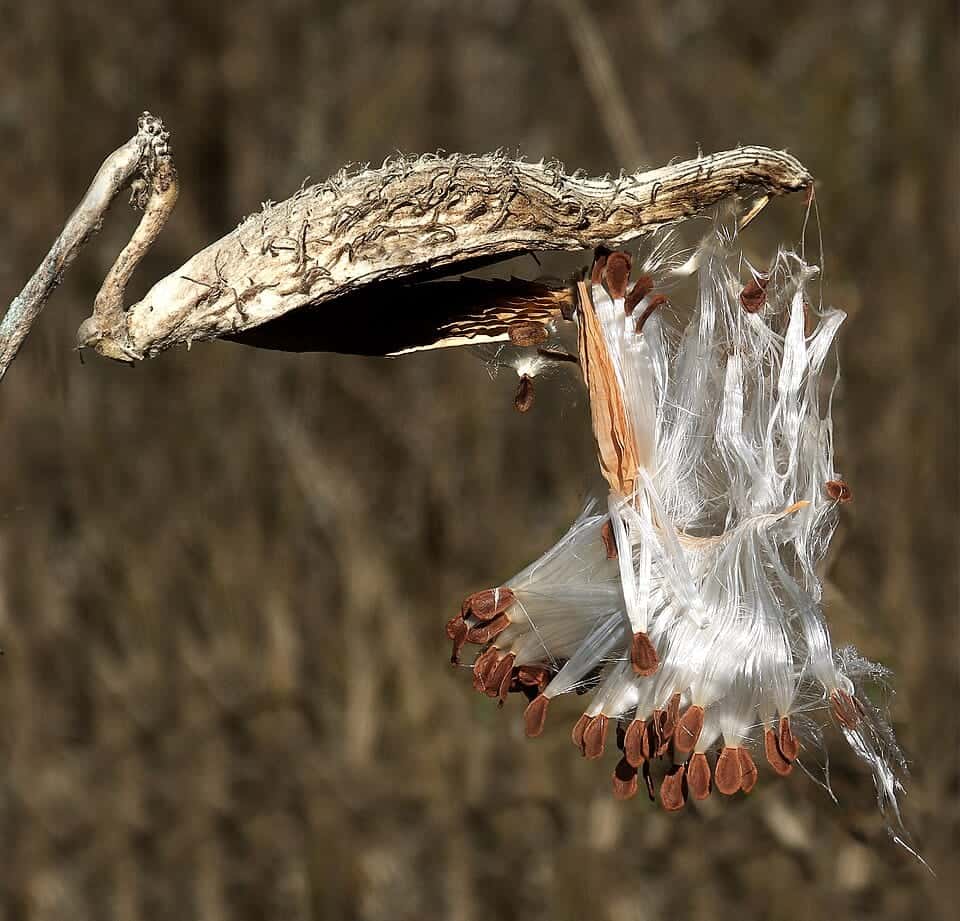
You notice them along a roadside, in a meadow, or in the back of a garden bed: plump, teardrop-shaped pods, three to five inches long, standing upright on tall stems. Then, as the weeks cool, they begin to split. Each pod cracks open along a single seam and spills out a cloud of flat brown seeds, every one attached to a tuft of fine, silky-white floss that catches the wind and carries the seed drifting through the air. The empty pods curl back like little canoes, and the silk collects on grass and fences downwind. It is one of the most familiar images of late summer and fall — and the plant is milkweed, the single most important host plant for monarch butterflies. Here is how to identify it.
How to Identify Milkweed
Common milkweed (Asclepias syriaca) is the most widespread of a large family of native plants, and its fall pods are the giveaway, but the whole plant is distinctive across the season. Look for this combination of traits:
- The pods: teardrop- or spindle-shaped green follicles, three to five inches long, often bumpy or warty on the surface and frequently growing in pairs, that dry to gray-brown and split along one seam
- The seeds and floss: flat, brown, overlapping seeds packed inside, each tipped with a tuft of silky white "parachute" hairs (the pappus) that expand and lift the seed away on the wind when the pod opens
- The leaves: large, broad, oval leaves in opposite pairs up a stout stem, with a pale midrib and a smooth or slightly velvety underside
- The milky sap: broken leaves and stems ooze a thick, sticky white latex — this "milk" is the source of the name and a strong confirming clue
- Earlier in the year: rounded clusters (umbels) of pink-to-mauve, sweetly fragrant flowers in early to mid summer, which become the pods you see splitting open in fall
A stout plant hung with warty, teardrop pods that split to release silk-borne seeds — with broad paired leaves that bleed milky sap when broken — is unmistakable once you have seen it. There are many milkweed species across the country (swamp, showy, and butterfly milkweed among them) with narrower leaves or different flower colors, but the paired leaves, milky sap, and floss-filled pods run through the group.
Try Spotter free on iPhone or Android
Plants, animals, fungi and rocks from one photo. 5 free identifications every day, no card required.


Why Milkweed Matters
Milkweed is not just a roadside weed — it is the entire foundation of the monarch butterfly’s life cycle. Monarch caterpillars can eat nothing else: the females lay their eggs only on milkweed, and the caterpillars grow up feeding on its leaves, storing the plant’s bitter compounds in their bodies to make themselves distasteful to predators. No milkweed means no monarchs, which is why the loss of milkweed across farmland and roadsides is one of the main reasons monarch numbers have fallen. The flowers also feed a huge range of bees, butterflies, and other pollinators through the summer, and a whole cast of specialist insects — milkweed bugs, milkweed beetles, and tussock moth caterpillars — lives on the plant. Those floss-filled pods splitting in the fall are the plant seeding the next generation, and many gardeners deliberately scatter or plant the seeds to grow more monarch habitat.
A Note on the Sap
The milky sap that helps identify milkweed is also mildly toxic and can irritate skin and especially eyes, so it is worth handling broken stems with care and washing your hands after — a good reason to keep curious children and pets from chewing on the plant. This is an identification guide, not a foraging one: milkweed has a long history of traditional uses, but various parts are toxic if prepared or eaten wrong, so treat it as a plant to admire, grow for monarchs, and photograph rather than sample. If you want to help monarchs, the best move is simply to let established milkweed stand and consider planting a species native to your region.
Not sure whether the pod-bearing plant spilling silky seeds along your fence line is common milkweed or something else? Snap a photo — of the pods, the paired leaves, or the summer flowers — and let Spotter help you identify it as a starting point, so you know whether you are looking at monarch habitat worth protecting.
Try Spotter free on iPhone or Android
Plants, animals, fungi and rocks from one photo. 5 free identifications every day, no card required.