You are walking a field edge, old fencerow, or roadside in early fall when a scrubby shrub stops you: it is absolutely dripping with small round red berries, and when the wind turns its leaves you catch a flash of silvery-white on the undersides. Lean in and you will see the berries are not plain red at all — they are dusted with tiny silver and brown speckles, as if flecked with metallic paint. This is autumn olive (Elaeagnus umbellata), an Asian shrub introduced to the United States long ago for erosion control and wildlife plantings that has since become one of the most aggressive invasive shrubs across much of the East and Midwest. It fruits heavily in September and October, which is exactly why it seems to appear out of nowhere this time of year. Here is how to identify it.
How to Identify Autumn Olive
A few features together make autumn olive fairly easy to recognize, especially in fruit:
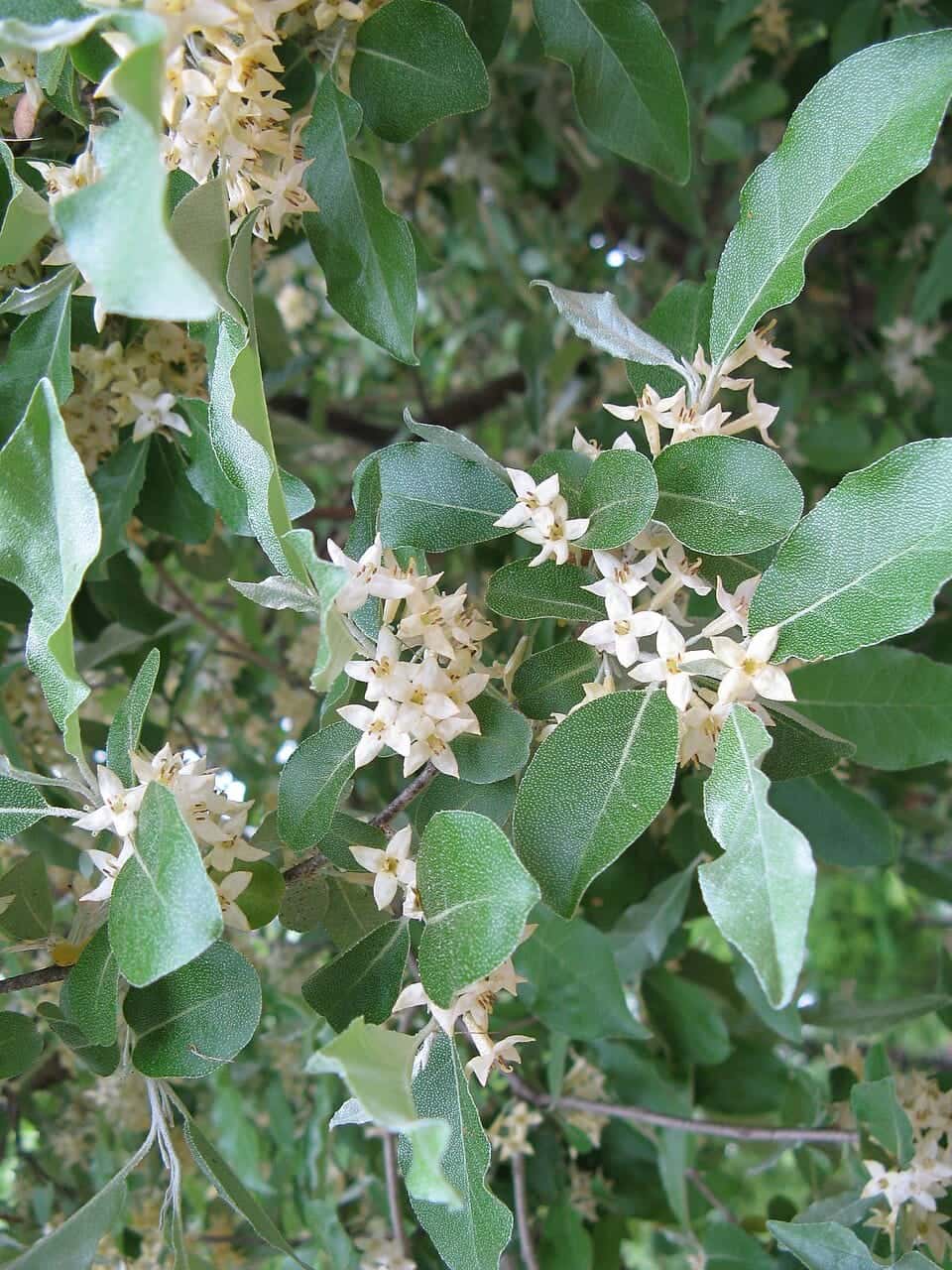
- The leaves: oval with a slightly wavy edge, 1 to 3 inches long, dull grayish-green above and distinctly silvery-white and scaly beneath — the flashing silver underside in a breeze is the classic tell
- The berries: small and round, about a quarter inch, ripening from silvery-pink to speckled red in fall, densely covered in tiny silver or brown scales that give them a dotted, metallic look
- The twigs: young twigs are silvery to golden-brown and scaly, often with sharp thorns or spur-like spines along the branches
- The form: a sprawling, multi-stemmed shrub up to 10 to 20 feet tall and often just as wide, growing in full sun along field edges, fencerows, old pastures, roadsides, and disturbed ground
- The spring flowers: earlier in the year it bears clusters of small, pale-yellow, strongly fragrant tubular flowers — a sweet scent many people notice before they ever spot the shrub
A sun-loving shrub with silvery-backed leaves and a heavy crop of small, silver-speckled red berries in fall is almost certainly autumn olive. The dotted, scaly coating on both berries and leaf undersides is the feature that separates it from native shrubs with red fall fruit.
Try Spotter free on iPhone or Android
Plants, animals, fungi and rocks from one photo. 5 free identifications every day, no card required.


Why It Spreads So Aggressively
Autumn olive is a textbook invasive because it does everything fast. A single mature shrub can produce enormous quantities of fruit — tens of thousands of seeds in a year — and birds and other wildlife eat the berries and scatter the seeds far and wide. On top of that, it is a nitrogen fixer, meaning it can enrich and colonize poor, disturbed soils where many native plants struggle, letting it march into old fields and open woodlands. Once established, it forms dense thickets that shade out native shrubs and wildflowers and change the character of grasslands and forest edges. Cut it down and it resprouts vigorously from the stump, which is why it is so hard to control. For all these reasons, many states list it as invasive and discourage planting it.
Native and Look-Alike Shrubs
A few other shrubs bear red fall fruit and can cause confusion:
- Russian olive (Elaeagnus angustifolia): a close relative with much narrower, more silvery leaves and dry, olive-like yellowish fruit; also invasive, more common in the West
- Winterberry holly: a native shrub with glossy green (not silver-backed) leaves and bright red berries clinging to bare stems into winter
- Native honeysuckle and viburnum shrubs: various species with red fall berries but green leaves lacking the silvery, scaly underside of autumn olive
A note on the berries: autumn olive fruit is sometimes gathered by foragers, but as with any wild plant, never eat something you cannot identify with complete certainty, and treat any wild-food question as one for a knowledgeable local expert rather than a photo or an app. If you are dealing with autumn olive on your own property, your state’s invasive-species or extension resources can point you to control methods that fit your situation.
Not sure whether that berry-laden shrub is autumn olive, a native look-alike, or something else? Photograph the leaves, twigs, and fruit and let Spotter help you identify the plant, so you know whether you are looking at a native shrub or an invasive worth keeping an eye on.
Try Spotter free on iPhone or Android
Plants, animals, fungi and rocks from one photo. 5 free identifications every day, no card required.