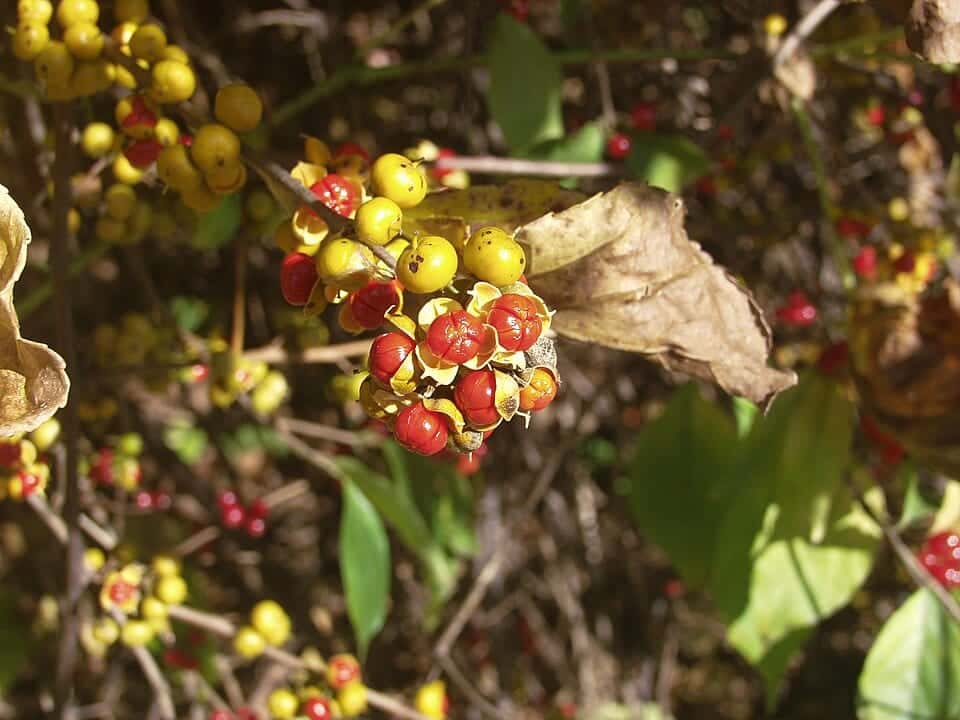
It is one of the prettiest things you will notice on a fall walk: a woody vine draped over a fence line, a roadside thicket, or high into a tree, suddenly conspicuous because it is covered in beads of color. The berries start as small yellow-orange capsules, then split open into three parts to reveal a shiny scarlet-red seed inside each one, so the whole vine seems studded with orange-and-red ornaments. People clip it for wreaths and autumn arrangements every year. But that beauty is a warning sign: across much of North America this is Oriental bittersweet, one of the most damaging invasive vines on the continent, and telling it from the native American bittersweet it is crowding out is worth doing. Here is how to identify it.
How to Identify Oriental Bittersweet
Oriental bittersweet (Celastrus orbiculatus) is a deciduous, twining woody vine introduced from East Asia that now blankets fields, forest edges, and trees across the eastern and central states. Look for this combination of traits:
- The berries: rounded fruits scattered all along the stems, ripening from green to a yellow-orange husk that splits into three to expose a fleshy scarlet-red seed — most striking after the leaves drop in fall
- The berry placement: this is the key mark — Oriental bittersweet’s fruits grow in small clusters at the leaf joints (axils) all along the length of the stem, not just at the tips
- The husk color: the outer capsule around the red seed is yellow to yellow-orange
- The leaves: roundish and glossy, finely toothed, alternate along the stem, turning clear yellow in fall before dropping
- The vine itself: a twining woody climber that wraps around trunks and other stems, reaching high into trees, with older vines becoming thick, rope-like, and heavy
A vine covered in orange-and-red split berries all along its stems, climbing a tree or fence in fall, is the signature look. The berries are the reason it spreads so fast: birds eat them and drop the seeds far and wide, and the cut vines used in decorations sprout new infestations when tossed outdoors.
Try Spotter free on iPhone or Android
Plants, animals, fungi and rocks from one photo. 5 free identifications every day, no card required.


Oriental vs. Native American Bittersweet
North America has its own native bittersweet, American bittersweet (Celastrus scandens), which is far less aggressive and increasingly rare partly because the invasive one hybridizes with and displaces it. Because they look similar, the two are easy to mix up, but a few features separate them:
- Berry location: the biggest tell — American bittersweet carries its fruit in a single cluster at the very tip of each stem, while Oriental bittersweet has berries in many small clusters spaced all along the stem at the leaf joints
- Husk color: American bittersweet’s capsules are orange to orange-red; Oriental’s are more yellow to yellow-orange
- Abundance: an American bittersweet vine holds a modest terminal bunch of berries, whereas an Oriental vine is often loaded with fruit up and down every stem
- Leaf shape: American bittersweet leaves tend to be more elongated and tapered, Oriental leaves rounder — a softer clue than the berry placement
The quickest rule: berries only at the branch tips point to the native American bittersweet, while berries strung all along the stems point to invasive Oriental bittersweet. When you can see where the fruit sits, you can usually tell them apart with confidence.
Why It Matters
Oriental bittersweet is not just a vigorous climber — it is a tree-killer. Its heavy vines twine tightly around trunks and can girdle and strangle them, cutting off the flow of nutrients, while the sheer weight of a mature vine and its dense canopy of leaves shades out and can topple even large trees. On the ground it forms smothering thickets that crowd out native shrubs and wildflowers. Because birds spread the seeds so effectively and cut stems resprout readily, it moves into new ground fast. If you find it on your property, the responsible move is to avoid spreading it: do not plant it, do not use the fruiting vines in wreaths or decorations that later get tossed outside, and consider cutting and removing vines before the berries ripen. Many regions list it as a noxious or invasive species, so it is worth checking local guidance on the best way to control it.
Not sure whether the orange-berried vine climbing your fence or trees is invasive Oriental bittersweet or the native American kind? Snap a photo — ideally showing where the berries sit along the stem — and let Spotter help you identify the plant as a starting point, so you know whether you are looking at a native to protect or an invader to remove.
Try Spotter free on iPhone or Android
Plants, animals, fungi and rocks from one photo. 5 free identifications every day, no card required.