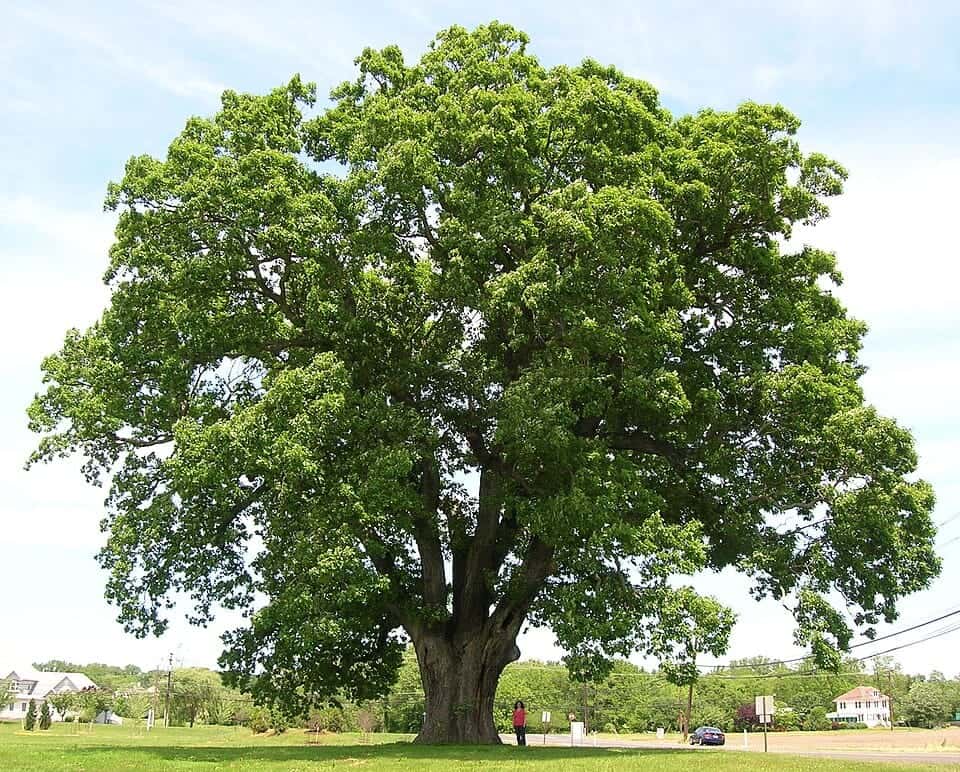
Oaks are the backbone of forests and yards across much of North America, and in fall they make themselves impossible to ignore: acorns rattle down onto sidewalks and rooftops, and the leaves turn shades of russet, bronze, and deep red. But "oak" is a big word. There are dozens of species, and telling one from another can feel hopeless — until you learn the trick that experienced naturalists use. Nearly every oak belongs to one of two great groups: the white oaks or the red oaks. Once you can sort a tree into the right group, you have done most of the work, and a handful of clues make it surprisingly easy. Here is how to tell them apart, using the leaves, acorns, and bark right in front of you this fall.
Start With the Leaves: Rounded vs. Bristle-Tipped
The fastest test is the shape of the leaf lobes — the finger-like sections along the edge of the leaf:
- White oak group: the lobes are rounded and smooth, with no spines or bristles at the tips — the leaf edges look soft and wavy, like gentle fingers
- Red oak group: the lobes end in sharp points, each tipped with a tiny stiff bristle or hair — run a finger along the edge and it feels pointed and prickly rather than smooth
That single bristle at the leaf tip is the classic dividing line. If the lobes are rounded and bristle-free, you are in the white oak camp; if every point carries a tiny spine, it is a red oak. (A few oaks have unlobed or barely lobed leaves, but the bristle-tip rule still holds — look for that pointed hair on the margin.)
Confirm With the Acorns
Fall is the perfect time to check, because the acorns are right there on the ground. Two features help:
- Time to ripen: white oak acorns mature in a single season and drop in early fall — often already down in September — while red oak acorns take two years, so a red oak often shows both tiny first-year acorns and larger mature ones on the tree at once
- Inside the cap: peel off the acorn cap and look at the inner surface — white oaks have a smooth, nearly hairless interior, while red oaks have a fuzzy, felt-like coating inside the cap
- The shell: red oak acorn shells also tend to have a woolly inner lining around the nut, another sign of the group
A quick field check: rounded, bristle-free leaves plus a smooth-lined acorn cap point to a white oak; sharp, bristle-tipped leaves plus a fuzzy-lined cap point to a red oak.
Check the Bark and Fall Color
When leaves and acorns are out of reach, the trunk still offers hints, though these are softer clues than leaves and acorns:
- White oaks: bark is often lighter, ash- to pale-gray, and tends to break into loose, scaly, blocky plates or flaky ridges; fall color leans toward brown, russet, and wine-red
- Red oaks: bark is usually darker gray-brown with firmer ridges, and many show smooth, shiny "ski-trail" stripes running down the ridges on the upper trunk; fall color leans toward bright to deep red
Try Spotter free on iPhone or Android
Plants, animals, fungi and rocks from one photo. 5 free identifications every day, no card required.


Why the Difference Matters
The two groups are not just a naming convenience — the split shapes the woods around you. Because white oak acorns are lower in bitter tannins, deer, turkeys, squirrels, and jays often clean them up first, so a white oak can be stripped bare while a nearby red oak still holds a heavy crop. Red oak acorns, richer in tannins and slower to sprout, tend to linger on the ground and become crucial late-winter food. White oak wood is famously dense and water-resistant — the traditional choice for barrels and boats — while red oak is more porous. Knowing the group tells you a lot about how a tree feeds wildlife and how its wood behaves, all from clues you can read on an afternoon walk.
Standing under an oak with acorns underfoot and not sure which group you are looking at? Photograph a leaf, an acorn, and a patch of bark, and let Spotter help you place it — start with white versus red, and the specific species gets much easier to pin down from there.
Try Spotter free on iPhone or Android
Plants, animals, fungi and rocks from one photo. 5 free identifications every day, no card required.