
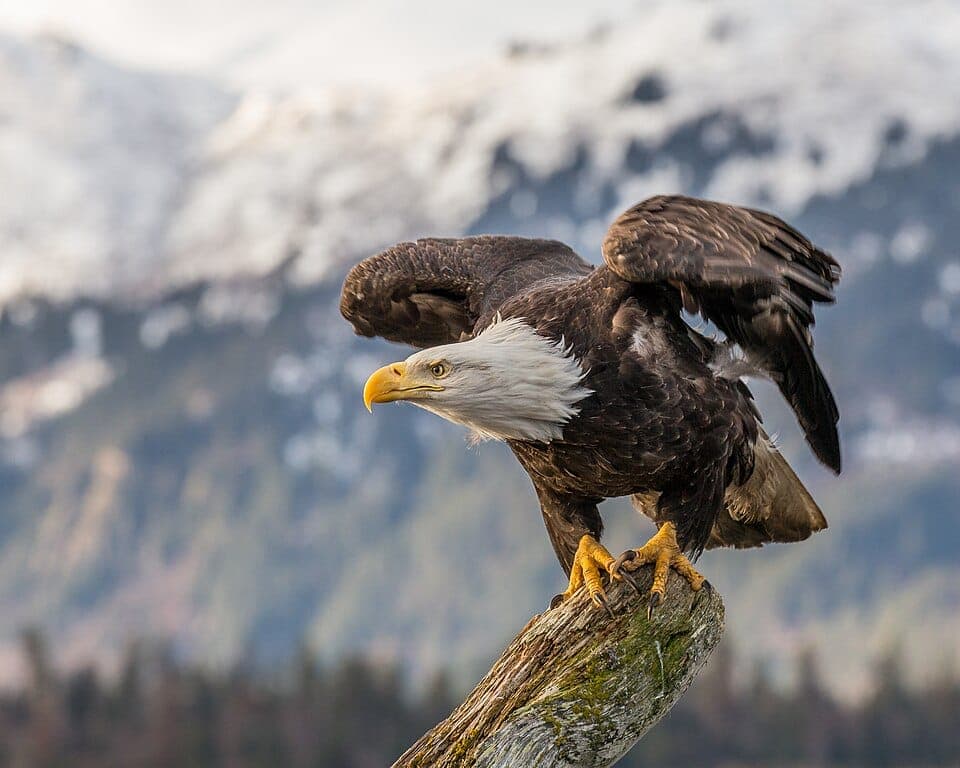
The easiest way to tell a bald eagle from a golden eagle is the adult plumage: a mature bald eagle has a snow-white head and white tail set against a dark brown body, while a golden eagle is dark brown all over with a warm golden wash across the back of its head and neck. The real confusion comes from young bald eagles, which are mottled brown for their first four to five years and are constantly mistaken for golden eagles. When the head-and-tail shortcut fails, the reliable tells are the amount and placement of white, whether the legs are feathered all the way to the toes, the size of the bill and head, and where and how the bird is hunting. Here is how to separate the two for certain.
How to Tell a Bald Eagle From a Golden Eagle
Both are huge dark raptors with wingspans of roughly 6 to 7.5 feet, so sheer size will not separate them. Work through plumage first, then fall back on the structural clues — legs, bill, and proportions — that hold true at every age.
Adults: the easy case
An adult bald eagle is unmistakable — a dark chocolate-brown body and wings with a brilliant white head and tail and a massive yellow bill. An adult golden eagle is uniformly dark brown with golden-buff feathers over the crown and nape that can glint in good light, and a smaller, mostly dark bill with a yellow base. If you can clearly see a white head and white tail, it is a bald eagle; if the bird is all dark brown with a golden nape, it is a golden eagle.
Juveniles and immatures: the hard case
Young bald eagles take four to five years to grow their white head and tail, and until then they are dark brown mottled with variable white — which is exactly why they get called golden eagles. The pattern of white is the key. A young bald eagle shows messy, irregular white blotching concentrated on the belly, the underwing linings, and the "wingpits" (axillaries), with a dark, diffusely mottled tail. A young golden eagle is cleaner and more sharply patterned: solid dark brown with crisp, well-defined white patches at the base of the flight feathers out toward the wrist, and a white tail with a single broad dark band at the tip. Clean, defined white patches say golden; smeary, blotchy white says young bald.
Legs: the definitive tell
If you can see the legs, you can settle it at any age. A golden eagle has legs feathered all the way down to the toes, while a bald eagle has bare, yellow lower legs. Feathered to the feet means golden; bare yellow shanks mean bald. This single feature works on perched birds regardless of how confusing the plumage is.
Bill, head, and proportions
A bald eagle has an enormous bill and a large head that, in flight, projects well forward — its head reaches out nearly as far as the tail is long. A golden eagle has a proportionally smaller bill and head and a longer tail, so in flight it looks longer-tailed and smaller-headed. The bald eagle’s big, heavy, all-yellow bill is itself a strong clue up close.
Habitat and behavior
Where and how the bird is living narrows it down fast. Bald eagles are tied to water — rivers, lakes, reservoirs, and coasts — where they fish and scavenge, and they gather in numbers at dams, open water, and carcasses. Golden eagles favor open and rugged country — mountains, foothills, canyons, grasslands, and deserts, mostly in the West — where they hunt live mammals like rabbits and ground squirrels. An eagle eating a fish by a lake is almost certainly a bald; one soaring over open western hills hunting jackrabbits is likely a golden.
Try Spotter Free on iOS & Android
Plants, animals, fungi, and rocks — all from a photo. 5 free identifications every day, no credit card required.
A Quick Field Checklist
Run through these in order and most eagles resolve in seconds:
- 1White head and white tail on a dark body? Adult bald eagle. All dark brown with a golden nape? Adult golden eagle.
- 2All-brown bird, unsure of age? Check the legs: feathered to the toes is a golden eagle; bare yellow lower legs is a bald eagle.
- 3In flight, read the white: crisp white patches at the base of the flight feathers plus a white tail with one dark terminal band means a young golden; messy white on the belly, wing linings, and wingpits means a young bald.
- 4Check the setting: fishing or scavenging at water points to bald; hunting mammals over open western terrain points to golden.
Other Big Birds Mistaken for Eagles
Several large soaring birds get reported as eagles:
- Turkey vulture — smaller and lighter, it soars with wings held in a shallow V (dihedral) and teeters unsteadily, showing a tiny bare red head and silvery flight feathers below. Eagles soar on flatter, steadier wings.
- Osprey — a fish hawk with a clean white belly and underwings, a dark eye-stripe, and long wings kinked into an M shape; much slimmer than a bald eagle and nearly always near water.
- Red-tailed hawk — commonly called an eagle but far smaller, with a shorter wingspan, a pale chest, and (in adults) a rusty tail. Scale against nearby birds usually gives it away.
- Immature bald vs. golden eagle — the two most likely to be confused with each other; use the leg feathering and the placement of white described above to separate them.
Why It Matters
Both eagles are protected under the federal Bald and Golden Eagle Protection Act, which makes it illegal to harm, harass, or disturb them or to possess their feathers and nests without authorization. That means admiring them from a distance: keep well back from perched birds and especially from nests, which eagles may abandon if disturbed. Enjoy the sighting, photograph it from afar, and leave any found feathers where they lie.
Frequently Asked Questions
Which is bigger, a bald eagle or a golden eagle?
They are very close in size, with wingspans of roughly 6 to 7.5 feet. Bald eagles average slightly heavier with a notably larger bill and head, while golden eagles look a touch longer-tailed and smaller-headed in flight. Size alone will not tell them apart.
Why do juvenile bald eagles look like golden eagles?
Young bald eagles do not get their white head and tail until they are four to five years old, so for years they are dark brown mottled with white. That brown plumage is what fools people — but the white on a young bald is blotchy and spread over the belly and wing linings, while a golden’s white sits in crisp patches at the base of the flight feathers and the tail.
Are golden eagles found in the eastern United States?
Mostly they are western birds of open and mountainous country, but a smaller eastern population migrates and winters along the Appalachians and in the East in modest numbers. Even so, a large dark eagle seen near water in the East is far more likely to be an immature bald eagle than a golden.
Can bald and golden eagles live in the same area?
Yes, their ranges overlap across much of the West and parts of the East, especially in winter, so both can turn up in the same region. They tend to separate by habitat and diet — balds near water and fish, goldens over open land hunting mammals — which is often the quickest clue to which one you are seeing.
Caught a big dark raptor soaring overhead and not sure whether it is a bald eagle, a golden eagle, or a vulture? Snap a photo — even a distant one — and let Spotter help you identify it as a starting point, then confirm it with the head, the legs, and the pattern of white.
Try Spotter Free on iOS & Android
Plants, animals, fungi, and rocks — all from a photo. 5 free identifications every day, no credit card required.