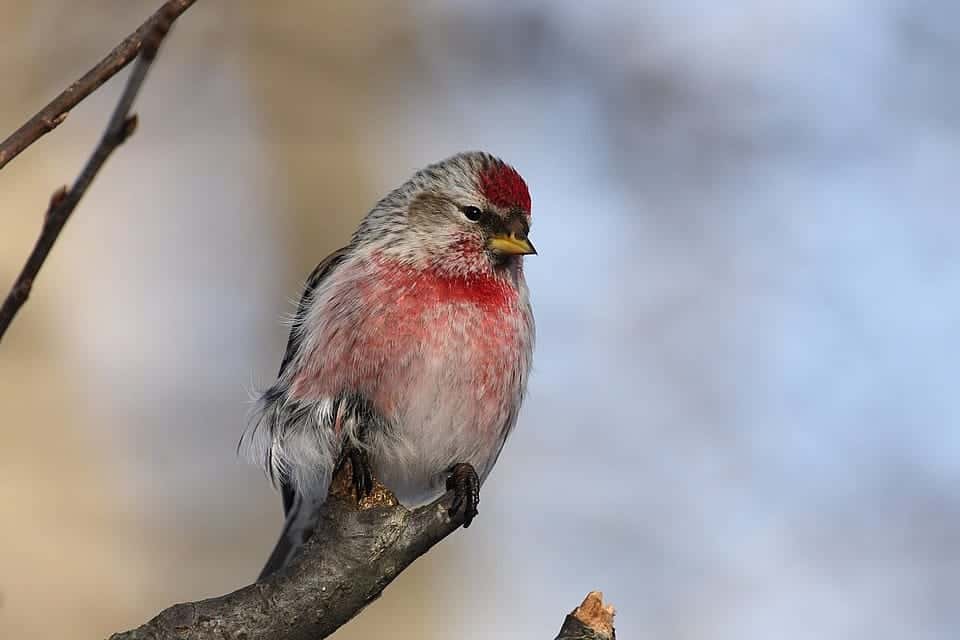
A common redpoll is a small, streaky brown finch with a red patch on its forehead, a black chin, and two pale wing bars, and across most of the United States it turns up only in the depths of winter. If a sparrow-sized bird covered in fine brown streaks is swarming your feeder in January with a tiny flame of red above its bill, a redpoll is the likely answer. It breeds across the Arctic and pushes south into the northern states only in certain winters, arriving in sudden flocks that can number in the dozens or hundreds. Those irregular invasions, called irruptions, track the seed crop up north, so some winters bring redpolls to Wisconsin feeders and others pass with almost none.
How to Identify a Common Redpoll
Run through five things together: the red forehead, the black chin, the overall streaky brown body, the wings and bill, and the time of year. No single mark settles it alone, because redpolls travel with goldfinches and pine siskins that share their size and feeding habits, but together these marks separate a redpoll from the small brown finches it mixes with.
The red forehead patch (the 'poll')
The bird is named for the red cap on its forehead. 'Poll' is an old word for the top of the head, and a redpoll wears a bright crimson patch right above the bill, set against an otherwise brown-and-white face. The patch is small and sits forward on the crown rather than covering the whole head, which is one of the quickest ways to rule out a house finch, where the red spreads back over the head and down the breast. On a bird at your feeder, look for that single neat spot of red just above the beak.
The black chin
Just below the bill, a redpoll shows a small black chin, a dark smudge that pine siskins and goldfinches lack. Paired with the red forehead, the black chin is close to diagnostic: a small streaky finch with both a red cap and a dark chin is a redpoll. The mark can be hard to see while the bird feeds head-down, so wait for it to lift its head between seeds.
Small size and a streaky brown body
A redpoll is tiny, 4.5 to 5.5 inches long and only about half an ounce, the size and build of an American goldfinch. The body is pale with heavy brown streaking on the back, sides, and flanks, and the streaked rump and notched tail add to the busy look. This is the feature that invites confusion with the pine siskin, which is streaky and the same size, so the red cap and black chin do the real work of telling the two apart. Our goldfinch guide covers the drab winter goldfinches that often share the same feeder.
Two pale wing bars and a small yellow bill
A redpoll has two thin, pale wing bars and a short, conical yellow bill built for shelling small seeds. It shows no yellow in the wings or tail, and that is the cleanest split from the pine siskin, which flashes yellow edging in the wings and carries a thinner, more sharply pointed bill. If a small streaky finch shows warm yellow in the spread wing, it is a siskin, not a redpoll.
Males wear a pink wash
Adult males add a rosy-pink wash across the breast and sometimes the rump, brightest in spring but visible on many winter birds. Females and young birds skip the pink and show only the red forehead, black chin, and brown streaking. So the amount of pink tells you the bird's sex and age, not its species; a plain, pinkless redpoll is a female or a youngster.
When and where you will see it
Season is a real identification clue for this bird. Research-grade redpoll sightings in Wisconsin logged on iNaturalist are almost entirely a cold-weather affair: of roughly 190 records, 98 percent fall between November and March, and January and February alone account for about 60 percent of them. From May through October there are none at all. So a small streaky finch with a red cap in a northern yard in midsummer is far more likely to be something else, while the same bird in January fits a redpoll well. Look for them on birch and alder catkins or at feeders stocked with nyjer and small sunflower seed, often in restless, chattering flocks.
Redpoll Look-Alikes
Three small finches cause nearly all the confusion: the pine siskin, the house finch, and the winter American goldfinch. The table sorts them by marks you can judge at a feeder.
| Bird | Size | Head | Breast | Bill and wings |
|---|---|---|---|---|
| Common redpoll | 4.5–5.5 in | Small red forehead patch, black chin | Males pink-washed; streaked sides | Tiny yellow bill; two pale wing bars, no yellow |
| Pine siskin | 4.3–5.5 in | No red, no black chin; brown streaks | Heavily streaked, no pink | Thin pointed bill; yellow edging in the wings |
| House finch | 5–5.5 in | Males red over the head, no black chin | Males red-washed; brown streaks below | Stout curved bill; plain brown wings |
| American goldfinch (winter) | 4.3–5.1 in | No red; plain buff and olive | Unstreaked pale buff | Short pale bill; black wings, buff wing bars |
For the two brown finches people most often mix up, see purple finch vs house finch. And because redpolls are a northern irruptive species, the mix of finches at your feeder shifts from one winter to the next; our Wisconsin bird guide covers the regulars you can expect most years.
One Species Now: the 2024 Redpoll Lump
Reach for an older field guide and you may find two or three kinds of redpoll listed: the common redpoll, the paler and frostier hoary redpoll, and the lesser redpoll of Europe. In 2024 the American Ornithological Society merged them into a single species called simply the redpoll, Acanthis flammea. According to researchers at the University of Colorado Boulder, genetic work found almost no DNA difference between the forms; a single flipped stretch of one chromosome, a supergene, drives the differences in bill size and how pale a bird looks. The frosty hoary birds and the darker, more streaked ones are now understood as variation within one widespread species rather than separate ones. For identifying a bird at your feeder it changes little, the field marks above still apply, but it is why the name you see is shifting from common redpoll to just redpoll.
Frequently Asked Questions
What is the difference between a redpoll and a pine siskin?
Both are small, streaky brown finches of the same size, and they often travel together, but a redpoll has a red forehead patch and a black chin and shows no yellow in the wings. A pine siskin has neither the red cap nor the black chin, carries a thinner, sharper bill, and flashes yellow edging in the wings and tail. When a mixed flock lands, scan for the red caps.
Are common redpolls rare?
They are abundant across the Arctic, but in most of the Lower 48 they are irregular winter visitors. Redpolls specialize on birch and other small seeds, and when the northern seed crop fails they push south in large numbers, a boom-and-bust pattern called an irruption. Some winters bring flocks to feeders well south of their usual range, while other winters pass with few or none.
Why is it now just called a redpoll?
Because the 2024 American Ornithological Society checklist lumped the former common, hoary, and lesser redpolls into one species, Acanthis flammea. Genetic studies showed the forms share a single gene pool around the top of the world, with their visible differences traced to one chromosomal inversion. The pale hoary type is now treated as one end of the range of a single, variable species.
What do redpolls eat at feeders?
They favor small seeds. Nyjer (thistle) seed and finely cracked or small sunflower seed in a tube or mesh feeder draw them, the same offerings that pull in goldfinches and siskins. Away from feeders they work birch and alder catkins, hanging upside down to pry out the tiny seeds.
A flock of small, streaky finches at a winter feeder is worth a second look: find the red forehead and black chin and you have a redpoll, not a siskin or a house finch. Spotter can give you a first read from a photo on the bird identifier page, and these marks confirm it.
Try Spotter free on iPhone or Android
Plants, animals, fungi and rocks from one photo. 5 free identifications every day, no card required.