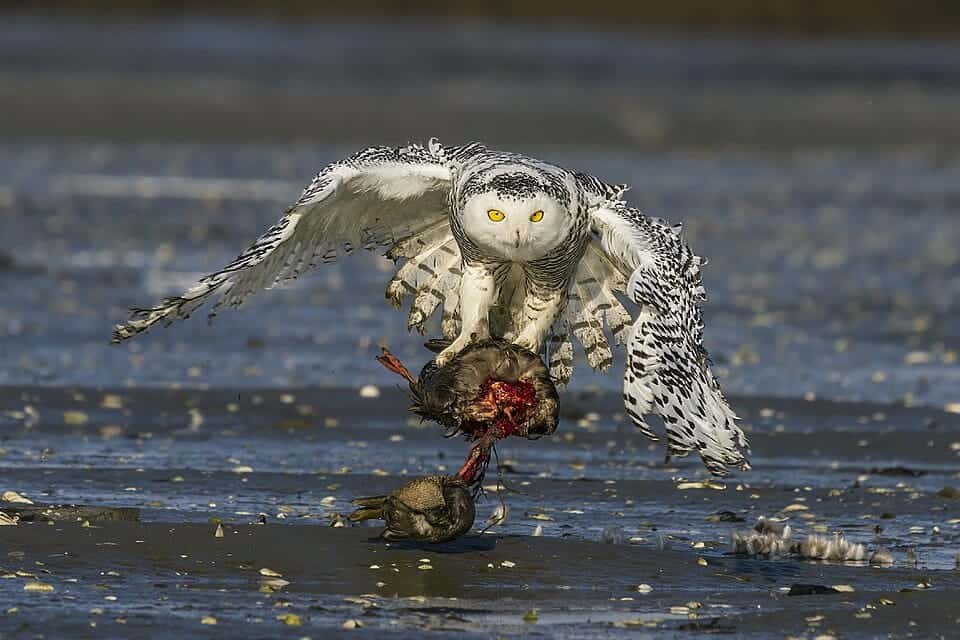
A snowy owl is a large, round-headed owl that is mostly or entirely white, with bright yellow eyes and no ear tufts. If you are looking at a big pale owl perched out in the open on a winter field, fence post, or lakeshore in daylight, a snowy owl is the likely answer. Adult males can be almost pure white, while females and young birds are white with heavy dark barring, so the amount of black on the bird tells you its age and sex rather than its species. It is the heaviest owl in North America, an Arctic breeder that drifts south into the northern states only in the cold months, which is exactly when most people in the Great Lakes region ever see one.
How to Identify a Snowy Owl
Run through five things together: the size and head shape, the eyes and bill, how much black barring the bird carries, when and where it is active, and the time of year. No single mark is unique on its own, but together they separate a snowy owl from the pale owls it gets confused with.
A big white owl with a round, tuftless head
A snowy owl is bulky and broad, roughly 20 to 28 inches long with a wingspan near four to five feet, and it is the heaviest owl on the continent at up to about 6.5 pounds. The head is large, smoothly rounded, and completely without ear tufts. That tuftless profile is the first thing to check: the great horned owl, the other big owl people reach for, wears two obvious feather tufts that a snowy owl never has. A snowy owl at rest often looks like a pale, football-shaped lump sitting low to the ground.
Bright yellow eyes and a bill you can barely see
The eyes are a vivid lemon-yellow, set in a broad face with no dark mask or heart shape. The black bill is small and almost buried in dense white facial feathers, and the feathering runs all the way down the legs to the toes, insulation for an Arctic bird. Yellow eyes rule out a barn owl, which has dark eyes, and the clean, open face rules out the barn owl’s stark white heart-shaped disk.
How much black barring: it tells age and sex, not species
This is where most identifications go sideways. Only old adult males approach pure, unmarked white. Females are larger and carry dense dark bars across the back, wings, crown, and flanks, and the youngest birds are the most heavily marked of all. So a white owl covered in black barring is still a snowy owl, almost certainly a female or a youngster, not a different kind of bird. Do not let the barring talk you out of the identification.
Active in daylight, out in the open
Most owls are night-hunting woodland birds. The snowy owl is the opposite. On its Arctic breeding grounds the summer sun barely sets, and in its winter range it routinely hunts and perches in broad daylight, often sitting in plain view at midday. The National Audubon Society describes it wintering in open country such as prairies, farmland, coastal marshes, beaches, and large airports, flat treeless places that look like the tundra it came from. A big pale owl sitting out in the open on a cold, bright afternoon, on a fence post, a utility pole, a rooftop, or right on the ground, fits the snowy owl better than almost anything else.
When and where you will actually see one
Snowy owls nest on the high Arctic tundra and push south in winter in numbers that swing wildly from year to year, a pattern called an irruption that tracks booms and busts in the lemming populations they feed on up north. In the Great Lakes region that makes late fall through late winter the window. The timing is sharp: research-grade snowy owl sightings in Wisconsin logged on iNaturalist pick up in November, climb through December, and peak in January and February, which together hold roughly six of every ten records. From May through October, barely a handful are reported across the whole stretch. If you think you are seeing a snowy owl in Wisconsin in July, look again; if it is January, the odds are genuinely in your favor.
Snowy Owl Look-Alikes
Three birds account for most mistaken snowy owls: the pale form of the great horned owl, the barn owl, and, at a distance, non-owls entirely. The table sorts the two owls by marks you can judge through binoculars.
| Owl | Overall look | Ear tufts | Eyes | Active when | Quick tell |
|---|---|---|---|---|---|
| Snowy owl | White, barred on females and young | None | Yellow | Often by day | Round white head, no tufts, out in the open |
| Great horned owl (pale form) | Grayish, mottled brown and white | Two prominent tufts | Yellow | Mostly night | Ear tufts and heavy barring; never clean white |
| Barn owl | Golden-buff above, white below | None | Dark | Night | Heart-shaped white face and dark eyes |
At a distance across a snowy field, a white plastic bag snagged on a post, a gull, or a stray domestic goose fools people every winter. Before you call it, look for the upright owl posture, the round tuftless head, and those forward-facing yellow eyes through binoculars. If it is hunched, blocky, and watching you back, it is an owl; if it is loose, flapping, or long-necked, it is not.
Watching Snowy Owls Responsibly
Many of the snowy owls that reach the northern states are young birds making their first trip south, and some arrive thin and tired. Crowding one, or flushing it into the air for a better photo, burns energy it may not be able to spare. Watch from a distance, stay in your vehicle where you can since birds often tolerate a car better than a person on foot, and never bait an owl with live or store-bought mice to draw it close. Reporting your sighting to a project like iNaturalist or eBird helps biologists track how big each winter’s irruption is.
Frequently Asked Questions
Are snowy owls rare?
They are not globally rare, but in most of the Lower 48 you will not see one in a typical winter. Appearances are irregular and tied to Arctic lemming cycles: some winters bring a large irruption with owls turning up well south of normal, while other winters pass with almost none. Seeing one is a matter of being in open country during the right winter.
Do snowy owls come out during the day?
Yes, routinely. Unlike most owls, snowy owls hunt and perch in daylight, a habit left over from breeding under the round-the-clock sun of the Arctic summer. That is why so many winter sightings are of a bird sitting calmly in the open at midday, which is unusual behavior for any other large owl.
What is the difference between a snowy owl and a barn owl?
Look at the eyes and face. A snowy owl has yellow eyes and a round, mostly white head, and it is often out in daylight. A barn owl has dark eyes, a distinctive heart-shaped white facial disk, and golden-buff upperparts, and it is strictly nocturnal. The two are rarely in doubt once you see the face clearly.
Why is my snowy owl covered in black bars?
Because it is a female or a young bird, not a different species. Only old adult males approach pure white. Females carry heavy dark barring, and immatures are the most densely marked of all, so a white owl laced with black bars is still very much a snowy owl.
Spotted a big pale owl on a winter fence post and not sure what you are seeing? Check for the round, tuftless head and yellow eyes, and note whether it is out in daylight. For owls you hear rather than see, see our guide to identifying owls by sound, and for the other winter birds sharing the region, browse birds of Wisconsin. You can also get a first read from a photo on the bird identifier page.
Try Spotter free on iPhone or Android
Plants, animals, fungi and rocks from one photo. 5 free identifications every day, no card required.