
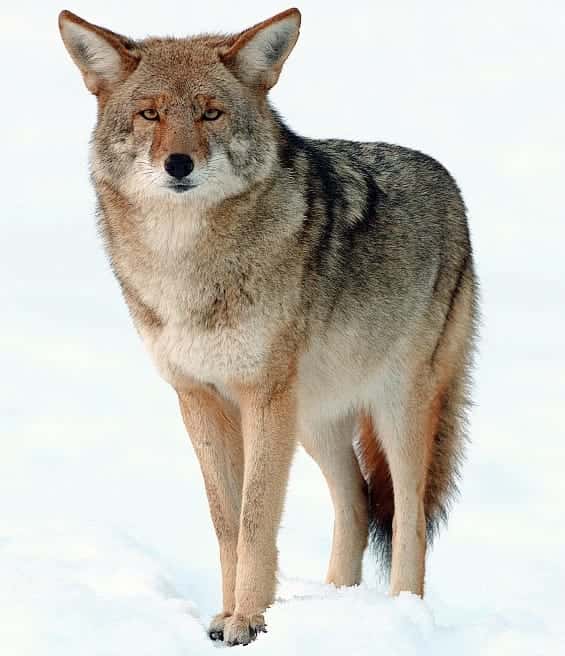
The quickest way to tell a coyote from a wolf is size, and then the head. A wolf is a big, heavy-bodied animal — about the size of a large German shepherd or bigger, 60 to 150 pounds — with a broad, blocky snout, relatively short rounded ears, long legs, and oversized feet. A coyote is far smaller and leaner, roughly the size of a medium dog at 20 to 50 pounds, with a narrow, pointed snout, tall pointed ears that look large for its head, and a slender build. If the animal is bulky and wolfish with a wide face and short ears, it is almost certainly a wolf; if it is light, lanky, and fox-faced with big ears and a low, bushy tail, it is a coyote. Here is how to tell them apart for certain.
How to Tell a Coyote From a Wolf
Across most of North America you will only ever see a coyote — they live in every state except Hawaii, including cities and suburbs — while wild wolves are confined to parts of the northern Rockies, the western Great Lakes, Alaska, and Canada. So location is a strong first clue. But where their ranges overlap, or when a photo gives you no sense of scale, a short list of features settles it: overall size, the shape of the head, the coat, and how the animal carries its tail.
Size and build
Size is the headline difference. A gray wolf is one of the largest wild canines on Earth: 26 to 32 inches tall at the shoulder, five to six feet long including the tail, and 60 to 150 pounds, with a deep chest, long legs, and big paws that can be four to five inches long. A coyote is built like a slim, leggy medium dog: 21 to 24 inches at the shoulder and only 20 to 50 pounds, with a narrow chest and dainty feet. The catch is that a young wolf can be coyote-sized and a big coyote in a full winter coat can look larger than it is, so use size together with the head, never on its own.
Head, snout, and ears
The face is the most reliable clue when size is unclear. A wolf has a broad, heavy, blocky muzzle and a wide forehead, with ears that are short, rounded, and modest in proportion to its large head. A coyote has a narrow, finely pointed snout — almost fox-like — and tall, sharply pointed ears that look conspicuously large for its smaller head. If the ears seem oversized and the muzzle is slender and tapering, you are looking at a coyote; a wide face with small, rounded ears means wolf.
Coat and color
Both species are grizzled mixes of gray and brown, so color alone is not decisive, but the tendencies help. Wolves are often more uniformly grizzled gray and come in a wider range of shades, including black and nearly white, especially in the north. Coyotes are typically tawny gray to reddish brown, with rusty legs, ears, and face, a paler throat and belly, and a generally more washed-out, sandy look. A very black or very white large canine in the wild is far more likely to be a wolf than a coyote.
Tail and how they carry it
Watch the tail, especially when the animal is moving. A coyote almost always carries its bushy, black-tipped tail pointed down and low, trailing below the line of its back even as it trots. A wolf typically holds its tail straight out, horizontal and in line with its back, when walking or running. Tail carriage is one of the quickest ways to call a running canine at a distance: low and droopy means coyote, level and streaming out behind means wolf.
Sound
The two sound different, and you will often hear them before you see them. Coyotes are famously noisy, giving a high, yipping, cackling chorus of barks and sharp howls that seems to come from many animals at once — a sound common across suburbs and farmland at night. A wolf howl is deeper, longer, and more mournful, a drawn-out low moan without the frantic yipping. A rising tangle of yaps and giggles is coyotes; a single long, low howl rolling across the valley is a wolf.
Quick checks
- Size: a big, heavy, shepherd-sized-or-larger animal is a wolf; a slim, medium-dog-sized animal is a coyote.
- Head: a broad, blocky muzzle with short rounded ears means wolf; a narrow, pointed snout with tall oversized ears means coyote.
- Tail: carried level with the back means wolf; carried low and drooping means coyote.
- Sound: a long, low, mournful howl means wolf; a frantic chorus of yips and cackles means coyotes.
- Location: almost everywhere in the Lower 48 it is a coyote; wild wolves live only in the northern Rockies, western Great Lakes, Alaska, and Canada.
Try Spotter free on iPhone or Android
Plants, animals, fungi and rocks from one photo. 5 free identifications every day, no card required.


Coyote vs. Wolf vs. Dog and Other Lookalikes
A few other canines get pulled into the confusion, and domestic dogs are the single biggest source of mistaken wolf and coyote sightings.
- Domestic dogs — many breeds, from huskies to shepherds, look wolfish or coyote-like; dogs tend to have shorter muzzles, floppier or more varied ears, curled or upright tails, and are usually seen near people or homes rather than hunting alone at the edge of the woods.
- Red fox and gray fox — much smaller than either, 7 to 15 pounds, with a long, very bushy tail; a red fox has a white tail tip and black lower legs, nothing like a coyote in size or proportion.
- Coywolf (eastern coyote) — in the Northeast and Great Lakes many coyotes carry some wolf and dog ancestry and run larger, 30 to 50 pounds, with a broader head; they are still called coyotes and still yip, but they blur the line and explain many small-wolf reports in the East.
- Jackals and dingoes — not found in the wild in North America; if you are in the U.S. or Canada, you can rule them out.
Safety Around Wolves and Coyotes
Both animals generally avoid people, and attacks on humans are rare, but neither should be approached, fed, or cornered. Never feed a coyote or leave pet food and garbage out — coyotes that lose their fear of people become bold and are the ones that cause problems, especially with small pets; keep cats indoors and small dogs leashed and close, particularly at dawn and dusk. If a coyote approaches, do not run: make yourself look big, shout, wave your arms, and haze it until it leaves. Wolves are powerful predators and deserve a wide berth; keep your distance, keep dogs leashed, and never try to close in for a photo. With either animal, back away calmly, keep children and pets near you, and use a zoom lens rather than shrinking the gap.
Frequently Asked Questions
Could the animal in my yard be a wolf?
Almost certainly not, unless you live in the northern Rockies, the western Great Lakes states, Alaska, or Canada. In the vast majority of the United States, a wolf-like canine trotting through a neighborhood or field is a coyote — or a loose domestic dog. Check a current wolf range map for your state before concluding you saw a wolf.
How big is a coyote compared to a wolf?
A coyote weighs about 20 to 50 pounds — the size of a medium dog — while a gray wolf weighs 60 to 150 pounds and stands much taller and heavier. A wolf is roughly two to three times the mass of a coyote, though a young wolf can briefly overlap a large coyote in size.
What is a coywolf?
Coywolf is an informal name for the eastern coyote, a coyote that carries some wolf and dog ancestry from past interbreeding. They are common in the northeastern U.S. and southeastern Canada, run larger than western coyotes, and have broader heads, which is why they are sometimes mistaken for small wolves.
Do coyotes and wolves live in the same places?
Mostly not. Where wolves are abundant they tend to exclude and even kill coyotes, so coyotes thrive best where wolves are absent — which is most of the continent today. Their ranges overlap only at the edges of the remaining wolf country.
Try Spotter free on iPhone or Android
Plants, animals, fungi and rocks from one photo. 5 free identifications every day, no card required.