
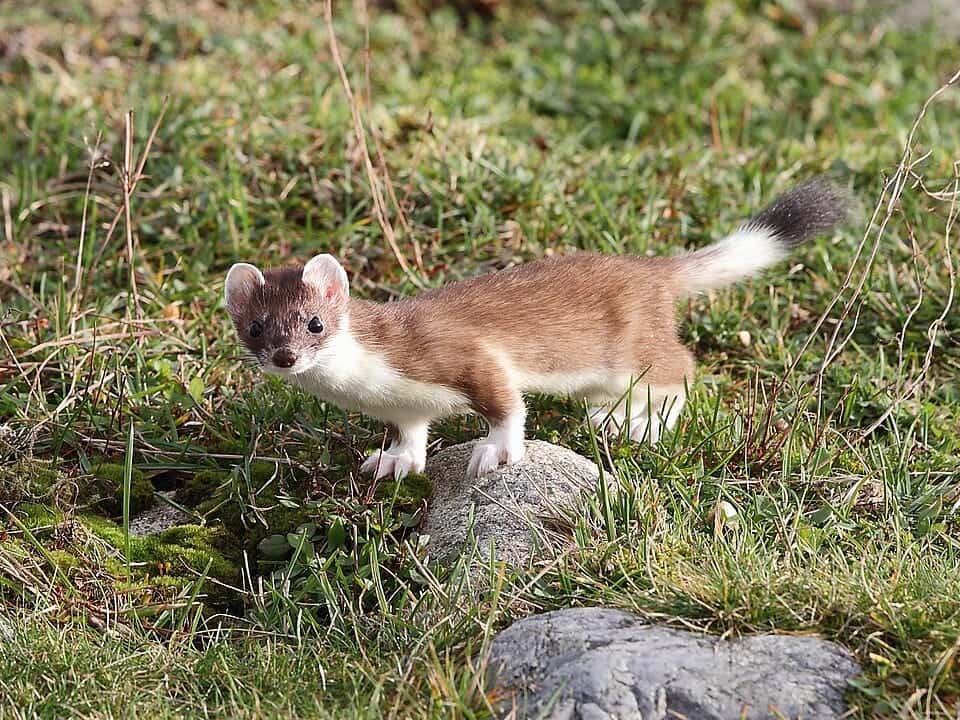
A weasel is a tiny, impossibly long-bodied predator in the same family as mink and otters — picture a slinky, low-slung animal no bigger than a chipmunk stretched out to the length of a ruler, running in a humped bound with a black-tipped tail trailing behind. If you glimpsed a small brown animal — or, in winter, a snow-white one — with a snaky body, short legs, and a quick, darting hunt along a field edge or stone wall, you were almost certainly watching a weasel rather than the mink, chipmunk, or rat it is most often mistaken for. North America has three native weasels: the long-tailed weasel, the short-tailed weasel (also called the stoat, or in its white winter coat the ermine), and the least weasel. Telling them apart comes down to a few simple clues. Here is how to identify a weasel and work out which one you saw.
How to Identify a Weasel
Weasels are built unlike almost anything else in a field or backyard: a long tube of a body on tiny legs, moving in a distinctive humpbacked bound. Start with the body shape and size, confirm with the fur color and the black tip of the tail, and — in the northern half of the continent — factor in the season, because a weasel that is brown in summer may be pure white in winter.
Size and shape
Every weasel shares the same silhouette: an extremely long, slender, flexible body; a small, flat, triangular head barely wider than the neck; short legs; and small, rounded ears. They are far smaller than people expect. The least weasel, the smallest carnivore on Earth, is only about 4 to 10 inches long including the tail and weighs barely more than an ounce. The short-tailed weasel runs roughly 7 to 14 inches, and the long-tailed weasel — the largest of the three — reaches 11 to 22 inches. Even the biggest weasel is a lightweight, slim enough to chase a mouse down its own burrow.
Color and the black tail tip
In their warm-season coat, all three weasels are rich brown above and pale — white, cream, or faint yellow — on the throat, chest, and belly, with a crisp two-tone line running the length of the body. The single most useful color mark is the tail: both the long-tailed and short-tailed weasel carry a distinct black tip at the end of the tail year-round, in every season and coat. The least weasel is the exception — its tail is short and either lacks a black tip or shows only a few dark hairs. If you can clearly see a black-tipped tail, you have ruled the least weasel out.
The winter-white ermine
Across the northern United States and Canada, short-tailed and long-tailed weasels molt to a pure-white winter coat triggered by shortening daylight, leaving only the black tail tip dark. A weasel in this white phase is what furriers historically called ermine. A snow-white, small, long-bodied animal bounding across winter snow with a single black dot at the tip of its tail is almost always an ermine. Farther south, where snow is rare, weasels may stay brown all winter or turn only patchy white.
Movement and behavior
Weasels move in a way that is hard to mistake once you have seen it: a bounding, humpbacked lope in which the long back arches up with each leap, the animal often pausing to stand bolt upright on its hind legs to look around — periscoping — before darting on. They are relentless, high-energy hunters, investigating every hole, crevice, and stone wall, and they can vanish and reappear several feet away in a blink. They are active day and night and do not hibernate.
Habitat, range, and season
Weasels live almost everywhere there are small rodents to eat — fields, hedgerows, forest edges, marshes, farmland, and suburban yards with brush piles or stone walls — across nearly all of North America. They den in the repurposed burrows of the mice and voles they prey on, often lining the chamber with the fur of their victims. You are most likely to spot one in the open along a field edge, a rock wall, or a woodpile, moving fast. Because they stay active all winter, tracks in fresh snow — paired prints in a bounding pattern, often diving into and out of the snowpack — are one of the most reliable signs.
Try Spotter free on iPhone or Android
Plants, animals, fungi and rocks from one photo. 5 free identifications every day, no card required.


How to Tell the Three Weasels Apart
If you got a good look or a photo, two features — overall size and the length of the tail relative to the body — separate the three North American weasels:
- Long-tailed weasel — the largest and most widespread in the U.S., 11 to 22 inches long, with a long tail roughly 40 to 70 percent of the head-and-body length and always black-tipped. Brown back, often with buffy or yellowish underparts; some southern populations show white facial markings. In the brown phase its feet are brown.
- Short-tailed weasel (stoat, or ermine when white) — medium, 7 to 14 inches, with a tail that is shorter, about a third of the head-and-body length, and black-tipped. White feet in the brown phase help separate it from the long-tailed weasel, which has brown feet.
- Least weasel — tiny, 4 to 10 inches, with a very short tail (well under a quarter of the body length) that lacks the bold black tip. If the animal is minuscule and the tail is a short brown stub, it is a least weasel.
Weasel Look-Alikes: Mink, Chipmunk, and Rats
Several small mammals get called weasels by mistake. Here is how to rule them out:
- Mink — a close cousin and much larger, 1.5 to 2 feet long, uniformly dark chocolate-brown with no pale belly line, a bushy dark tail with no black tip, and almost always found right at the water’s edge. A weasel is smaller, two-toned, and black-tipped.
- Chipmunk — close in size to a least weasel but marked with bold dark-and-light stripes down the back and sides, a bushy tail held upright, and a seed-stuffing, ground-squirrel manner. Weasels have no stripes and a far longer, snakier body.
- Rats and mice — a rat has a thick, naked, scaly tail, a blunt body, and a scurrying rather than bounding gait. Weasels are far more elongated, carry fur on the tail, and move in leaping bounds.
- Pine marten and fisher — larger, bushy-tailed weasel relatives of northern forests; both dwarf a true weasel and lack the two-tone belly and black tail tip.
Are Weasels Dangerous?
Weasels pose essentially no danger to people. They are shy and will vanish long before you get close, and they are far too small to threaten an adult, though they will bite hard if cornered or handled — so, as with any wild animal, never try to pick one up. The real friction is with backyard poultry: a weasel can slip through a gap as small as an inch and may kill more birds than it can eat in a single night, a surplus-killing instinct tied to caching food for lean times. If you keep hens, the fix is exclusion — hardware cloth over every opening, buried aprons, and secure latches — not harming the animal, which is also a valuable natural control on mice and voles. Treat any weasel that seems tame, disoriented, or sick with distance, and report it to local wildlife officials.
Frequently Asked Questions
Is a weasel the same as an ermine or a stoat?
Essentially, yes. "Stoat" is another name for the short-tailed weasel, and "ermine" refers to that same animal in its white winter coat. All three names describe one species, the short-tailed weasel.
What is the difference between a weasel and a mink?
Size, color, and habitat. A mink is roughly twice as long as most weasels, uniformly dark brown with no pale belly stripe and no black tail tip, and it sticks close to water. A weasel is smaller, two-toned, black-tipped, and hunts in fields and hedgerows as readily as near water.
Why is a weasel white in winter?
Short-tailed and long-tailed weasels in the north molt to a white coat as the days shorten, camouflaging them against snow while they hunt. Only the black tail tip stays dark. Where winters are mild and snowless, weasels often remain brown year-round.
Are weasels good or bad to have around?
On balance, good. A single weasel eats enormous numbers of mice, voles, and rats, making it a free form of rodent control. The exception is unprotected poultry, which weasels will raid — so the answer is to secure the coop rather than remove the animal.
Caught a small, long-bodied animal bounding across a field, a stone wall, or fresh snow and not sure whether it was a weasel, a mink, or a chipmunk? Snap a photo and let Spotter help you identify it as a starting point, then confirm it with the body length, the black tail tip, and the season.
Try Spotter free on iPhone or Android
Plants, animals, fungi and rocks from one photo. 5 free identifications every day, no card required.