A fossil is the preserved remains or trace of a once-living thing — a shell, bone, leaf, or footprint turned to stone over thousands to millions of years. The quickest way to tell a fossil from a plain rock is to look for a recognizable biological shape or repeating pattern: the ribs of a shell, the spiral of a snail, the honeycomb of coral, the grain of wood, or the segmented body of an ancient sea creature, often a different color or texture than the rock around it. Here is how to confirm you have a real fossil and how to narrow down what kind of organism it came from.
How to Identify a Fossil
Most fossils people find are not dinosaur bones — they are the far more common remains of ancient sea life, plants, and the tracks animals left behind. Work through shape, texture, color, and where you found it, in that order.
Look for a biological shape or pattern
Life is organized, and rocks usually are not. The strongest sign of a fossil is a shape that looks too orderly to be an accident: bilateral symmetry (two matching halves, like a clam), radial symmetry (spokes or a star, like a sea lily), a coiled spiral (a snail or ammonite), repeating chambers or ribs, a honeycomb or chain pattern (coral), or the parallel grain and rings of wood. If part of the object repeats in a regular way, you are probably holding something that was once alive.
Feel the texture and weight
Fossils are often smoother, harder, or glossier than the rock they sit in, because their original material was slowly replaced by dense minerals. Fossil bone is a special case: the inner bone stays porous while the outer surface is dense and may show fine parallel lines. A true fossil is usually heavier and more solid than a fresh bone or piece of wood of the same size, because it has essentially turned to stone.
Check the color and how it sits in the rock
Fossils frequently stand out from their surroundings in color — a pale shell in dark shale, a dark leaf print on tan rock, a glossy black tooth in gray sediment. Many fossils are still embedded in a surrounding “matrix” of rock, and weathering can leave them standing in relief as the softer rock erodes away. A shape that is clearly a different material than the stone around it is a good sign.
Note where you found it — rock type matters
Fossils form in sedimentary rock — limestone, shale, sandstone, and mudstone — not in igneous rock like granite or basalt, and rarely in heavily altered metamorphic rock. If your specimen came from a limestone road cut, an eroding cliff, a stream bank, a quarry, or a gravel beach, fossils are plausible. Where you found it also helps date it: the same-looking shell means very different things in an ancient marine limestone versus a young clay bed, so always note the location.
Try Spotter Free on iOS & Android
Plants, animals, fungi, and rocks — all from a photo. 5 free identifications every day, no credit card required.
Common Fossils and How to Recognize Them
Once you are confident it is a fossil, these are the kinds most people actually find:
- Bivalves and brachiopods — clam-like shells; a bivalve has two matching mirror-image halves, while a brachiopod’s two halves are different sizes.
- Ammonites and snails — coiled, spiral shells; ammonites are flat spirals often marked with ribbed chambers, and are a prized find.
- Crinoids — small round or star-shaped discs and stacked “stem” segments, sometimes called “Indian beads,” from ancient sea lilies.
- Corals — honeycomb, chain, or horn-shaped patterns made of tiny repeating cells.
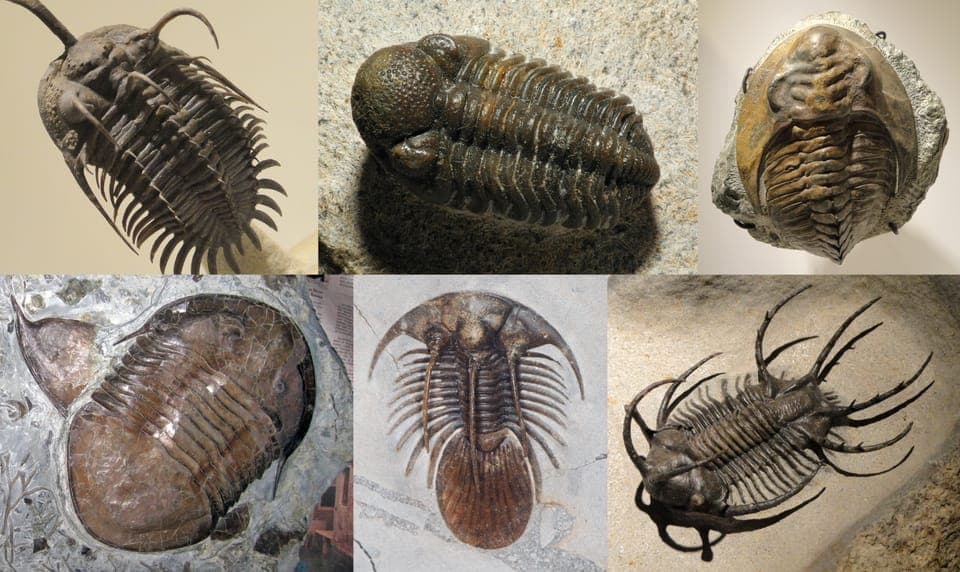
- Trilobites — segmented, oval, bug-like bodies divided into three lobes; a classic and sought-after fossil.
- Petrified wood — stone that preserves the grain, growth rings, and even bark texture of a tree.
- Plant and leaf impressions — dark imprints of leaves, ferns, or bark pressed into shale.
- Shark teeth — glossy, triangular teeth, often black or gray, common on some beaches and rivers.
- Trace fossils — footprints, burrows, and ripple marks that record behavior rather than a body part.
Fossil or Just a Rock? How to Tell the Difference
Several natural rock features fool people into thinking they have found a fossil. These “pseudofossils” are common, so learn to rule them out:
- Concretions — hard, rounded lumps that form around a nucleus in sediment; often mistaken for eggs or bones, but they have no internal biological structure.
- Dendrites — black, fern- or tree-like stains on a rock surface that look like fossil plants but are actually mineral crystal growth, not life.
- Chert and flint nodules — lumpy, rounded shapes with no repeating biological pattern.
- The test: a real fossil shows organized, repeated biological structure — symmetry, chambers, ribs, cells, or grain — while random lumps and branching stains do not.
What to Do With a Fossil You Find
Before you dig or collect, know the rules. On most public land, casual collecting of common invertebrate and plant fossils is allowed, but vertebrate fossils (bones, teeth, tracks) are protected and may not be collected without a permit; national parks prohibit collecting entirely. On private land, always get the owner’s permission. Whatever you find, photograph it in place and write down exactly where it came from — that geologic context is often more valuable than the fossil itself. If you think you have found a vertebrate or something unusual, leave it and contact a local museum, university geology department, or state geological survey, which will usually help identify it.
Frequently Asked Questions
How old does something have to be to be a fossil?
By convention, a fossil is generally older than about 10,000 years — older than the end of the last Ice Age. Preserved remains younger than that are usually called “subfossils.” In practice, most fossils you will find are far older, from tens of millions to hundreds of millions of years.
Is it a bone or just a rock?
One classic field test is the “stick test”: touch the object to a clean, wet tongue or a damp thumb. Porous fossil bone briefly sticks because it draws in moisture, while a plain rock does not. Weight and structure help too — fossil bone is dense and heavy, with a porous interior and a smooth, sometimes striated outer surface.
Can I identify a fossil from a photo?
Often yes, at least for common types. Take sharp close-ups of the key features — the hinge of a shell, the spiral of an ammonite, the edge of a tooth — from a few angles, and note where and in what kind of rock you found it. Those details are what an app or an expert needs to narrow it down.
Where are fossils easiest to find?
Look where sedimentary rock is freshly exposed: road cuts, stream and river banks, eroding cliffs and lake shores, quarries (with permission), and gravel beaches. Regions built on limestone and shale are especially productive, because those rocks formed from ancient seafloors full of shells and sea life.
Found a stone with a shape that looks a little too organized to be an accident? Photograph it from a few angles and let Spotter help you identify it — and figure out what ancient plant or animal left it behind.
Try Spotter Free on iOS & Android
Plants, animals, fungi, and rocks — all from a photo. 5 free identifications every day, no credit card required.