
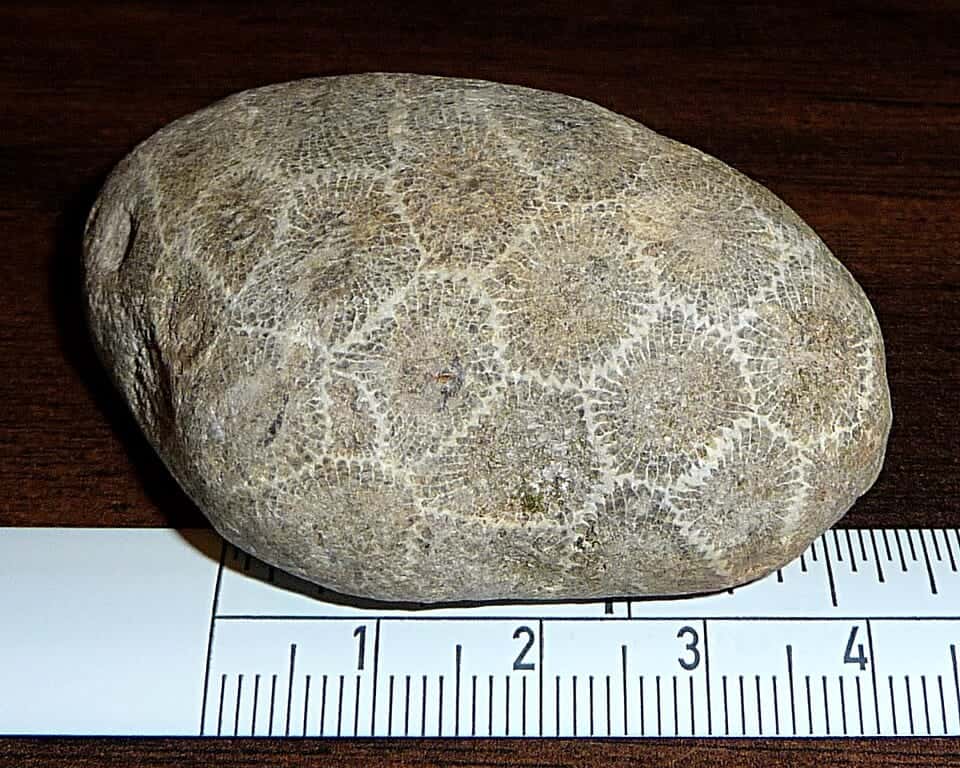
A Petoskey stone is a piece of fossilized coral that lived in a warm sea covering Michigan about 350 million years ago, and you identify it by the honeycomb of six-sided cells on its surface, each cell carrying a dark central eye with fine lines radiating out from it. The catch is that the pattern is faint or invisible when the stone is dry, so a Petoskey stone often looks like a plain gray cobble until you wet it, which makes dipping it in water the single fastest identification test.
Petoskey stones are the fossilized skeletons of a colonial coral called Hexagonaria percarinata, and they are the official state stone of Michigan. Glaciers scattered them across the Great Lakes region, so beachcombers find them far beyond the town of Petoskey the stone is named for. Here is what to look for.
How to Identify a Petoskey Stone
Each hexagon you see on a Petoskey stone was a single coral animal, or polyp, in a colony of thousands. According to Michigan State University, the coral grew in the warm, shallow sea that covered Michigan during the Devonian period, and over time calcite and silica replaced the original skeleton. Three features separate a real Petoskey stone from an ordinary rock: the packed cells, the dark eye at the center of each, and the lines radiating from that eye.
The six-sided cells (corallites)
The surface is covered in close-packed cells called corallites, each the former home of one coral polyp. Because the cells grew pressed against one another, they share walls and take on a polygonal shape, usually six-sided but sometimes five. On a true Petoskey stone the cells are fairly large, roughly 5 to 15 millimeters across, about the size of a pencil eraser up to a fingernail. A rock covered in this tight, repeating honeycomb of sizable polygons is the first sign you have the right fossil.
The dark eye and the radiating lines
Look at the center of each cell. A dark spot, often called the eye, marks where the polyp mouth once sat; it darkened because sediment settled into the opening before the skeleton mineralized. Around each eye, fine lines called septa radiate outward to the cell walls, like spokes from a hub. This combination, a dark central eye with radiating lines in every cell, is the detail that confirms a Petoskey stone over its look-alikes, which have the honeycomb but not the eyes.
Wet it, or the pattern hides
A dry Petoskey stone is chalky and pale, and the pattern can be almost impossible to see. Water changes everything: dip the stone in a lake, a puddle, or a sink and the hexagons and eyes jump into view. This is why most Petoskey stones are found right at the waterline, still wet from a wave, and why collectors carry a spray bottle. Polishing has the same effect permanently, which is why finished Petoskey stones look so vivid.
Size, weight, and hardness
Petoskey stones are made of calcite, which is soft, about 3 on the Mohs hardness scale. A steel knife blade scratches one easily, and the stone will not scratch glass, which separates it from quartz-family beach pebbles that will. They are usually rounded, palm-sized gray cobbles smoothed by wave action, and they are dense enough to take a good polish. If you want the difference between the calcite in a Petoskey stone and harder minerals, see quartz vs. calcite.
Where Petoskey stones turn up
The bedrock source runs across northern Lower Michigan, and the richest hunting is around Little Traverse Bay near the town of Petoskey. But Pleistocene glaciers plucked the fossils from that bedrock and dragged them south and west, so Petoskey stones also wash up along Great Lakes beaches and turn up in gravel across Michigan, Illinois, Indiana, Iowa, and Wisconsin. On the Wisconsin side of Lake Michigan they are an uncommon but real beachcombing find, carried there by the same ice that shaped the lakes. For more of what the region yields, see our guide to the rocks and minerals of Michigan.
Try Spotter free on iPhone or Android
Plants, animals, fungi and rocks from one photo. 5 free identifications every day, no card required.


Petoskey Stone vs. Its Look-Alikes
The closest look-alike is the Charlevoix stone, a smaller-celled fossil coral (Favosites) from the same ancient seas, prized because it is the rarer find. Plain limestone and decorative honeycomb calcite get mistaken for Petoskey stones too. The table below, built from the sources cited in this post, lays out the field marks that tell them apart.
| Field mark | Petoskey stone (Hexagonaria) | Charlevoix stone (Favosites) | Honeycomb calcite | Plain limestone or dolomite |
|---|---|---|---|---|
| What it is | Fossil rugose coral, Devonian, about 350 million years old | Fossil tabulate coral from the same Devonian seas | A mineral (calcite), not a fossil | Sedimentary rock with no visible fossil cells |
| Cell (corallite) size | Large, about 5 to 15 mm across | Small, about 1 to 3 mm across | Variable, geometric rather than biological | No cells |
| Center of each cell | A distinct dark eye (the coral mouth) | No eye; the cells look hollow | No eye; cells are open crystal tubes | None |
| Radiating lines (septa) | Fine lines radiate from every eye | Faint or absent; mostly just cell walls | None; straight, sharp crystal walls | None |
| Where you find it | Great Lakes beaches and gravel, well beyond Petoskey | The same beaches, but much rarer | Rock shops and polished decor, not beaches | Almost everywhere |
If the cells are small and hollow with no central dot, you likely have a Charlevoix stone, the rarer and more sought-after cousin. If no cellular pattern shows up at all once the rock is wet, it is probably just limestone or dolomite. Agates are the other classic Great Lakes beach find worth learning; see how to identify agate, and for the broader skill, how to identify a fossil.
Is It Legal to Collect Petoskey Stones?
In Michigan, the Michigan Geological Survey explains that you may collect up to 25 pounds of rocks, minerals, and invertebrate fossils per person per year from state land and public Great Lakes shorelines, for personal, non-commercial use only, counted across all your trips combined. Collecting is banned outright inside national lakeshores such as Sleeping Bear Dunes and Pictured Rocks, and in nature preserves and historic sites. The limit has teeth: the state once confiscated a 93-pound Petoskey boulder a man pulled from Lake Michigan. Rules differ by state and on private land, so get permission and check local regulations before you fill a bucket.
Frequently Asked Questions
What does a Petoskey stone look like when it is dry?
Dry, it looks like a plain, chalky gray cobble, and the hexagon pattern is faint to invisible. Wetting or polishing the stone brings out the packed six-sided cells and their dark eyes, which is why Petoskey stones are easiest to spot right at the waterline.
Where can you find Petoskey stones?
The classic spot is the Lake Michigan shoreline of northern Lower Michigan, especially around Little Traverse Bay near Petoskey. Because glaciers carried the fossils far from their source, they also appear on Great Lakes beaches and in gravel across Michigan, Wisconsin, Illinois, Indiana, and Iowa. Beaches are most productive after waves or wind have reworked the gravel.
How can you tell a real Petoskey stone from a fake?
Most so-called fakes are either other fossil corals, such as the Charlevoix stone, plain patterned limestone, or molded resin replicas sold as souvenirs. A real Petoskey stone shows six-sided cells with a dark eye and radiating lines in each. A resin copy feels light and warmish rather than cool and dense, and its pattern often looks too perfect and evenly repeated.
Is a Petoskey stone a rock or a fossil?
Both. It is a fossil, the skeleton of a colonial coral, that has been turned to stone as calcite and silica replaced the original material. So it is a fossil preserved in rock form, which is why it is both the Michigan state stone and a genuine fossil.
Found a gray cobble with a honeycomb pattern on a Great Lakes beach and not sure whether it is a Petoskey stone, a Charlevoix stone, or plain limestone? Wet it, look for the dark eye at the center of each six-sided cell, and you can identify the fossil from there.
Try Spotter free on iPhone or Android
Plants, animals, fungi and rocks from one photo. 5 free identifications every day, no card required.