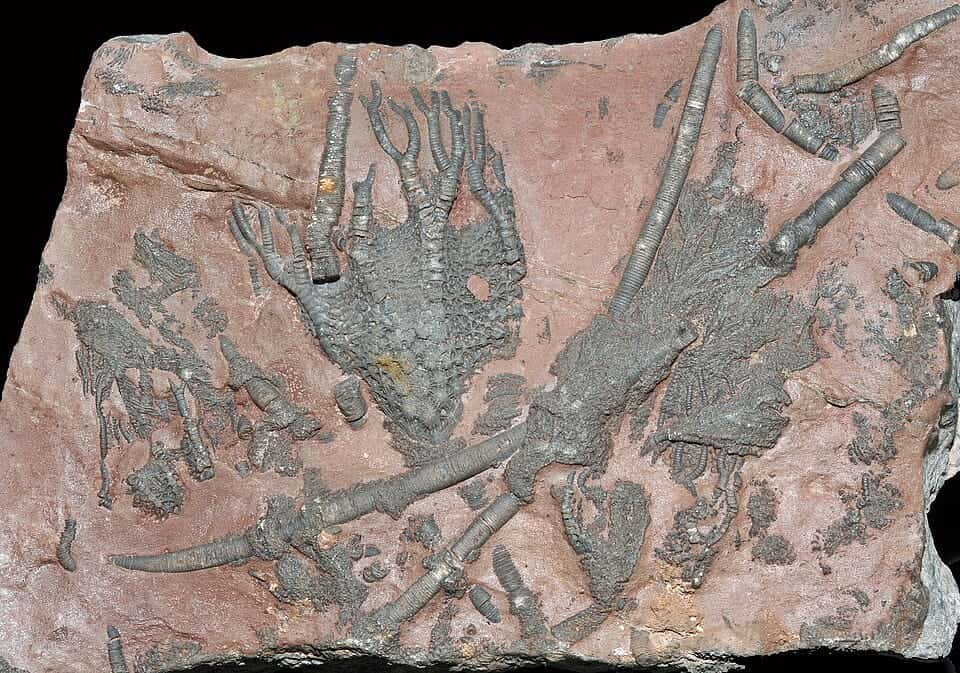
Crinoid fossils are the fossilized stem pieces of ancient sea lilies, and you recognize them by round, oval, or star-shaped discs with a small hole through the center, often stacked into short columns that look like a tiny roll of coins or a threaded screw. Each disc is usually smaller than a pencil eraser, pale gray to tan, and set in or weathered out of limestone. If you have picked up a stone covered in little beaded discs with holes in the middle, you are very likely holding a crinoid.
Despite the flower-like name, a crinoid is not a plant. It is an echinoderm, the same animal group as sea stars and sea urchins, and crinoids still live in the oceans today as stalked sea lilies and free-swimming feather stars. When a crinoid dies, its skeleton of stacked calcite plates falls apart quickly, so you rarely find a whole animal. What survives are the loose stem segments, called columnals, which fill many Paleozoic limestones. In the upper Midwest and along rocky Great Lakes beaches, they wash up in the same gravel as Petoskey stones and horn corals, so a single handful of beach stones can hold three different fossils.
How to Identify Crinoid Fossils
Crinoid pieces come in two forms: single discs that broke off one by one, and short columns where several discs are still cemented together. Both share a few marks that separate them from the corals and shells they wash up with.
The central hole is the giveaway
Look at the middle of the disc, with a hand lens if you have one. A crinoid columnal had a canal running down the center of the living stem, so most segments show a small hole, pit, or filled dot right in the middle. That central opening, called the lumen, is the single most reliable mark. Corals, clams, and brachiopods do not have a neat hole punched through the center. On weathered pieces the hole may be packed with sediment and show only as a darker dot, but it still sits dead center.
Round, oval, or star-shaped discs
Most columnals are circular, like a bead or a washer, but many are five-sided or shaped like a tiny flower or star. That five-part pattern is the echinoderm signature, the same five-fold symmetry you see in a sea star, and no coral or shell copies it. Some disc faces also carry fine radiating ridges, called crenulations, where one segment locked onto the next. A pale disc with five-way symmetry and a center hole is a crinoid and little else.
Stacked stems, screws, and star stones
When several segments stay joined you get a short column that looks like a miniature roll of coins or a length of bamboo. Weathered along its length, the stacked ridges can resemble the thread of a screw, which is why old British collectors called them screwstones. Loose rounded segments have been strung like beads for centuries and picked up folk names such as Indian beads, star stones, and St Cuthbert’s beads, according to the British Geological Survey. Those names all describe the same fossil stem.
Size, color, and where they turn up
Crinoid segments are small, usually 2 to 10 millimeters across and often under a centimeter, though whole fossil stems can run several inches long. They are made of calcite, so they take on the color of the limestone around them, white, cream, tan, or gray, and they are soft enough that a steel knife scratches them. Look for them in gray marine limestone and in the gravel that limestone sheds, from Midwest road cuts and quarry piles to the wave-washed stones of the Great Lakes. The Field Museum describes them on Lake Michigan beaches as small discs with holes in their centers, like Cheerios.
Crinoid Look-Alikes
Crinoid pieces share the gravel with several other common marine fossils, and the quickest way to separate them is the center-hole test plus the overall shape. This table compares the fossils you are most likely to confuse on a limestone beach or in a gravel pile.
| Fossil | Shape | Hole through the center? | Typical size | Pattern and where found |
|---|---|---|---|---|
| Crinoid columnal | Round, oval, or 5-point star disc, or a stacked column | Yes, a small central canal | 2-10 mm disc; stems to several inches | Smooth or finely ridged discs in gray limestone and beach gravel |
| Horn coral | Single cone or curved horn | No | 1-8 cm long | Radiating lines (septa) inside a cup at the wide end |
| Colonial coral (incl. Petoskey stones) | Many-celled mass | No | 2-15 cm | Repeating six-sided or tube-shaped cells, each a former polyp |
| Brachiopod | Two-part shell, like a small clam or scallop | No | 1-5 cm | Ribbed, fan-shaped shell with mirror-image halves |
| Bryozoan | Lacy sheet or branching twig | No | A few mm to a few cm | Net or mesh of tiny pores, no central hole |
The other quick check is symmetry. A crinoid disc shows round, five-fold symmetry, while a brachiopod shell is bilateral, with a left and right half that mirror each other. If you are still unsure, compare your find against the fossil identifier or our broader guide to identifying a fossil and what kind it is.
Where to Look for Crinoid Fossils
Crinoids turn up anywhere Paleozoic marine limestone is exposed or has been crushed into gravel: quarry spoil piles, road cuts, creek beds, and the rocky shorelines of the Great Lakes. On the lakes, a rocky beach the morning after a storm is best, because the waves sort fresh stones onto the shore. Collecting rules vary, so pick up loose stones only from a public beach or a quarry that allows it, leave fossils in place in state and national parks, and ask first on private land. A hand lens and a spray bottle help, since wetting a stone makes the center holes and ridges stand out.
Frequently Asked Questions
What is the fossil that looks like a screw or a Cheerio?
That is almost always a crinoid. A short crinoid stem weathered along its length shows stacked ridges that resemble screw threads, while a single loose segment looks like a small disc or bead with a hole in the middle, the Cheerio shape beachcombers describe. Both are stem pieces of the same animal.
Are crinoids plants or animals?
Animals. The name sea lily comes from their flower-like shape, but crinoids are echinoderms, related to sea stars and sea urchins, and they filter food from the water with feathery arms held up on a stalk.
How old are crinoid fossils?
Most of the ones people find are Paleozoic, roughly 540 to 250 million years old. Crinoids were so abundant in the Mississippian Period, about 340 million years ago, that whole limestone beds are built from their broken stems, and geologists sometimes call it the Age of Crinoids.
Are crinoids extinct?
No. Crinoids still live in oceans worldwide, both as stalked sea lilies anchored to the deep sea floor and as feather stars that swim and crawl in shallow water. The fossils are just far more common than live sightings, because their stacked skeletons break apart and pile up.
Found a stone studded with little holed discs and want a second opinion? Photograph it wet and in good light, and Spotter can help you identify it.
Try Spotter free on iPhone or Android
Plants, animals, fungi and rocks from one photo. 5 free identifications every day, no card required.