
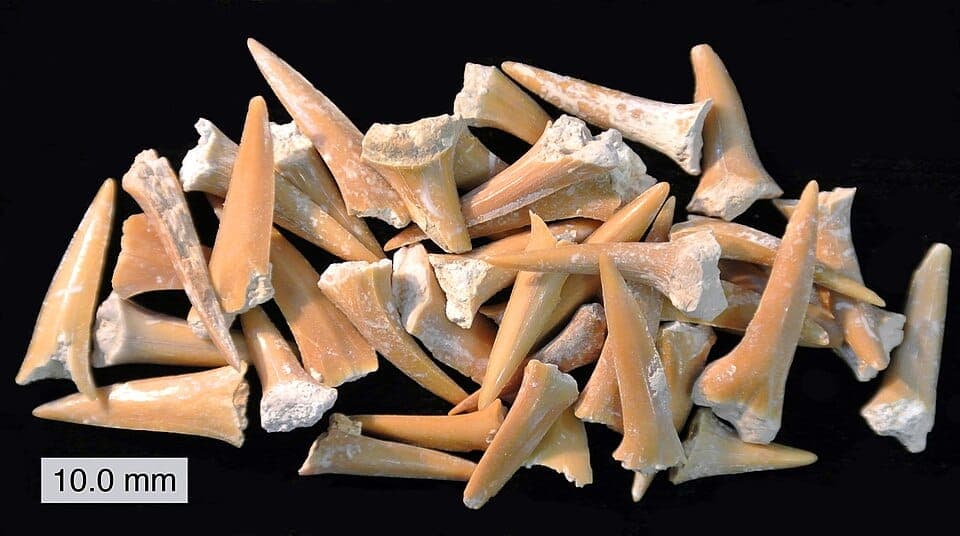
The fastest way to identify a shark tooth on the beach is to look for a small, glossy triangle that is darker and shinier than everything around it — usually black, gray, or brown — with a slightly thicker base (the root) where it attached to the jaw and a smooth or finely serrated point. Most teeth that wash up on a beach are fossils, stained dark by millions of years in the sediment, which is exactly why they stand out against the dull tan shells and sand. Once you train your eye to scan for shiny dark triangles right along the waterline and in the shell piles, shark teeth seem to appear everywhere. Here is how to identify a shark tooth for certain, where to look, and how to tell a real tooth from the rock chips and broken shell that fool beginners.
How to Identify a Shark Tooth
A shark tooth has a handful of features that, taken together, no pebble or shell fragment can fake: a triangular crown, a distinct root, a glassy surface, and often a row of tiny serrations along the edge. Work through the shape, the color, the root-and-crown structure, and the feel of the thing, and a genuine tooth separates cleanly from the look-alikes. The good news is that fossil teeth are built to survive, so the features you need are usually still there even after years of tumbling in the surf.
Look for a glossy black (or brown) triangle
Color is the first thing that catches a hunter’s eye. Fossil shark teeth are usually black, bluish-gray, brown, or tan because the original white enamel was replaced and stained by minerals in the seabed over millions of years. Against a beach of pale, matte shells and quartz sand, that dark tooth looks almost wet — a hard, shiny glint even when the surrounding sand is dry. Scan for shiny dark spots and ask yourself one question: is it a triangle? Freshly lost modern teeth turn up too, and those are white, but the overwhelming majority of beach finds are dark fossils.
Find the root and the crown
Every true shark tooth has two parts, and seeing both is the surest confirmation. The crown is the sharp, enameled, triangular blade — the part that did the cutting, often smooth and glossy. The root is the thicker, duller, often lighter or more porous base that anchored the tooth in the jaw, frequently showing two lobes with a small notch or nutrient groove between them. A plain triangular rock chip has no root; a shark tooth almost always shows that distinct blade-on-a-base, two-tone structure.
Check for serrated edges
Many sharks — including the extinct megalodon and its relatives, and modern tiger and great white sharks — have finely serrated edges like a steak knife. Run a fingertip very gently along the side of the crown (teeth can be sharp) or look closely in good light: a row of tiny, even teeth along the edge is a dead giveaway. Not every tooth is serrated — sand tiger and mako teeth have smooth, needle-like cutting edges and often little side cusps — so a smooth edge does not rule out a tooth, but a serrated one rules it in.
Size, weight, and feel
Most beach teeth are small — a quarter-inch to about an inch — because small sharks shed thousands of teeth in a lifetime and the little ones survive tumbling in the surf best. A fossil tooth feels dense, hard, and smooth, noticeably heavier and more solid than a brittle, porous shell fragment of the same size. If you can crush or flake it with your fingers, it is shell or soft stone, not a tooth. The big, palm-sized megalodon teeth exist but are rare prizes; expect thumbnail-sized teeth as the everyday find.
- 1Go at low tide, ideally after a storm or strong onshore wind, which churns teeth up from offshore and piles them near the waterline.
- 2Find the shell hash — the gravelly bands of broken shell, small stones, and coarse sand along the high-tide line and at the water’s edge, where heavier debris collects.
- 3Keep the sun in front of you so the light glints off the glossy enamel rather than falling behind you.
- 4Scan slowly for shiny dark triangles rather than trying to see whole teeth; let the color and the straight edges catch your eye, then look closer.
- 5Sift the shell gravel by hand or with a small mesh scoop, and recheck the same productive patches as each wave reworks them.
Try Spotter Free on iOS & Android
Plants, animals, fungi, and rocks — all from a photo. 5 free identifications every day, no credit card required.
Shark Teeth vs. Rocks, Shells, and Other Beach Finds
Beginners pocket a lot of "teeth" that turn out to be something else. Here is how a real tooth differs from its common impostors:
- Dark pebbles and rock chips — can look triangular and shiny when wet, but have no root, no crown-on-base structure, and no serrations; they are uniform all the way through.
- Broken shell fragments — often pale and triangular, but brittle, porous, and lightweight; they flake and crush, while a tooth is dense and hard.
- Barnacle plates and clam hinges — whitish and wedge-shaped, but chalky and layered rather than glassy, with no distinct blade.
- Fossil ray and fish mouth plates — genuinely fossil and often found right alongside shark teeth, but they are flat, button- or bar-shaped grinding surfaces, not pointed blades.
- Sea glass and worn ceramic — shiny and sometimes dark, but smooth-edged, frosted, and obviously manufactured, with no root or point.
The quick test is the three-part check: a pointed, glossy triangular crown, sitting on a thicker, duller root, ideally with fine serrations along the edge. Miss the root and it is probably a rock; find it and you almost certainly have a tooth.
Where and When to Look (and a Note on Collecting)
Shark teeth turn up on beaches worldwide, but some coasts are famous for them — stretches of the U.S. mid-Atlantic and Southeast, the Gulf Coast, and any beach near eroding fossil-bearing cliffs or rivers that drain old marine sediments. The best conditions are low tide after rough weather, when waves have excavated and sorted fresh material onto the beach. Collecting loose teeth from a public beach is generally a wonderful, low-impact hobby, but rules differ by location: many parks, preserves, and fossil-protected sites restrict or prohibit collecting, and digging into dunes or cliffs is often illegal and dangerous. Check the local regulations before you dig, take only loose surface finds where allowed, and leave the dunes intact.
Frequently Asked Questions
Are the black teeth on the beach real shark teeth?
Yes. The black (or brown and gray) color comes from fossilization — minerals replaced the tooth and stained it dark over millions of years buried in the seabed. That dark, glossy color is actually the best way to spot them against pale sand and shells.
How can I tell a shark tooth from a rock?
Look for the root. A shark tooth has a sharp, glossy triangular crown sitting on a thicker, duller base (the root), often with fine serrations along the edge. A rock chip is uniform all the way through with no root, no blade, and no serrations.
How old are the shark teeth I find?
Most beach teeth are fossils ranging from a few thousand to tens of millions of years old, depending on the sediments they eroded from. Sharks have cruised the oceans for over 400 million years and constantly shed teeth, which is why fossil teeth are so abundant.
Why do I only find small shark teeth?
Small teeth are vastly more common because small and young sharks shed enormous numbers of them, and little teeth survive the pounding surf better than large, fragile ones. Big teeth like megalodon’s exist but are rare finds and usually turn up broken.
Found a glossy black triangle and not sure whether it is a tooth, a fossil, or just a shiny rock? Snap a photo and let Spotter help you figure out what washed up at your feet.
Try Spotter Free on iOS & Android
Plants, animals, fungi, and rocks — all from a photo. 5 free identifications every day, no credit card required.