
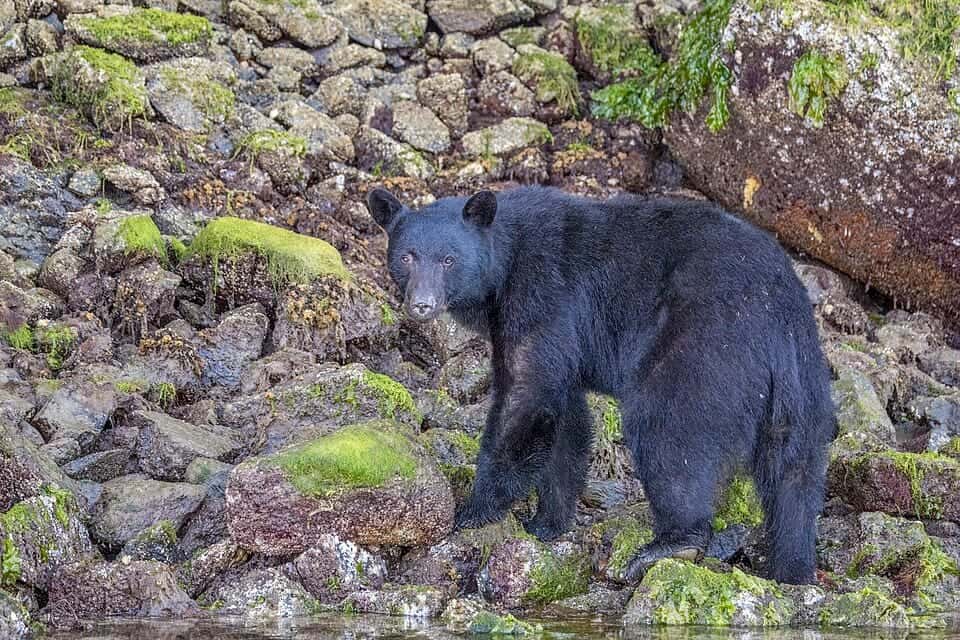
A bear track is unmistakable once you know the shape: a broad, flat print with five toes arranged in a gentle arc above a wide pad, tipped with short claw marks, looking startlingly like a wide, stubby human hand or foot. The hind print in particular shows a long heel and sole that can resemble a flat bare footprint, while the front print is shorter and wider. Bears have five toes on every foot — unlike the four-toed prints of dogs, coyotes, and cats — and they walk flat-footed, pressing the whole sole into the ground. Here is how to identify a bear track, read its size and claws, and tell a black bear print from a grizzly.
How to Identify a Bear Track
Bears are plantigrade, meaning they walk on the soles of their feet the way people do, so their tracks are large, flat, and detailed, especially in mud, wet sand, or snow. Each foot leaves five toes, a broad pad, and usually a row of claw dots ahead of the toes. Run through the number of toes, the front-versus-hind shape, the size, and the claws, and a bear track is one of the easiest large prints to confirm.
Five toes and a broad pad
Count the toes first. A bear always registers five toes on both the front and hind feet, lined up in a shallow curve above a single large pad — though the innermost toe (the equivalent of our big toe) is the smallest and sometimes fails to print in a shallow track, which can fool you into counting four. The toes are relatively small and even, sit close together, and arc across the top of a wide pad rather than spreading out like fingers. Five toes plus a broad, flat pad immediately rules out every dog, cat, and coyote, which show four toes.
Front track vs. hind track
Bears leave two very different prints. The front track is wider than it is long, with a broad pad behind the toes, and it often shows an extra small pad to one side; it looks a bit like a wide, squashed palm. The hind track is longer and narrower, with an elongated heel pad that makes the whole print resemble a short, flat human footprint — sometimes seven inches or more long in a big bear. Finding both a handprint and a footprint in the same trail is a quick confirmation that you are looking at a bear.
Size
Size separates the bears from smaller five-toed animals and hints at the species. A black bear front pad is roughly 3.5 to 5 inches wide and its hind track 5 to 7 inches long. A grizzly (brown) bear is larger, with a front pad commonly 5 to 7 inches wide. Much smaller five-toed prints — under two or three inches — point to raccoons, otters, skunks, or other medium mammals rather than a bear. If the print is the size of your palm or bigger and shows five toes with claws, think bear.
Claws
Claw marks are the key to telling the two North American bears apart. A black bear has short, strongly curved claws that leave small marks close to the toe pads, often within an inch or two. A grizzly has long, straighter front claws, two to four inches, that print as distinct pricks set well ahead of the toes, sometimes with an obvious gap beyond the toe pads. As a field rule: if the claw marks sit far out in front of the toes, suspect a grizzly; if they are tucked close to the toes, it is a black bear.
Gait and trail
Bears usually amble along at a walk, and their trail often shows the hind foot landing near or overlapping the front print, leaving a slightly pigeon-toed line of large, paired tracks that toe inward. A line of big, flat, five-toed tracks wandering between food sources — berry patches, streams, oak stands, trash areas — with the hind prints looking almost human is a classic bear trail.
Bear Tracks vs. Other Animals' Tracks
A few other prints get mistaken for bear tracks, and a few things help you rule them out:
- Dog, coyote, and wolf — four toes, not five, with claw marks and an overall oval shape and no flat human-like heel; any clear five-toed large track rules them out.
- Large cats such as cougar — four toes, no claw marks (the claws retract), and a round print with a distinctive three-lobed rear pad; very different from a bear five-toed arc.
- Human footprints — a bare human foot can resemble a bear hind track, but it has no claw marks and a different toe arrangement with one large separate big toe, while a bear hind track shows five small even toes in a curve with claw dots above them.
- Raccoon and otter — also five-toed and flat-footed, but far smaller, with long, finger-like toes that splay out; a raccoon front print looks like a tiny human hand, not a wide pad.
- Porcupine and beaver — five toes but small, with long claws and often a pebbly or textured sole and tail-drag marks nearby.
Safety: What a Fresh Bear Track Means
A fresh bear track means a bear is using the area, so treat the find as a cue to be alert, not to follow the animal. Never track a bear to get closer or to photograph it. In bear country, make noise as you hike so you do not surprise one, keep dogs leashed, store food and scented items properly, and carry bear spray where appropriate. If the claw marks and front-pad width suggest a grizzly, give the area extra caution — grizzlies are more likely to defend a space. If you encounter a bear, do not run; back away slowly, speak calmly, and follow the recommended response for the species and situation. Report persistent bear activity near homes or campgrounds to your local wildlife authorities.
Frequently Asked Questions
How can you tell a black bear track from a grizzly track?
Look at the claws and the front pad. Grizzlies have long, straight claws that print well ahead of the toes and a wider, squarer front pad; black bears have shorter, curved claws that mark close to the toes. A straight edge laid across the top of the front pad will clip the toes on a black bear but miss them on a grizzly, whose toes sit in a more sharply angled line.
Why does a bear track look like a human footprint?
Because bears walk flat-footed on the soles of their feet, just as humans do. The hind foot has a long heel and sole, so its print shows a broad, elongated shape much like a wide, stubby bare human foot — except for the five small toes in a curve and the claw marks above them.
How big is a bear paw print?
A black bear front pad is about 3.5 to 5 inches wide and its hind print 5 to 7 inches long; a grizzly front pad is often 5 to 7 inches wide, with the hind print even longer. In general, if a five-toed, clawed print is as big as or bigger than your own hand, it is a bear.
Do bear tracks always show claw marks?
Usually yes. Bears cannot retract their claws, so most clear prints show small claw dots or pricks ahead of the toes. The distance of those claw marks from the toe pads — close for black bears, far out for grizzlies — is the best single clue to which bear left the track.
Try Spotter free on iPhone or Android
Plants, animals, fungi and rocks from one photo. 5 free identifications every day, no card required.