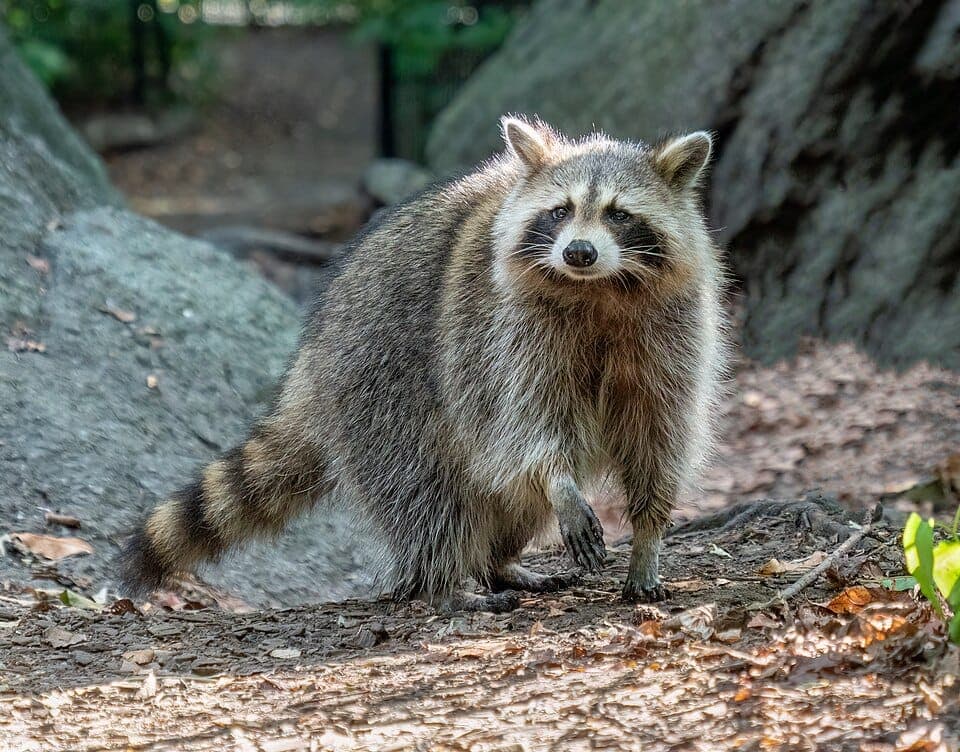
The fastest way to identify a raccoon track is that it looks like a tiny human hand: five long, slender toes spread out around a wide central pad, usually with small claw dots at the toe tips, and a print about 2 to 3 inches across. A raccoon walks flat-footed on all five toes, so both front and hind feet leave clear, hand-like impressions — the front print looks like a splayed little palm and the longer hind print resembles a narrow bare foot. No other common backyard animal leaves that dexterous, five-fingered mark, which is what makes raccoon tracks some of the easiest wild sign to name once you know the shape. Here is how to identify a raccoon track for certain and tell it from the opossum, skunk, and house cat prints people most often confuse it with.
How to Identify a Raccoon Track
Raccoons are nocturnal and heavy-footed, and they love the soft, wet ground along creeks, ponds, storm drains, and muddy trails — exactly the places that record a print well. Because a raccoon plants its whole foot flat like a little bear, its tracks are detailed and easy to read in fresh mud, damp sand, or a dusting of snow. Run through the toe shape, the size, the claw marks, and the walking pattern and a raccoon track separates cleanly from every look-alike.
Five long toes, like little fingers
This is the signature. Each raccoon foot has five long, thin, well-separated toes that fan out around a solid central pad, so the whole print looks startlingly like a miniature human hand. The toes are mobile and dexterous — raccoons use their front paws almost like hands to feel for food — so they often splay wide and press in deeply. If you can count five long fingers around a palm-like pad, you have a raccoon; most other animals this size show four toes, not five.
Size and the front-vs-hind print
Front prints are roughly 2 to 3 inches long and about as wide as they are long, giving them that compact, hand-shaped look. Hind prints are longer, about 3 to 4 inches, and narrower, because the raccoon rests its whole heel on the ground, leaving an elongated mark that looks like a small, slender human foot. Seeing both the stubby "hand" and the longer "foot" together in a trail is one of the best confirmations you are looking at a raccoon.
Claw marks and pad shape
Raccoons do not retract their claws, so each toe usually prints a small, distinct claw dot just beyond its tip. The claw marks sit close to the toes — short and fine, not the long gouges a dog leaves — and the central pad is broad and roughly rectangular. That combination of five clawed toes plus a wide pad rules out cats, which show four toes and no claw marks because their claws retract.
The walking pattern: side-by-side pairs
Raccoons move with a distinctive waddling gait that leaves a telltale pattern: the left hind foot lands next to the right front foot (and vice versa), so the trail shows pairs of prints set side by side — one "hand" and one "foot" together — stepping down the trail. This paired, almost pigeon-toed track line is nearly unique to raccoons and is often easier to spot from a few feet back than any single print. Stride between pairs is short, usually under a foot, because raccoons amble rather than bound.
Tracks, scat, and other sign
Supporting sign helps confirm a raccoon. Look for tipped-over trash and scattered garbage, muddy five-fingered smears on siding, decks, and the lips of trash cans, raided bird feeders, and holes and rolled-up sod where they have grubbed for insects. Raccoons also use communal latrine sites — do not handle the scat (see the safety note below). Prints leading to and from water, a culvert, a hollow tree, or a chimney all point to a raccoon using the area.
Try Spotter Free on iOS & Android
Plants, animals, fungi, and rocks — all from a photo. 5 free identifications every day, no credit card required.
Raccoon Tracks vs. Opossum, Skunk, Cat, and Other Look-Alikes
Once you know the five-fingered hand shape, most look-alikes fall away quickly. Here is how a raccoon track differs from the animals it is most often confused with:
- Opossum — also five-toed and hand-like, but the hind foot has a thumb-like big toe that sticks out sharply to the side at almost 90 degrees, giving a lopsided, star-burst look; opossum tracks often show a tail-drag line, which raccoons do not leave.
- Skunk — similar size but the toes are shorter and the front feet carry long, obvious claw marks for digging; skunk prints look more like a tiny long-clawed badger than a hand, and the toes do not splay as widely.
- House cat — about the same width but shows only four rounded toes, no claw marks (claws retract), and a single large three-lobed pad; a cat print never looks like a five-fingered hand.
- Dog and coyote — four toes, prominent claw marks, and an oval, forward-pointing shape with no splayed fingers; much more compact and symmetrical than a raccoon.
- Muskrat — five long toes like a raccoon but far more slender and splayed, often with a tail-drag, and almost always right at the water’s edge; the hind foot is much larger than the front.
- Gray squirrel — four toes on the front and five on the hind, small and delicate, usually in bounding sets of four with the big hind feet landing ahead of the front; nothing like the raccoon’s flat, paired hand-and-foot trail.
The decision tree is short: five long fingers around a palm-like pad with fine claw dots points to a raccoon; a sharply offset thumb means opossum; four toes with no claws means a cat; and four toes with claws means a dog or coyote.
Why Reading Raccoon Tracks Is Worth It (and a Safety Note)
Tracks tell you who is visiting your yard when you are asleep. A line of five-fingered prints across the mud settles the "what is getting into my trash?" question and tells you whether to secure cans, feeders, and chicken coops. Raccoons themselves are not aggressive and will usually flee, but keep a respectful distance: they are a leading carrier of rabies, and a raccoon that is active in daylight, disoriented, or unafraid should be reported to animal control rather than approached. Just as important, never handle raccoon droppings or disturb a latrine with bare hands — raccoon roundworm can be present — and keep pets and children away from it. Enjoy the detective work of reading the trail, and let the animal keep its distance.
Frequently Asked Questions
What animal has tracks that look like little human hands?
Almost always a raccoon. Its five long, fingered toes spreading around a broad pad make a print that looks like a tiny human hand, and the longer hind print looks like a small bare foot. An opossum track is the other hand-like print, but its hind foot has a thumb that juts out to the side.
How can I tell raccoon tracks from opossum tracks?
Look at the thumb. A raccoon’s five toes all point roughly forward in a neat fan, while an opossum’s hind foot has an opposable "thumb" that sticks out nearly sideways, making the print look lopsided. Opossums also frequently drag their tail, leaving a line between the prints; raccoons do not.
Why do raccoon front and back feet look different?
Because a raccoon walks flat-footed and the two feet are shaped differently. The front foot is short and compact — the classic "hand" — while the hind foot includes the heel, so it prints longer and narrower, like a small human foot. Seeing both shapes in one trail is a strong confirmation.
Are raccoon tracks a sign of something dangerous?
The tracks themselves are harmless, and raccoons usually avoid people. The cautions are that raccoons can carry rabies — so give a wide berth to any acting tame or out in daylight and report it — and that their droppings can carry roundworm, so never handle raccoon scat or latrines with bare hands.
Found a clear five-fingered print in the mud and want to be sure what left it? Snap a photo with a coin or your boot beside it for scale and let Spotter help you identify the track — and the animal that made it.
Try Spotter Free on iOS & Android
Plants, animals, fungi, and rocks — all from a photo. 5 free identifications every day, no credit card required.